Swamp Cooler Legionella in Phoenix: What the Evidence Shows
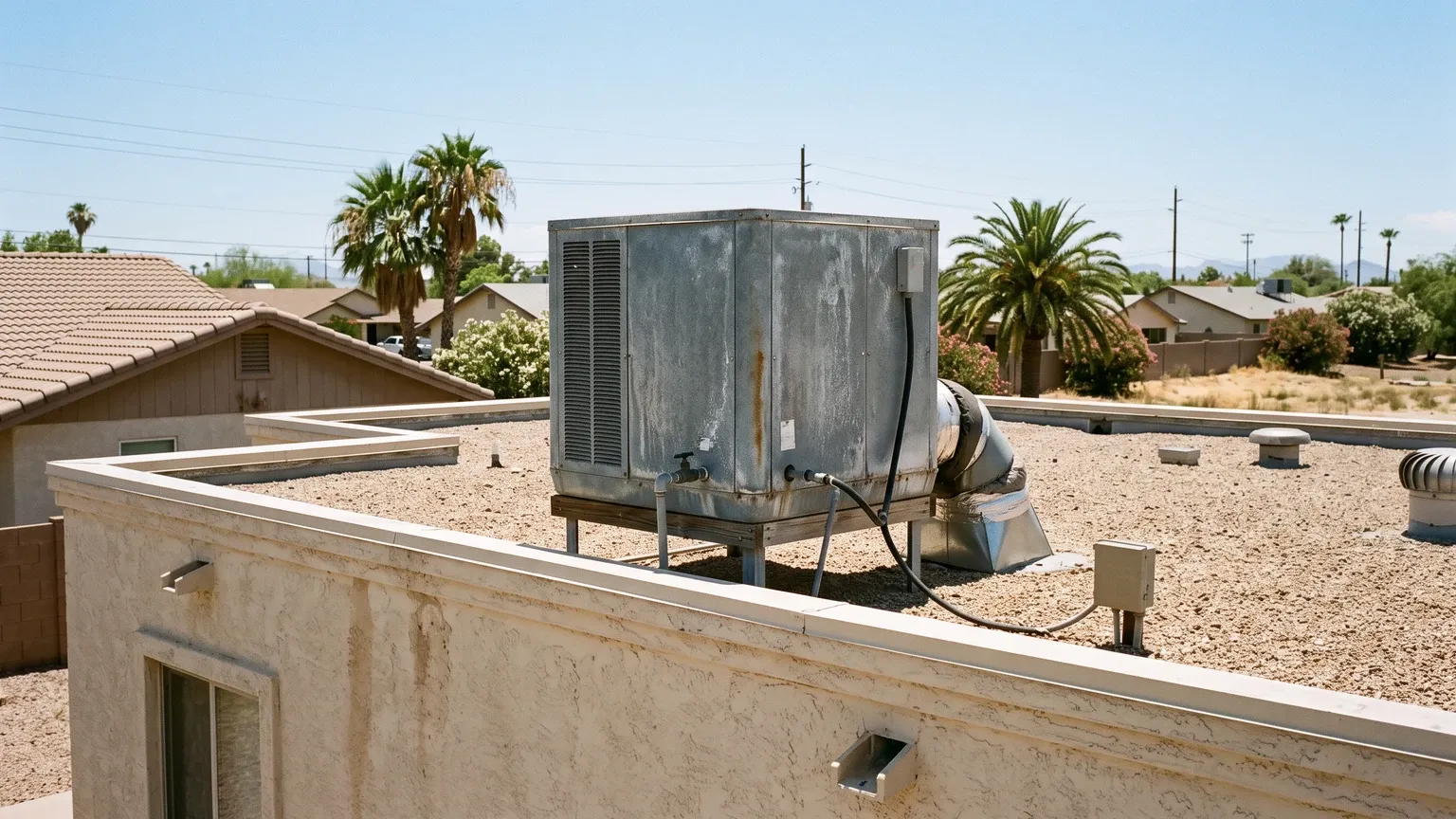
A 2022 review in Indoor Air found no reported case of Legionnaires’ disease traced to a residential swamp cooler, though it calls its own search nonsystematic. The bacterium has been cultured from cooler units, and OSHA and the Department of Energy both warn about stagnant water in an idle sump. The effects studied in cooler homes are allergic and respiratory, and those findings conflict.
Can a swamp cooler give you Legionnaires’ disease?
No such case appears in the published literature that has been searched for one. The best source is a 2022 review in Indoor Air by Johnston, Cowger and Weber, which describes itself as, to the authors’ knowledge, the first review of residential evaporative coolers and the bioaerosols they release. They searched and wrote: “In this review, we did not find any reports implicating residential ECs in cases of Legionnaire’s Disease or Pontiac Fever, the two primary diseases caused by L. pneumophila.” (“EC” is their shorthand for evaporative cooler.)
Two things qualify that. The first is the type of search: the authors state plainly that “this is a nonsystematic review” and that they “primarily searched Google Scholar and MEDLINE (EBSCO) databases with no restrictions for date of publication.” The second is their own caution: “ECs have some similarities to industrial cooling towers and thus have the potential to harbor L. pneumophila; however, we found little in the published literature on this topic.”
Their bottom line weighs both. No case studies linked cooler use to Legionnaires’ disease or Pontiac fever and only one linked it to farmer’s lung, which the authors say “suggest they are not a significant source of infectious disease transmission.” Then, in the next breath: “However, epidemiological studies on health effects from ECs are limited. We found only three in this review, two of which used retrospective study designs, and thus cannot be used to determine the incidence of health outcomes or causality of diseases associated with ECs.”
So the honest headline is narrow. As of that 2022 search, no residential swamp cooler had been tied to a reported case, in a literature the authors themselves call thin.
Why does Legionella guidance still name evaporative coolers?
Because the bacterium has been found in coolers, and because standing water is where it would grow.
The review documents the organism without the disease. “Two studies from the Sudan report finding L. pneumophila in residential EC units, however, no cases of Legionnaire’s Disease or Pontiac Fever were reported.” In South Australia, during a Legionella investigation, Cameron and colleagues sampled coolers and “isolated the organism from one out of 21 EC units, again with no reported illnesses.”
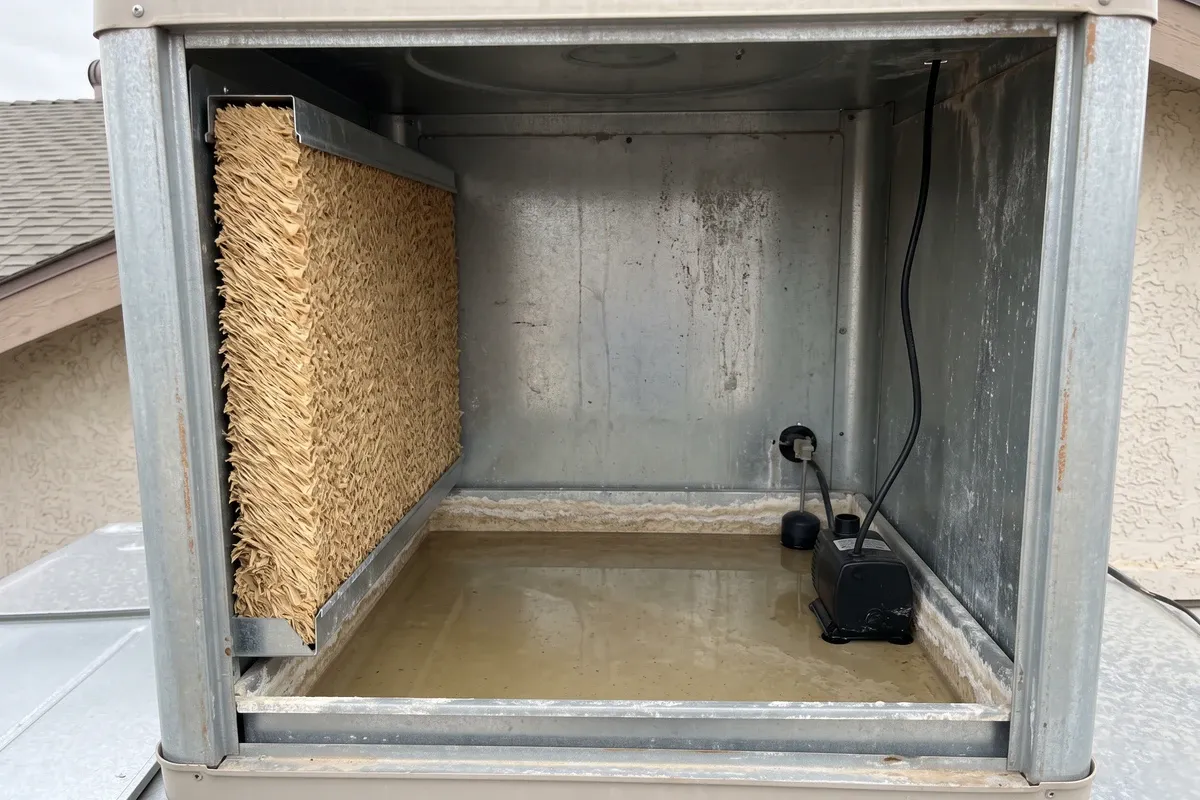
The Department of Energy’s Building America Solution Center, run through PNNL, says: “During the cooling season, the drain pan should be emptied whenever the cooler will be idle for more than a few days as standing water left in the pan can become a breeding ground for mosquitos and bacteria, including Legionella (the cause of Legionnaires’ Disease).”
The CDC names these units too, in its guidance for building water management programs. Its Legionella Control Toolkit module on other devices says to “maintain evaporative coolers to ensure they are functioning properly with managed airflow across condensate pans,” on the premise that “any system or equipment containing nonsterile water can grow Legionella.”
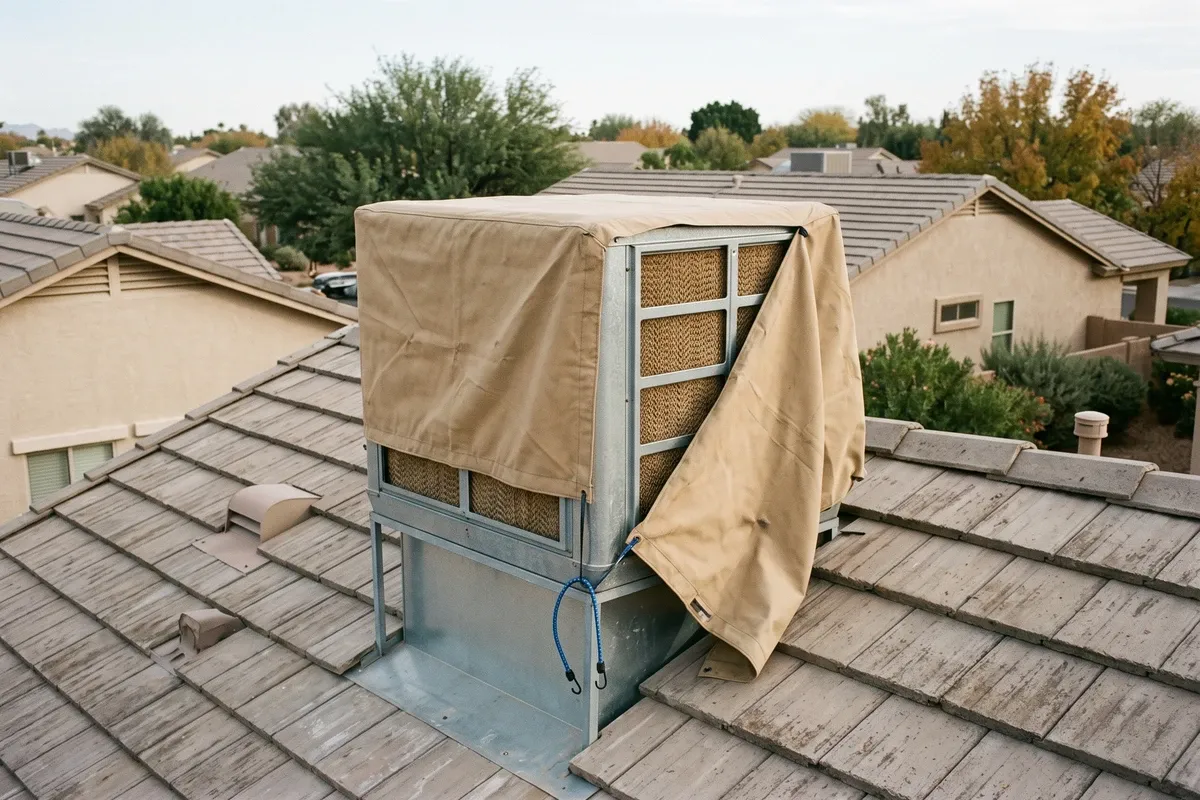
OSHA is the most specific of the three, and it cuts both ways on the same page. On idle water it warns that direct evaporative air coolers used intermittently as humidifiers “can collect stagnant water in the sumps and promote Legionella growth.” On running units it says close to the opposite. OSHA is writing there about wet evaporative coolers, slinger air coolers and rotary air coolers, which it calls “common in commercial applications.” It says that where these systems “use 100-percent outside air in a dry climate, the water sump temperatures are generally low and do not represent a significant Legionella hazard,” adding that “properly operating and maintained systems ensure sump water temperatures remain cool and the water does not become stagnant.” That is a commercial scope. The condition it names, though, 100-percent outside air in a dry climate, is exactly what a residential swamp cooler runs on, so a Phoenix cooler running in July fits the description. That is our reading of OSHA’s condition, not an OSHA finding about residential coolers. The same cooler in November, covered with water still in the tray, does not fit it at all.
The temperature argument is weaker than it sounds
The usual reassurance is that cooler water is too cold for Legionella. The review makes that case by relaying an older source: “Puckorius et al. (1995) identify two reasons why ECs are low risk for transmitting Legionella.” The first is temperature. In the review’s words: “Legionella bacteria grow in water at temperatures ranging from 20–45°C, but the optimal temperature range is 37–41°C. ECs operate around the wet bulb temperature, which is generally below 24°C, and often under 20°C. Thus, water temperature in EC units is likely a limiting factor as it ranges closely around the point where the bacteria become dormant.”
Look at the numbers, not just the conclusion. A running cooler’s water overlaps the bottom of the growth range. The CDC’s own toolkit puts the favorable growth range at “77–113°F, 25–45°C” and then adds: “Note that Legionella may grow at temperatures as low as 68°F (20°C).” And the CDC’s 2003 guideline for environmental infection control in health-care facilities reports that “an Australian study of cooling towers found that legionellae colonized or multiplied in towers with basin temperatures above 60.8°F (16°C), and multiplication became explosive at temperatures above 73.4°F (23°C).” Both of those sit inside the band a running cooler occupies. The review’s own hedge is the word “likely,” and it is doing real work.
Puckorius’s second argument is about how the water leaves the unit. As the review relays it: “L. pneumophila must be transmitted as a respirable aerosol (<5.0 μm) to reach the alveoli. However, ECs typically release water in the form of vapor (gaseous state) rather than aerosols, and therefore do not transmit the bacteria into the home.” That is a 1995 argument summarized in 2022, not a measurement the review reports, and the review keeps the word “typically.”
Running versus idle, and a gap we could not find filled
Every temperature figure above describes a cooler that is running, where evaporation holds the water near the wet bulb temperature. The DOE and OSHA warnings are about a cooler that is idle. No sump temperatures for an idle, covered cooler on a Phoenix roof appear in the review, and we did not find any published.
Temperature is not the only lever, either. The CDC’s guideline lists the factors that “enhance colonization and amplification of legionellae in man-made water environments”: “temperatures of 77°F–107.6°F [25°C–42°C], stagnation, scale and sediment, and presence of certain free-living aquatic amoebae that can support intracellular growth of legionellae.” A covered Phoenix cooler pan supplies stagnation and, with local hard water, scale and sediment. The evidence does not show a hazard, and it does not show that a pan of still water is fine.
Is a swamp cooler the same Legionella risk as a cooling tower?
Most of the alarming Legionella material is about cooling towers, and a swamp cooler is a different machine. The CDC groups several water systems together as places the bacterium multiplies: “Cooling towers, evaporative condensers, heated potable water distribution systems, and locally-produced distilled water can provide environments for multiplication of legionellae.”
| Cooling tower | Evaporative condenser | Residential swamp cooler | |
|---|---|---|---|
| What heats the water | Rejects building heat | Rejects refrigerant heat | Nothing; water cools by evaporating |
| Typical water temperature | 85–95°F (29–35°C) typical, per CDC | Similar to a cooling tower, per CDC | Near the wet bulb temperature while running |
| What leaves the unit | Drift of fine droplets | Drift of fine droplets | Vapor, per the review’s summary of Puckorius |
| Inside ASHRAE 188’s scope? | Depends on the building, not the machine | Depends on the building | Depends on the building |
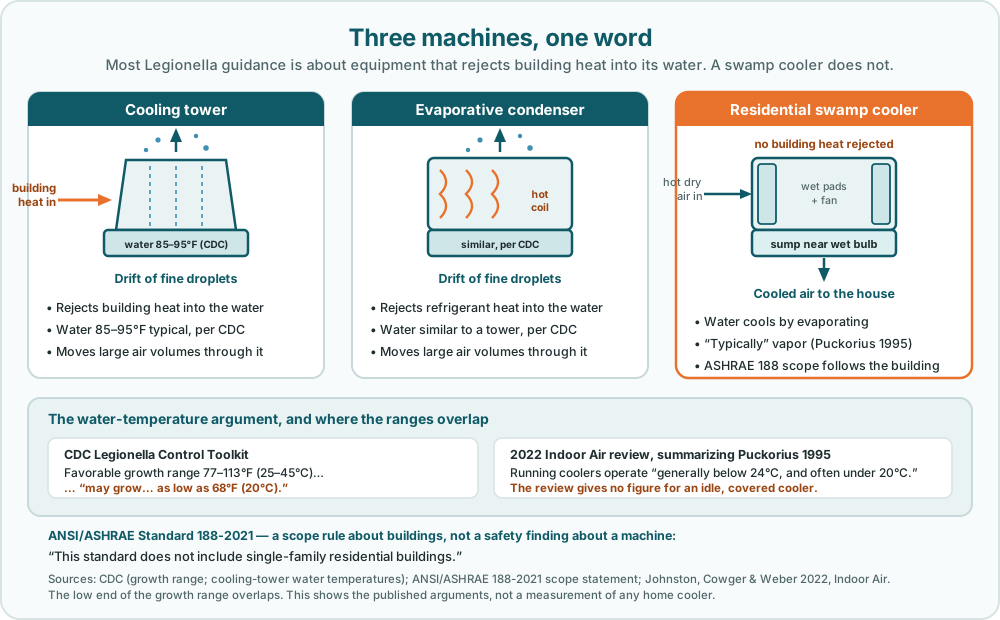
That contrast is about heat and droplets, not about a rule that exempts the machine. It is worth being precise about one standard that gets quoted loosely here. ANSI/ASHRAE Standard 188-2021, Legionellosis: Risk Management for Building Water Systems, “applies to human-occupied commercial, institutional, multiunit residential, and industrial buildings. This standard does not include single-family residential buildings.” That excludes a building type, not a machine. A swamp cooler on an apartment block is inside the standard’s scope, and a cooling tower on a house would be outside it. A scope boundary is a question of who the rule governs, not a judgment about risk.
One more thing on the CDC page about how Legionella spreads, and the order matters here. That page clears one kind of cooling equipment, and it clears it for a reason a swamp cooler cannot borrow. Under a heading for devices that aren’t a source of infection, the CDC says: “Home and car air-conditioning units don’t use water to cool the air, so they aren’t a risk for Legionella growth. This includes window units, such as the kind seen at some hotels.” Refrigerated air conditioning earns that exemption by not using water. A swamp cooler uses water, so the exemption does not reach it. That is our reading of the CDC’s logic, not a CDC finding about home coolers. Separately, the same page lists showerheads and sink faucets, hot tubs, decorative fountains and water features, large complex plumbing systems, cooling towers, and the windshield wiper fluid tank of a vehicle. Residential swamp coolers are absent from that list, which is a fact about the list and not a clearance.
Can a swamp cooler make you sick? What it actually exposes you to
The concerns that have been studied in cooler homes are allergic and respiratory, and the findings disagree. None of this is settled.
A hypersensitivity case from cooler pads. The review describes a 1975 JAMA report by Marinkovich and Hill as “a nearly fatal case of hypersensitivity alveolitis in an 11-year old girl that was associated with a residential EC unit.” Lab results “found thermophilic actinomycetes in the EC cooler pads, and the patient’s serum contained antibodies for Micropolyspora faeni, a common microorganism implicated in cases of farmer’s lung.” Actinomycetes are bacteria, not mold, a distinction worth keeping straight. This is one case report from 1975. Our guide to hypersensitivity pneumonitis from home mold covers the condition.
A Tucson cohort. Aldous and colleagues followed 936 infants in Tucson, Arizona, enrolled at birth between 1980 and 1984. From the abstract: “The risk of wheezing LRI was higher in infants with evaporative home cooling (24%) than in those without evaporative home cooling (15%) (odds ratio = 1.8, 95% confidence interval 1.1-3.0); this association was stronger among infants who lived with other children in the home.” The review summarizes the authors’ explanation as coolers possibly introducing “bioaerosols (pollen, mold, dust mite allergens) into homes that persist into winter months.” It is the strongest residential study the review found, it is one prospective study from the 1980s, and it shows an association rather than a cause.
An allergy split. Prasad and colleagues (Allergy Asthma Proc, 2009) skin-tested 190 patients with asthma or allergic rhinitis in Reno, aged 1 to 42 with a mean age of 5.4 years. In their published results, 42% of those with a cooler reacted to at least one mold versus 19% of those without, and 34% versus 17.5% for dust mite. Those are Prasad’s own published figures. The 2022 review reports the comparison group differently, at 25% and 21%, and we could not reconcile those numbers with Prasad’s published counts. Izadi and colleagues (Ann Allergy Asthma Immunol, 2018) reviewed a much larger group of atopic Colorado patients under 21 at National Jewish Health from 2008 to 2017 and found no association. As the review reports their figures, the mold relative risk was 1.03 (95% CI 0.96–1.10) and the dust mite relative risk 1.01 (95% CI 0.91–1.12), across cohorts of 9,286 and 8,503 patients. They also found allergic rhinitis significantly lower in cooler homes. The review’s read on the conflict: “The contradictory findings between Izadi et al. (2018) and Prasad et al. (2009) may be explained by sample size.”
What is less contested is exposure rather than illness. The review notes that endotoxin and fungal β-(1→3)-D-glucan levels “appear to be higher in homes with ECs,” and cites a Utah study of low-income homes where house dust glucan ran 2.65-fold and 3.64-fold higher by concentration and surface load in cooler homes. Higher exposure is not a diagnosis, and the review’s standing complaint is that the health studies to match it have not been done.
For the allergy side in depth, see our guide to mold and asthma. Our swamp cooler mold guide covers where mold grows in the unit, swamp cooler vs AC in Phoenix covers the tradeoffs, and mold in your AC and air vents covers the air-handler side.
How much Legionnaires’ disease is there in Arizona?
Read the scope before the number. The Arizona Department of Health Services publishes a statewide count of reportable diseases with no exposure or source attribution attached to any case, so it cannot tell you what caused anything. What it does show is that the disease is present: 149 confirmed and probable legionellosis cases in 2024, against a five-year median of 112. Those cases come from every source combined, and the report ties none of them to any device, coolers included.
Who it lands on matters more than the count. The CDC says most healthy people exposed to Legionella don’t get sick, and that those at increased risk include current or former smokers, people 50 years or older, and people with cancer, chronic lung disease, diabetes, kidney failure, liver failure or a weak immune system. On severity: “About 1 out of every 10 people who gets sick with Legionnaires’ disease will die due to complications from their illness.” Symptoms “usually develop 2 to 14 days after exposure to Legionella bacteria, but it can take longer,” and include cough, fever, headaches, muscle aches and shortness of breath. This is general information rather than medical advice; if those symptoms follow water-mist exposure, call a clinician. For the overlap with mold exposure, see who is most at risk from mold.
What to do when the cooler goes idle
Shutdown season in the Valley starts around October, and that is when this question turns practical. The action that matches the evidence is small: drain the pan before the cooler goes idle, and do it before the cover goes on.
The DOE’s end-of-season guidance is “the water line should be shut off, the pan should be drained and cleaned, and a winter cover should be installed to prevent dirt and dust from getting inside the unit.” Our step-by-step guide to winterizing and draining a swamp cooler walks through the procedure.
Dry it, do not just tip it out. The CDC’s infection-control guideline puts it in four words: “Legionellae do not survive drying.” That is the cheapest control available for the one scenario both OSHA and the DOE actually warn about.
Why a musty smell is a different problem
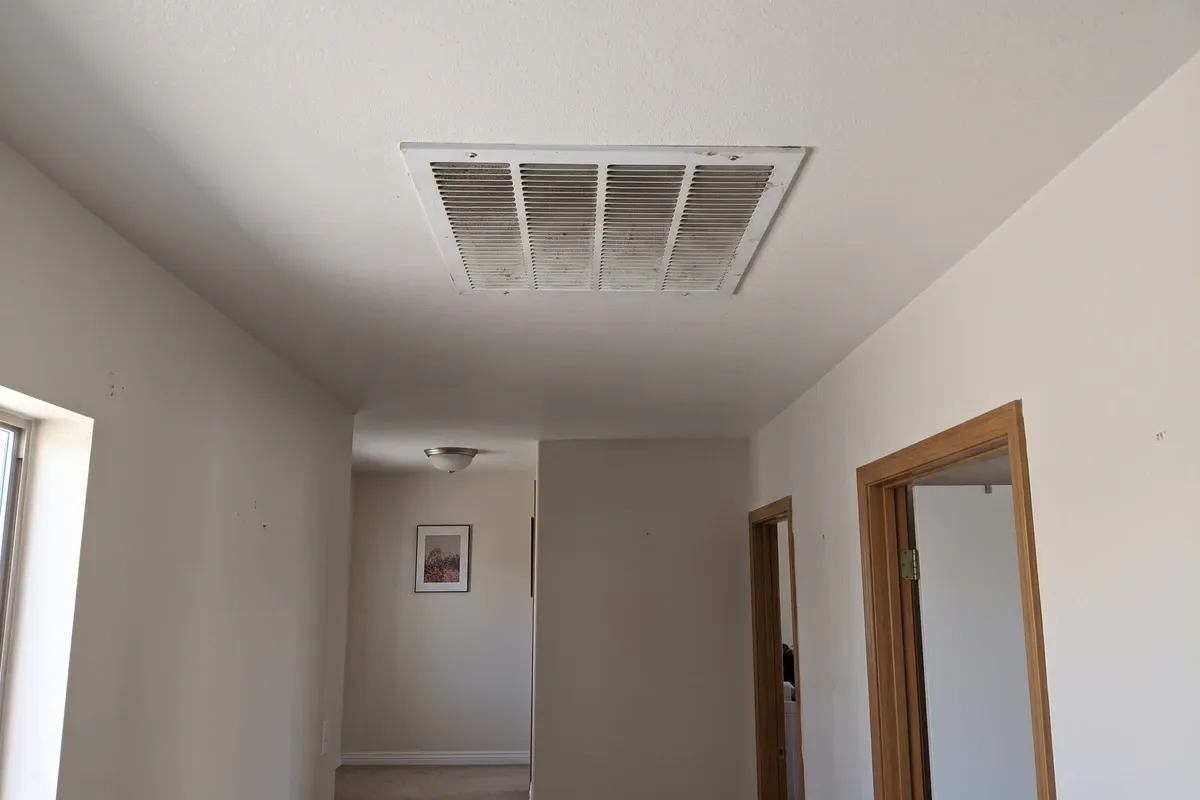
Sometimes the question is not Legionella at all. A musty smell when the cooler restarts in spring is a separate issue, usually moisture and growth on the pads, in the tray or in the duct, and it is a problem to find and fix rather than to mask.
If you are seeing visible growth, a smell that returns after cleaning, or growth beyond the unit itself, mold remediation is the next step, and you can request a free quote. For everything else on evaporative cooling and health, browse the mold guides hub.
Sources
- Johnston JD, Cowger AE, Weber KS — Bioaerosol and microbial exposures from residential evaporative coolers and their potential health outcomes: A review, Indoor Air, 2022;32(9):e13082: the nonsystematic search method, the finding of no reports implicating residential coolers in Legionnaires’ disease or Pontiac fever, the two reasons summarized from Puckorius (1995), the stated limitations, the Sudan and South Australia cultures, the endotoxin and β-(1→3)-D-glucan exposure findings, and the summaries of Marinkovich & Hill (1975), Aldous et al. (1996), Prasad et al. (2009) and Izadi et al. (2018).
- Puckorius P — Why evaporative coolers have not caused legionnaires’ disease, 1995: the two low-risk arguments, which we quote only as the 2022 review relays them. The review lists it as a single-author item (its reference gives Energy Fuel, 1995), and we were not able to read it directly.
- Marinkovich VA, Hill A — Hypersensitivity Alveolitis, JAMA, 1975;231:944-947: the case associated with a residential cooler.
- Aldous MB, Holberg CJ, Wright AL, Martinez FD, Taussig LM — Evaporative cooling and other home factors and lower respiratory tract illness during the first year of life, American Journal of Epidemiology, 1996;143:423-430: 936 Tucson infants, wheezing lower respiratory illness 24% versus 15%, odds ratio 1.8.
- Prasad C, Hogan MB, Peele K, Wilson NW — Effect of evaporative coolers on skin test reactivity to dust mites and molds in a desert environment, Allergy and Asthma Proceedings, 2009;30:624-627: 190 asthma and allergic-rhinitis patients, mean age 5.4 years, 42% versus 19% for mold and 34% versus 17.5% for dust mite.
- Izadi N, Brar K, Lanser B — Annals of Allergy, Asthma & Immunology, 2018;120:542-543: patients under 21 at National Jewish Health, Colorado, 2008 to 2017, no association with mold or dust mite sensitization.
- U.S. DOE / PNNL Building America Solution Center — Evaporative Cooling Systems: the drain-the-pan guidance for idle coolers and the winter shutdown sequence.
- OSHA — Legionellosis: Control and Prevention: direct evaporative air coolers used intermittently collecting stagnant sump water and promoting growth, and systems on 100-percent outside air in a dry climate having sump temperatures that do not represent a significant hazard.
- CDC — Controlling Legionella in Other Devices: the evaporative-cooler maintenance line, the nonsterile-water premise, the 77–113°F favorable growth range and the note on growth as low as 68°F (20°C).
- CDC — Causes and Transmission of Legionnaires’ Disease: the named sources, the devices that aren’t a source of infection, and who is at increased risk.
- CDC — About Legionnaires’ Disease and Pontiac Fever: severity, symptoms and the 2 to 14 day onset window.
- CDC — Guidelines for Environmental Infection Control in Health-Care Facilities: Water and its Appendix C: cooling towers and evaporative condensers as environments for multiplication, typical cooling tower water of 85–95°F, the Australian basin-temperature study, the amplification factors, and that legionellae do not survive drying.
- ANSI/ASHRAE Standard 188-2021 — Titles, Purposes and Scopes: the scope statement excluding single-family residential buildings.
- Arizona Department of Health Services — Summary of Selected Reportable Diseases, January–December 2024: statewide legionellosis counts, 149 in 2024 against a five-year median of 112, all sources.