Mold and Asthma: What the Evidence Actually Shows
Yes, mold and asthma are linked — but the honest version is more specific than most pages tell you. For people who already have asthma, health authorities find sufficient evidence that damp, moldy indoor air worsens asthma and triggers attacks. That is the strongest evidence tier below proven cause. The driver is inhaled mold spores, fragments, and allergens, not the musty-smell gases. Whether mold causes brand-new asthma is a weaker, “limited or suggestive” claim. Either way, the fix is the same: control the moisture, remove the mold, and manage the asthma with your doctor.
Does mold make asthma worse?
This is the part the evidence is clearest on, so it’s worth stating at full strength.
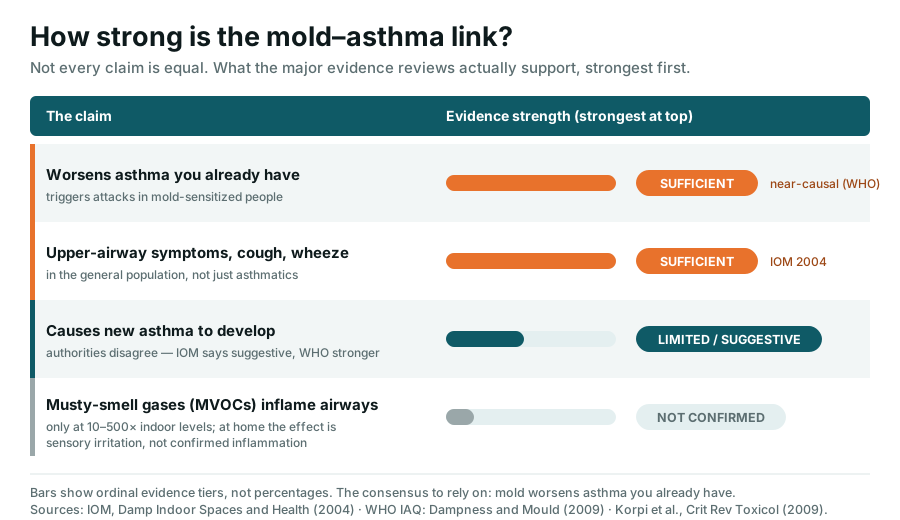
The Institute of Medicine’s 2004 report Damp Indoor Spaces and Health — the landmark systematic review that health agencies still cite — concluded that there is sufficient evidence of an association between the presence of mold in a damp indoor environment and asthma symptoms in sensitized asthmatic people. “Sufficient evidence of an association” is the second-highest rung on their scale — one step below proven causation, and higher than almost any other mold health claim reaches.
The World Health Organization went a notch further specifically for asthma flare-ups. Its 2009 indoor air quality guidelines state that for one health outcome, asthma exacerbation, we consider the evidence to be sufficient to document an association and almost sufficient to document causality of dampness-related factors. “Almost sufficient to document causality” is about as strong as this field gets.
The plain-language agencies agree. The EPA states that molds can trigger asthma episodes in sensitive individuals with asthma, and the CDC notes that people with asthma or who are allergic to mold may have severe reactions.
To put a number on the scale of it: a widely cited 2007 analysis in the journal Indoor Air (Mudarri and Fisk) estimated that dampness and mold in housing are associated with roughly 21% of current asthma cases in the United States. That is an estimate, not a precise count, but a signal that this is a large public-health issue, not a niche one.
Does mold cause asthma, or just trigger it?
Here the honest answer gets more careful, because two different questions get blurred together constantly.
Making existing asthma worse (above) is well supported. Whether damp, moldy housing causes a person to develop asthma in the first place is a separate, weaker claim, and the authorities don’t fully agree on it.
The IOM 2004 report found only limited or suggestive evidence of an association between exposure to a damp indoor environment and the development of asthma — and for mold specifically, it went lower, finding inadequate or insufficient evidence to determine whether an association exists between the presence of mold or other agents in damp indoor environments and the development of asthma.
The WHO’s later review was more willing to make the link, listing asthma development among the outcomes with sufficient epidemiological evidence of associations between dampness or mould and asthma development, asthma exacerbation, current asthma, respiratory infections. So one major authority calls asthma development suggestive-at-best and the other calls it sufficient. When two bodies this serious disagree, the honest framing is: there’s some evidence mold exposure may contribute to developing asthma, especially in children, but it’s genuinely contested — not settled fact.
What both agree on, and what you can rely on, is the exacerbation finding. If you have asthma, mold can make it worse. That’s the load-bearing claim.
What part of mold actually triggers asthma?
Not the smell. This is the single most common misconception, and getting it right changes what you do about it.
The asthma link runs through allergy. The American Academy of Allergy, Asthma & Immunology explains that if you are allergic to mold, your immune system is overly-sensitive to specific mold spores and treats them as an allergen, and that mold can also trigger asthma symptoms such as wheezing, shortness of breath or chest tightness. The EPA describes the same mechanism from the material side: molds produce allergens (substances that can cause allergic reactions) and irritants that you inhale. The active agents are the spores, fungal fragments, and allergens — physical particles your airways react to.
The musty smell is a different thing. That odor comes from microbial volatile organic compounds (MVOCs) — gases mold gives off. It’s tempting to assume the smell is what’s inflaming your lungs, but the science points the other way at real household concentrations. The definitive peer-reviewed review of MVOC toxicology (Korpi, Järnberg and Pasanen, Critical Reviews in Toxicology, 2009) found that inflammatory responses … after single or repeated MVOC exposures have not been unequivocally confirmed in controlled human exposure studies. Thus, sensory irritation by the stimulation of the trigeminal nerves seems to be the most likely mechanism of toxicity of typical MVOCs.
In plain terms: at the levels found in a normal home, the musty-smell gases mostly cause sensory irritation — the pungent, eye-and-nose-stinging sensation carried by the trigeminal nerve — not confirmed airway inflammation. The few studies that did show inflammatory effects used 10 and 500 times higher concentrations … than measured in field samples — nowhere near what you breathe at home. Even the WHO concedes that the mechanisms by which non-infectious microbial exposures contribute to adverse health effects associated with indoor air dampness and mould are largely unknown.
Why this distinction matters practically: it means masking the smell does nothing for your asthma. An air freshener over a mold problem removes the odor cue while leaving the spores and allergens — the part that actually drives asthma — exactly where they were.
Which people with asthma are most at risk?
Having asthma and being allergic to mold are not the same thing, and the difference is what determines your risk.
The people for whom household mold reliably acts as an asthma trigger are the mold-sensitized: those whose immune systems already react to mold spores as an allergen. The AAAAI and the EPA both describe mold triggering asthma in people allergic to it; as the EPA puts it, molds can also cause asthma attacks in people with asthma who are allergic to mold. The IOM’s own tier language points to the same dividing line: the “sufficient evidence” finding is specifically for asthma symptoms in sensitized asthmatic people — sensitized being the operative word.
If you don’t know whether you’re allergic to mold, an allergist can test for it. But you don’t need a test result to act on visible mold in your home — see below.
Two related questions — whether mold is riskier for a baby, an older parent, or someone with a weakened immune system, and whether “black mold” specifically is more dangerous — are covered separately, since they turn on different evidence than the asthma story here.
What to do about mold if you have asthma
The action is straightforward and, importantly, it does not require a mold test.
Fix the moisture first. The EPA’s core rule is that the key to mold control is moisture control, and that you should dry water damaged areas and items within 24-48 hours to prevent mold growth. Mold is a symptom of a water problem; remove the mold without fixing the water and it comes back.
Skip the test, remove what you can see. The CDC is direct: you do not need to know the type of mold. If mold is growing in your home, you need to clean up the mold and fix the moisture problem. The EPA adds that in most cases, if visible mold growth is present, sampling is unnecessary. Identifying the species doesn’t change what you do.
Don’t be the one doing the cleanup. The EPA advises that people with asthma should avoid contact with exposure to molds. If you have asthma, disturbing mold — which sends a burst of spores into the air — is exactly the exposure to avoid. Have someone else handle it, stay out of the area during and after the work, and follow your asthma action plan. For anything beyond a small patch, a professional mold inspection can locate the moisture source and confirm the extent before removal, so the disturbance happens once and is contained.
None of the above is medical advice — for how to manage your own asthma, your doctor and your asthma action plan come first. This is about the home side of the equation.
The Phoenix angle: two ways the Valley stacks moisture indoors
Phoenix homeowners are often told the desert is too dry for mold. For asthma triggers, that misses two real local moisture sources.
Evaporative “swamp” coolers add moisture to the air by design. Unlike refrigerated AC, which removes humidity, an evaporative cooler works by pushing air across wet pads — putting water vapor into the home. In a Valley home running a swamp cooler, indoor humidity is meaningfully higher than the outdoor-dry-air assumption suggests, and the cooler’s own pads and pan are a mold habitat if they’re not maintained.
Monsoon season spikes the moisture load. Phoenix’s July–August monsoon brings short bursts of high humidity and driving rain that can find its way in through flat-roof flashing and, on the same days, prevent evaporative cooling from being an effective cooling strategy. For an asthma household, those weeks are when a slow attic or wall leak quietly starts feeding mold. For the fuller picture of why Valley homes get mold despite the dry climate, the mold in the desert guide walks through every local driver — AC condensate lines, slab leaks, monsoon intrusion, and more.
If mold is already in the home and someone there has asthma, the sensible order is: get it found and removed properly, then keep the moisture sources in check. That’s the whole job.
For the broader honest picture on what mold-linked illness actually is at the population level — from mainstream tiers to contested clinical frameworks — our reporting on whether mold illness is real and our documented mold illness cases reference collect the primary sources in one place.
Sources
- Institute of Medicine (US) Committee on Damp Indoor Spaces and Health. Damp Indoor Spaces and Health. National Academies Press, 2004: ncbi.nlm.nih.gov/books/NBK215639
- World Health Organization. WHO Guidelines for Indoor Air Quality: Dampness and Mould, 2009 (Ch. 4, Health effects): ncbi.nlm.nih.gov/books/n/whodamp/ch4
- Korpi A, Järnberg J, Pasanen A-L. “Microbial Volatile Organic Compounds.” Critical Reviews in Toxicology 2009;39(2):139–193: PDF
- U.S. Environmental Protection Agency. “Mold and Health”: epa.gov/mold/mold-and-health
- U.S. Environmental Protection Agency. “How does mold affect asthma?”: epa.gov/mold/how-does-mold-affect-asthma
- U.S. Environmental Protection Agency. “A Brief Guide to Mold, Moisture and Your Home”: epa.gov/mold/brief-guide-mold-moisture-and-your-home
- Centers for Disease Control and Prevention. “About Mold”: cdc.gov/mold-health/about/index.html
- American Academy of Allergy, Asthma & Immunology. “Mold Allergy”: aaaai.org/conditions-treatments/allergies/mold-allergy
- Mudarri D, Fisk WJ. “Public health and economic impact of dampness and mold.” Indoor Air 2007;17(3):226–235: pubmed.ncbi.nlm.nih.gov/17542835