Is Mold Behind Drywall Dangerous? (Evidence-Based Answer)
Mold behind drywall carries the same evidence-based health concerns as visible mold. The Institute of Medicine found sufficient evidence of an association between indoor mold and upper respiratory symptoms, cough, wheeze, and asthma symptoms in sensitized people — evidence that covers mold exposure generally, not only what you can see. The extra caution with hidden mold is not its location: it is that cutting into a wall without proper containment can trigger a sudden large release of spores, turning a contained problem into an airborne one throughout your home.
What the research actually says — and what it does not
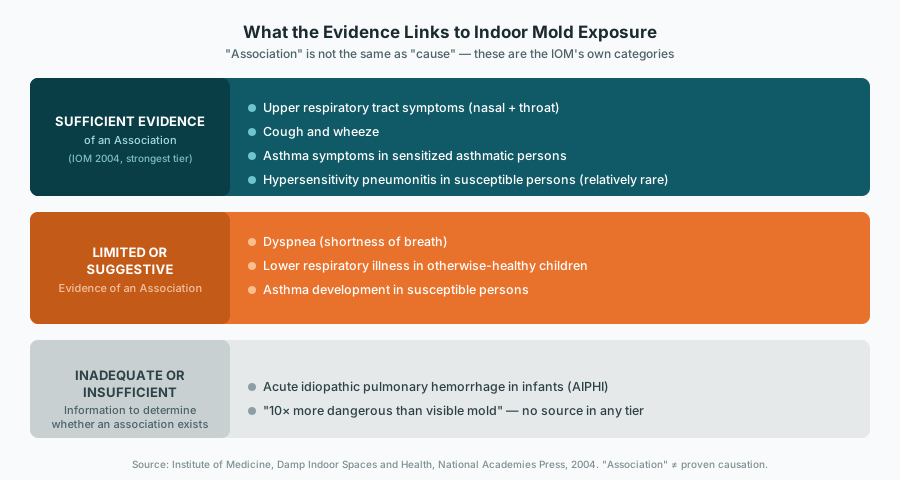
The most rigorous review of indoor mold evidence in the United States is the Institute of Medicine’s 2004 report, Damp Indoor Spaces and Health. The IOM organized the evidence into three tiers based on the strength and quality of studies available. The CDC summarizes the highest tier this way:
“In 2004 the Institute of Medicine (IOM) found there was sufficient evidence to link indoor exposure to mold with upper respiratory tract symptoms, cough, and wheeze in otherwise healthy people; with asthma symptoms in people with asthma; and with hypersensitivity pneumonitis in individuals susceptible to that immune-mediated condition.”
“Sufficient evidence” is the IOM’s strongest category, and it applies to mold exposure generally — including hidden mold behind walls. But the tier name matters: this is an association, not a proven cause. The IOM does not declare that mold causes these outcomes; it found the evidence strong enough to conclude the two are linked.
The evidence is weaker for other outcomes. The IOM placed these in the limited or suggestive tier — meaning some evidence exists but it is not as consistent:
- Dyspnea (shortness of breath)
- Lower respiratory illness in otherwise-healthy children
- Asthma development in susceptible persons
And some claims that circulate online about mold have no supporting evidence at all. The IOM placed acute idiopathic pulmonary hemorrhage in infants in the inadequate or insufficient information category — meaning available data could not determine whether a link even exists.
The WHO issued additional indoor air quality guidance in 2009, finding that the most important effects of damp buildings are “increased prevalences of respiratory symptoms, allergies and asthma as well as perturbation of the immunological system.” That aligns with the IOM’s sufficient-evidence tier and does not go further.
The CDC captures the honest range for most homeowners: “Exposure to damp and moldy environments may cause a variety of health effects, or none at all.”
Why hidden mold is not automatically more dangerous — until you disturb it
No CDC, EPA, or IOM guidance classifies mold as more dangerous by virtue of being hidden behind a wall. The health evidence is about exposure to mold generally.
What changes with hidden mold is the risk at the moment of investigation. The EPA is direct on this point in its schools and commercial buildings remediation guide:
“Investigating hidden mold problems may be difficult and will require caution when the investigation involves disturbing potential sites of mold growth — make sure to use personal protective equipment (PPE). For example, removal of wallpaper can lead to a massive release of spores from mold growing on the underside of the paper.”
That quote is about wallpaper, but the principle applies directly to drywall. Mold colonies growing on the back face of drywall paper, on insulation, or on framing inside a wall cavity can be relatively contained as long as the wall surface remains intact. Cut that surface open without containment barriers, negative air pressure, and PPE, and you can release a concentrated burst of spores into living space.
This is the core reason EPA’s separate hidden-mold guidance says: “If you believe that you may have a hidden mold problem, consider hiring an experienced professional.” Not because the mold behind the wall is inherently more toxic — but because the investigation itself carries a spore-release risk that a professional manages with containment that most homeowners cannot replicate.
How to find out whether it is actually there
The right approach is to escalate through a detection ladder, from least invasive to most destructive, stopping at the rung that gives you enough information to act.
Rung 1: Smell and water history. The EPA notes that you may suspect hidden mold “if a building smells moldy, but you cannot see the source.” Equally important is any water history: a prior slab leak, a reported upstairs condo incident, an AC drain pan overflow, a post-monsoon ceiling stain that was patched and repainted. These are often more informative than the smell alone, because hidden mold behind dry-looking drywall may not smell until the wall is warm and the HVAC is running. Do not rely on over-the-counter test kits: the CDC does not recommend mold testing, noting that results cannot reliably predict whether anyone will become sick and that there are no federal standards for acceptable mold levels in a home.
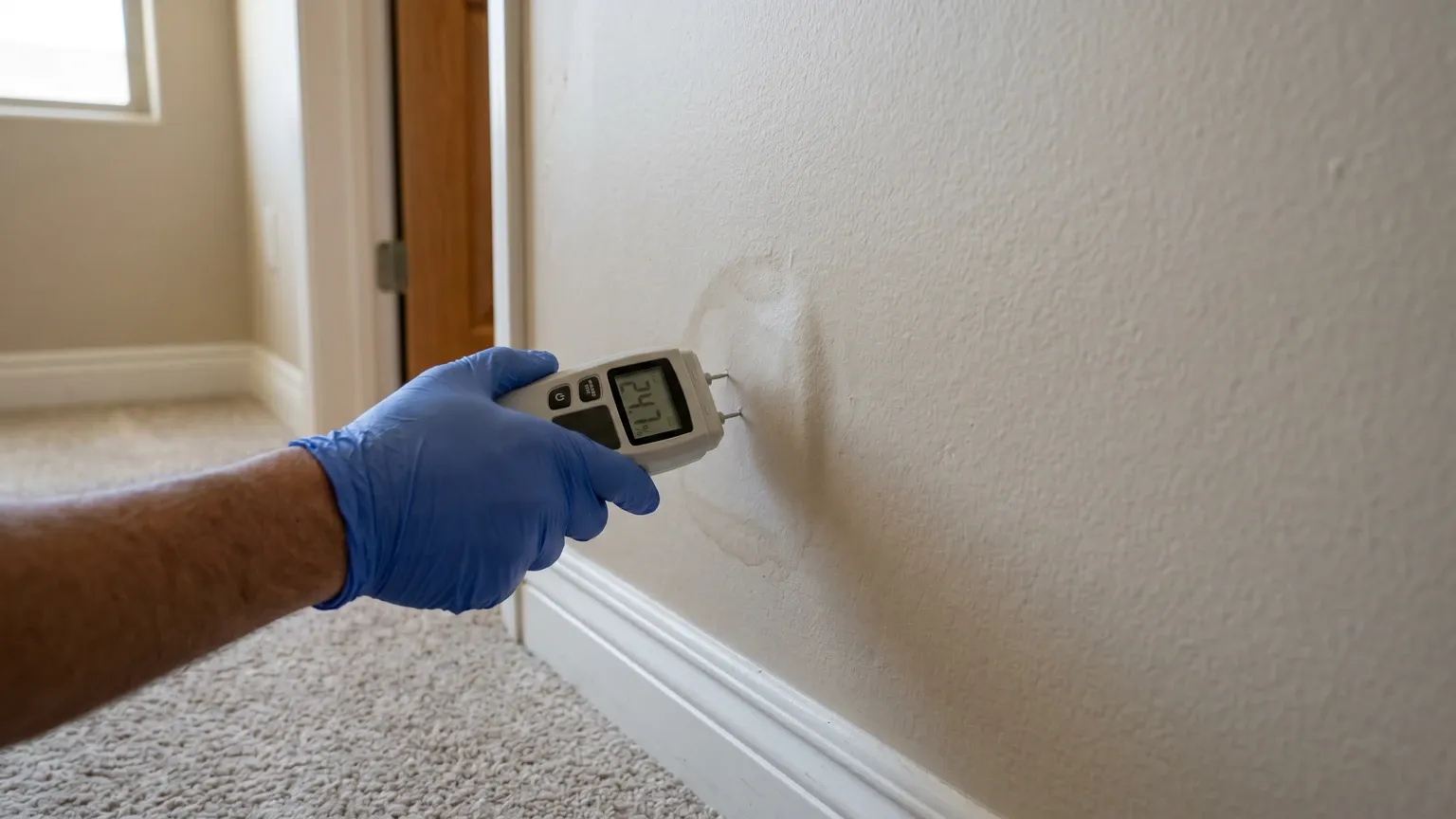
Rung 2: Moisture meter. This is the one non-destructive investigation tool the EPA names in its remediation guidance: “Moisture meters may be helpful for measuring the moisture content in a variety of building materials following water damage.” A pinless (non-penetrating) moisture meter can read elevated moisture content through intact painted drywall without puncturing it. Elevated readings in a suspect zone confirm that wet material is present even when the wall face looks dry. Pro inspectors bring calibrated units; pin-type meters are also rentable at home improvement stores for around $30 a day.
Rung 3: Thermal (infrared) imaging. This is an industry-standard professional tool, not one EPA names in its guidance. A thermal camera does not see mold — it detects temperature differentials. A wet wall cavity is typically cooler than a dry one during daylight hours because the evaporating moisture carries heat away. An inspector uses thermal imaging to map zones likely to be wet, then confirms those zones with the moisture meter. Thermal imaging alone does not prove mold is present; it identifies where to look next.
Rung 4: Boroscope inspection. A boroscope is a small flexible camera inserted through a roughly half-inch hole drilled at an inconspicuous location — inside a closet, below an outlet, at a baseboard line. It gives a direct visual of the wall cavity without opening the full bay.
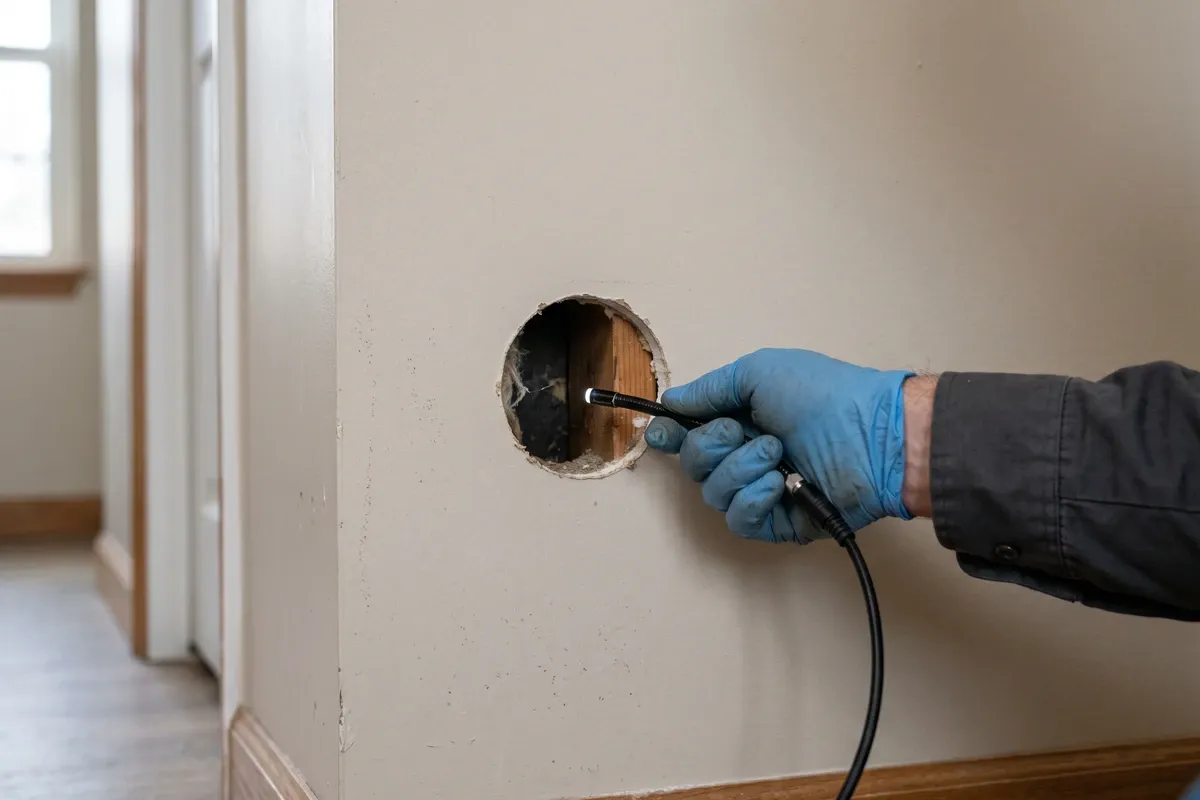
Even a half-inch hole involves disturbing the wall surface. EPA’s guidance on the spore-release risk applies here: use an N95 respirator and gloves when drilling, and have a professional do this step if you suspect significant mold in the cavity.
Rung 5: Test cut. A deliberate cutout of a section of drywall — typically in a 12-by-12-inch section or a full bay — gives direct access to the cavity, insulation, and back of the drywall. This is the confirmation step before full remediation, and it is the rung where containment barriers and negative air pressure matter most. Even if the visible mold on the back of the cutout appears to be under 10 square feet, remember that the EPA’s 10 sq ft rule is written for accessible, visible surface mold. EPA’s separate guidance for hidden mold says to consider hiring a professional regardless of the apparent size.
Five Phoenix scenarios where mold hides behind drywall
National guides on hidden mold describe general patterns. These are the specific wall-cavity scenarios that show up in Phoenix homes, each tied to a mechanism and a location in the wall assembly.
Slab leak — bottom plate. Phoenix homes are almost entirely slab-on-grade. When a copper supply line under the slab begins leaking — accelerated by the Valley’s mineral-heavy municipal water — moisture wicks upward through the concrete and into the wood bottom plate where the wall frame meets the slab. The wall face may look and feel completely dry for weeks while the bottom 12 inches of the wall cavity is saturated from below. Signals: a spike in the water bill, damp or swollen baseboard trim, or a cool-to-the-touch section of wall near the floor in summer when the surrounding wall is warm.
Attic air handler condensate — top plate. Most Phoenix production homes mount the HVAC air handler in the attic. During monsoon season, when the system runs near-continuously and humidity accelerates drain-line slime, the primary condensate drain line can clog and overflow the drain pan. That water drips straight down onto the top plate of the wall directly below the air handler. Mold grows in the top of the wall cavity, not the bottom — the opposite of what most people expect. Signals: a ceiling stain adjacent to a wall, a musty smell strongest in the top of a closet directly below the attic access, or an AC drain pan you can see overflowing on a humid summer day.
Post-monsoon roof leak — mid-wall. A monsoon microburst with 60-mph wind can push rain past flashing and into the wall assembly below the leak point. Phoenix stucco-over-frame walls trap the water between the stucco exterior and the drywall face. The interior drywall shows no visible mold for 2 to 8 weeks after the storm — the stucco and weather-resistive barrier hold moisture inside the wall while the mold establishes on the back of the drywall paper. A musty smell appearing in September or October, weeks after an August storm, is the pattern. Check any wall corner that feels cooler than the surrounding room on a hot day.
Condo upstairs failure — shared wall cavity. Multi-story condos in Old Town Scottsdale, downtown Tempe, and midtown Phoenix share plumbing risers and floor-ceiling assemblies. When an upstairs unit’s washer supply line bursts, AC condensate line clogs, or water heater fails, gravity pulls water into the downstairs unit — often inside a shared wall cavity that is invisible from either unit’s side. Signals: a stain appearing on your ceiling and a nearby wall from the same event, a known upstairs neighbor incident, or a buyer’s inspection flag on wall moisture near a shared plumbing wall. See our guide to condo upstairs AC condensate leaks in Phoenix for the specific liability and documentation steps that apply.
Swamp cooler overflow — below rooftop penetration. Homes still running evaporative coolers have a wall penetration or duct drop-in where the cooler connects to interior supply ducts. When the float valve sticks and water overflows the pan, it runs down the rooftop coupler and into the ceiling or wall assembly below. This is a Phoenix-area-specific hidden-mold vector; few other major metros have significant residential swamp-cooler inventory. Signal: wall staining or a musty odor directly under the cooler duct location, appearing after spring startup or a float-valve failure.
When to call a professional vs. handle it yourself
For visible, accessible surface mold, the EPA says areas smaller than about 10 square feet on hard, non-porous surfaces can usually be handled by a homeowner. Our mold on drywall guide covers that specific case in detail.
Hidden mold — the scenario this guide covers — gets a separate and more conservative EPA recommendation: “If you believe that you may have a hidden mold problem, consider hiring an experienced professional.” These two pieces of guidance are not in conflict. They cover two different situations, and the EPA wrote them separately for a reason.
The practical case for professional involvement with hidden mold comes down to three capabilities most homeowners do not have at home:
Containment. Negative air pressure and sealed containment barriers prevent spore dispersal to the rest of the home when the wall is opened. Without them, EPA’s warning about the “massive release of spores” during investigation applies directly to your kitchen or living room.
Source confirmation. A professional with calibrated moisture meters can confirm that the water source has actually been fixed — not just that the wall looks dry — before the cavity is closed. The EPA is clear: “If you clean up the mold, but don’t fix the water problem, then, most likely, the mold problem will come back.” And: “You must have completely fixed the water or moisture problem before the cleanup or remediation can be considered finished.”
Scope assessment. What appears to be a small stain can indicate a larger cavity problem. A professional investigates the full extent before committing to an approach.
Debunking the claims that keep circulating
“Hidden mold is 10 times more dangerous than visible mold.” No source. Not from EPA, CDC, IOM, or WHO. There is no evidence tier or published study establishing this multiplier. The health evidence covers mold exposure generally.
“The mycotoxins from mold behind my wall are making me sick.” This is the claim most in need of calibration. The IOM specifically addressed mycotoxin risk and found: “the doses of such toxins required to cause adverse health effects in humans have not been determined.” That does not mean mycotoxins are harmless. It means the science has not established what level of residential exposure — if any — causes illness. Claims linking hidden-wall mold to specific systemic conditions via mycotoxins go beyond what IOM, CDC, or WHO evidence supports.
“Mold spreads through electrical outlets from one room to the next.” Folk claim. No CDC, EPA, or IOM source. Mold follows moisture, not wiring. It spreads within the wall cavity where the moisture exists, not through outlet boxes into other spaces.
“Black mold behind the wall is the deadliest type.” Color alone does not determine health risk. The CDC states: “You do not need to know the type of mold.” A dark appearance tells you it is mold; it does not tell you more than that. Our black mold guide covers the color-danger myth in full.
“You need to air-test the wall before opening it.” The CDC does not recommend mold testing, noting that results cannot predict who will become sick and that no federal standard exists for acceptable mold levels. Testing before opening a wall adds cost and delay without changing the action: fix the moisture source, contain the investigation, open the wall with PPE.
“If there’s mold behind the wall, the whole house is contaminated.” This confuses localized hidden mold with a whole-home HVAC distribution event. A wet wall cavity with mold growing on the back of drywall paper is a contained problem — until it is disturbed incorrectly. The EPA’s guidance is to investigate cautiously, use PPE, and work with a professional precisely to keep a local problem local.
The health picture for higher-risk groups
The CDC’s health-effects description for people with asthma, allergies, or weakened immune systems is stronger than for the general population. For the general population: “Exposure to damp and moldy environments may cause a variety of health effects, or none at all.” For people with asthma or mold allergies, “severe reactions” are described. For immunocompromised people and those with chronic lung disease, the CDC notes they “may get infections in their lungs from mold.”
If you or anyone in your household is in one of those groups, the general-population framing above does not apply to you. See our guide to who is most at risk from mold exposure for the full risk-group breakdown, and consult a physician if you have current respiratory symptoms and a known or suspected mold problem.
Fix the water first — every time
Every piece of federal guidance on mold — EPA, CDC — returns to the same foundational point. The EPA states it three ways:
- “If mold is a problem in your home, you should clean up the mold promptly and fix the water problem.”
- “If you clean up the mold, but don’t fix the water problem, then, most likely, the mold problem will come back.”
- “You must have completely fixed the water or moisture problem before the cleanup or remediation can be considered finished.”
For Phoenix-specific scenarios, that means confirming the slab leak is repaired and the concrete has dried, that the condensate line drains freely and the pan shows no overflow, that the roof flashing has been sealed and tested through rain, that the upstairs plumbing failure is fixed at its source. The mold removal is the second step, not the first.
Our mold removal service page and our mold remediation guide cover the full remediation sequence for Phoenix homes, including what a professional job involves from containment through post-remediation verification.
Get a free quote for suspected hidden mold
If you have a musty smell with no visible source, a prior water event, or a buyer’s inspection flag on moisture — and you want to know what is actually behind the wall — a free, no-obligation quote is the fastest way to find out what you are dealing with. We handle hidden mold investigation and remediation across the Phoenix metro. Fill out the form below and we will get you a free, no-commitment quote after we know the actual scope.