Dew Point Calculator
Enter the temperature and relative humidity and this free calculator gives you the dew point, and unlike a plain weather calculator, what it means for mold: the temperature below which surfaces in your home start to sweat, and whether your indoor humidity is past the line the EPA recommends staying under.
Calculate your dew point and mold risk
°F dew point
This is an educational calculator based on a standard physics formula plus EPA and National Weather Service guidance, not a diagnosis, an inspection, or a mold test. It describes moisture conditions, not whether mold is present. The only humidity number here is the EPA's recommendation to stay below 60% (ideally 30-50%); there is no exact relative humidity at which mold switches on.
What the dew point tells you about mold
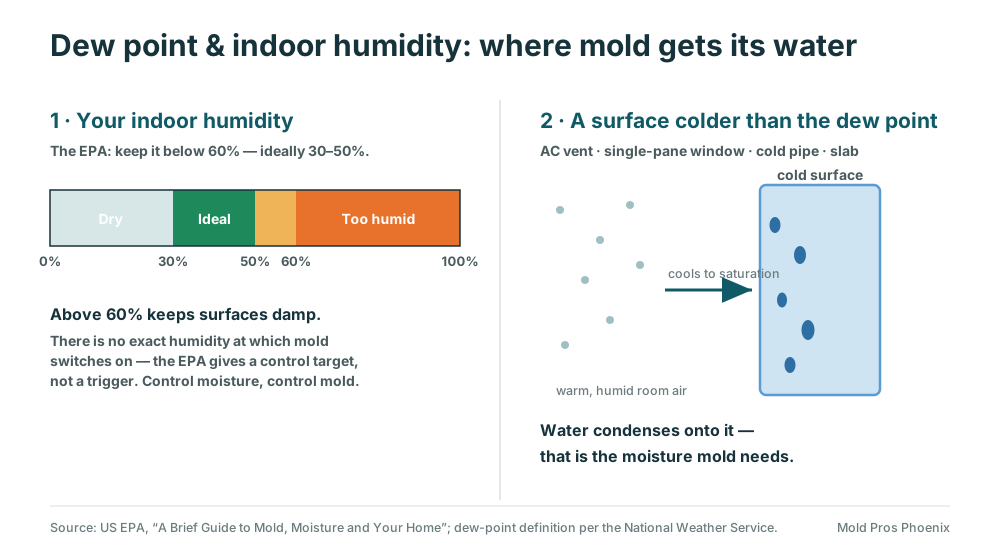
Most dew point calculators hand you a number and stop. The number that matters for your house is the one this is missing: any surface colder than the dew point will collect condensation. The National Weather Service defines the dew point as the temperature the air has to be cooled to before it is saturated, so when warm, humid air touches a surface below that temperature, water condenses out onto it. That is why a glass of iced tea sweats, and it is why a single-pane window, a cold-water pipe, or an air-conditioned supply register drips in summer. The EPA is blunt about why that matters: "There are many types of mold, and none of them will grow without water or moisture." Condensation is that water, delivered straight to a surface.
The other half is the humidity of the room air itself. The EPA's guidance is to "Keep indoor humidity low. If possible, keep indoor humidity below 60 percent (ideally between 30 and 50 percent) relative humidity." There is no exact relative-humidity number at which mold turns on; the EPA does not give one, and neither do we. What we do instead is band your reading against that guidance and show you where the cold surfaces are.
Dew point chart (°F) by temperature and humidity
This is the same calculation the tool above runs, laid out as a chart. Find your indoor temperature down the side and your relative humidity across the top; the cell is the dew point. Any surface in the room colder than that number is a candidate to sweat.
| Temp ↓ / RH → | 30% | 40% | 50% | 60% | 70% | 80% |
|---|---|---|---|---|---|---|
| 65°F | 33°F | 40°F | 46°F | 51°F | 55°F | 59°F |
| 70°F | 37°F | 45°F | 51°F | 55°F | 60°F | 64°F |
| 72°F | 39°F | 46°F | 52°F | 57°F | 62°F | 65°F |
| 75°F | 41°F | 49°F | 55°F | 60°F | 65°F | 68°F |
| 78°F | 44°F | 52°F | 58°F | 63°F | 67°F | 71°F |
| 80°F | 46°F | 54°F | 60°F | 65°F | 69°F | 73°F |
| 85°F | 50°F | 58°F | 64°F | 70°F | 74°F | 78°F |
Dew point in °F. A higher dew point means more moisture in the air and warmer surfaces that can still condense.
Reading your indoor humidity against EPA guidance
| Indoor humidity | Where it sits | What it means |
|---|---|---|
| Under 30% | Dry | Your indoor air is on the dry side. |
| 30-50% | Ideal range | Your indoor humidity is right where the EPA wants it. |
| 50-60% | Above ideal | Above ideal, but still under the EPA's 60% ceiling. |
| Over 60% | Above the EPA ceiling | Above the 60% the EPA recommends staying under. |
These bands follow the EPA's "below 60%, ideally 30-50%" guidance, a control target rather than a switch. A cheap clip-on hygrometer (a $10-20 humidity gauge) is all you need to read the relative humidity this uses; an infrared thermometer makes the optional surface-temperature check easy.
Why this matters more in Phoenix than people think
The desert is supposed to be too dry for mold. It isn't, and the dew point is the reason the myth falls apart. The dry reading on the outdoor forecast is not the dew point inside your home, where four things quietly push moisture onto cold surfaces:
- A running AC chills air at the coil and at the supply registers below its dew point, so registers, uninsulated ducts in a hot attic, and the air handler sweat — and that condensation can drip into ceilings and drywall. It is the single most common hidden-mold driver in Phoenix homes.
- During monsoon season (roughly July through September), outdoor dew points climb into the 50s and 60s°F. Indoor air-conditioned surfaces and single-pane windows then sit below that dew point and start to condense.
- Evaporative 'swamp' coolers cool by adding water to the air, which raises indoor humidity on purpose. That pushes the indoor dew point up until cooler interior surfaces begin to sweat — a uniquely Phoenix way to cross the dew point indoors.
- This is the whole reason 'it's too dry for mold in the desert' is false. The dry number on the outdoor forecast is not the dew point inside an air-conditioned or swamp-cooled home, where cold surfaces and trapped moisture do the rest.
For the fuller version of this, see how Phoenix homes still get mold and, if something has already been wet, how long it takes mold to grow. If a swamp cooler is your setup, our guide on swamp cooler mold goes deeper.
What to do with the number
If your humidity is past 60% or a surface is already at or below the dew point, the move is the same one the EPA recommends: bring the moisture down and dry the wet surface. Run the AC or a dehumidifier, use exhaust fans, insulate cold surfaces (the EPA specifically says to "cover cold surfaces, such as cold water pipes, with insulation"), and find what is adding the water. If surfaces have been sweating for a while, or you smell something musty, that is the point to get eyes on it. A Phoenix mold inspection finds growth that starts behind registers, in ceilings, and inside walls before it spreads.
Sources (4): Alduchov & Eskridge (1996), Improved Magnus Form Approximation of Saturation Vapor Pressure, J. Applied Meteorology 35(4), 601-609 (1996); Lawrence (2005), The Relationship between Relative Humidity and the Dewpoint Temperature in Moist Air: A Simple Conversion and Applications, Bull. American Meteorological Society 86(2), 225-233 (2005); EPA — A Brief Guide to Mold, Moisture and Your Home (2024); National Weather Service — Discussion on Humidity (2024).