Mold illness timeline: a sourced scientific and legal chronology (1993–present)
This is a sourced chronology of the mold-illness scientific, legal, and regulatory record — from the 1993 Cleveland infant pulmonary hemorrhage cluster through the American College of Medical Toxicology's 2025 position statement. Every date and event carries a primary-source citation: a federal-agency report, a coroner's finding, a court record, or a peer-reviewed publication. Journalists, researchers, and homeowners can cite specific milestones directly, without re-deriving the research chain themselves.

How to use this timeline
Cite this as you would a research desk, not a narrative history. Each entry is organized around a single date or short date range, the event, and a primary-source citation you can verify independently. This is not medical advice and not legal opinion — it is the raw evidence, organized chronologically, so you don't have to reconstruct the timeline from scratch.
This timeline is the third piece in a three-part reference set. Is Mold Illness Real? is the argument — what the evidence means, weighed and interpreted. Documented Mold Illness Cases is the evidence vault — the same material organized case-by-case, with full symptom and outcome detail for each. This page is the chronology — the same underlying record, organized by date instead of by case, so a reader can see how the science, the litigation, and the regulatory response unfolded relative to each other over time.
For the data and methodology underlying our Phoenix-specific mold research, see our methodology page and data and sources page. All three pieces in this reference set, plus our original Phoenix datasets, are indexed at our press and data page.
The 1990s: naming the problem
The modern mold-illness debate begins with a pediatric cluster in Cleveland, Ohio — a case series that would shape, and in some ways distort, three decades of subsequent argument.
1993–1998: the Cleveland AIPHI cluster
Between January 1993 and December 1998, 37 infants in the eastern metropolitan Cleveland area — concentrated in older housing stock with a documented history of water damage — were diagnosed with acute idiopathic pulmonary hemorrhage and hemosiderosis (AIPHI). Twelve died; seven others had initially been classified as SIDS. A 1994 CDC MMWR report identified major home water damage as a risk factor. Follow-up work by a Rainbow Children's Hospital team led by Dr. Dorr Dearborn found Stachybotrys chartarum in a higher proportion of case homes than control homes and proposed the mold as a causal factor — a finding that drew national attention as an early, alarming claim that residential mold could kill infants.
In 1997, family physician Ritchie C. Shoemaker, MD, began working with patients exposed to Pfiesteria — a toxic dinoflagellate — in a cluster of illness along Chesapeake Bay tributaries in Maryland. This work, conducted independently of the Cleveland investigation, would become the origin point of what Shoemaker later named Chronic Inflammatory Response Syndrome (CIRS), later extended to water-damaged-building exposure. The Cleveland cluster and the Shoemaker/Pfiesteria work are separate threads of the mold-illness record that later intersect in public discussion, but they began independently and on different evidentiary footing.
1999: the first CDC review
In 1999, the CDC convened an internal review panel to examine the original Cleveland investigation. The panel identified significant methodological shortcomings in the case-control design and exposure-assessment methods used in the initial Stachybotrys causation claim. This review set up the formal reanalysis published the following year.
2000–2004: the mainstream position takes shape
2000: CDC MMWR reanalysis
The CDC's 2000 MMWR update on the Cleveland cluster reached a specific and often-misquoted conclusion. Verbatim:
"A possible association between acute pulmonary hemorrhage/hemosiderosis in infants and exposure to molds, specifically Stachybotrys chartarum, was not proven."
— CDC, MMWR, 2000
This is not the same statement as "CDC debunked the mold link" — a framing that circulates widely and inaccurately. "Not proven" means the evidentiary bar for causation was not met by the original study design; it does not mean a contrary finding was made. The 2004 Institute of Medicine review (below) would later classify the evidence for AIPHI and Stachybotrys as "inadequate/insufficient" — the IOM's category for research where the base is too thin to draw a conclusion, not where the association has been shown false.
June 1, 2001: Ballard v. Fire Insurance Exchange verdict
A Travis County, Texas jury returned a $32,147,525 verdict against Farmers-affiliated Fire Insurance Exchange, following a 1998 bathroom plumbing leak that the insurer failed to properly remediate in the Ballard family's Dripping Springs home. The breakdown, per Insurance Journal's contemporaneous cover story: $6.2 million actual damages, $12 million punitive damages, $5 million mental anguish, $8.9 million attorney fees.
The critical detail for accurate citation: Trial Judge John Dietz excluded the plaintiffs' personal-injury and health-effects claims because the medical expert testimony did not meet the Texas Supreme Court's Robinson reliability standard for scientific evidence. The verdict was for property damage and insurance bad-faith claims handling — not a judicial finding that mold caused the family's reported illnesses. On appeal, the Texas Court of Appeals reduced the verdict to approximately $4 million net, with a confidential settlement following.
2002: Melinda Ballard testifies before Congress
Melinda Ballard testified before the U.S. House Financial Services Subcommittee's 2002 hearing, "Mold: A Growing Problem." She subsequently founded Policyholders of America, an insurance-reform advocacy organization. Her congressional testimony marks the point at which the Ballard case moved from a Texas jury verdict into national insurance-policy discussion.
2003: the ACOEM mold position paper
In 2003, the American College of Occupational and Environmental Medicine (ACOEM) published a position paper in the Journal of Occupational and Environmental Medicine. Its verbatim conclusion:
"Current scientific evidence does not support the proposition that human health has been adversely affected by inhaled mycotoxins in the home, school, or office environment."
— ACOEM, position paper, 2003
For the following several years, this was the single most-cited institutional document used to oppose mold-illness claims in litigation and in medical practice. As detailed under 2008 below, this paper's status as the mainstream position did not hold.
March 21, 2003: Ed McMahon settlement
The Tonight Show sidekick Ed McMahon settled his toxic-mold lawsuit against multiple defendants — including his insurer, adjusters, and remediation contractors — for $7.2 million. The suit followed a burst pipe in his Beverly Hills home; McMahon and his wife Pamela became ill, and the family dog, Muffin, died from what the McMahons attributed to mold exposure. Because the case settled, no medical-causation findings were entered on the record.
2004: Institute of Medicine, Damp Indoor Spaces and Health
The Institute of Medicine's 2004 report, Damp Indoor Spaces and Health, is the most authoritative U.S. systematic review of this topic and remains the reference framework cited by virtually every subsequent document in this timeline. It sorted the evidence into three tiers. Verbatim, the "sufficient evidence of an association" tier — the report's highest — covered damp indoor environments and: upper respiratory tract symptoms, cough, wheeze, asthma symptoms in already-sensitized asthmatic people, and hypersensitivity pneumonitis in susceptible persons. The "limited or suggestive evidence" tier covered dyspnea, new-onset asthma development, and lower respiratory illness in otherwise-healthy children. The "inadequate or insufficient evidence" tier — applied to airflow obstruction in healthy people, COPD itself, and specifically to Stachybotrys chartarum as a cause of infant pulmonary hemorrhage — is the tier most often misread. The IOM's own methodology is explicit that "inadequate or insufficient evidence to determine whether an association exists" is categorically distinct from "sufficient evidence of no association." These are not the same finding, and the distinction is where the most consequential misreadings of this report occur in both directions of the mold debate.
April 2004: the Kenya aflatoxicosis outbreak
In April 2004, one of the largest aflatoxicosis outbreaks on record struck rural Kenya. Contaminated homegrown maize carried aflatoxin B₁ measured at up to 4,400 parts per billion — 220 times the 20 ppb Kenyan food safety limit. The outbreak produced 317 cases and 125 confirmed deaths — a case-fatality rate of roughly 39%. This is the clearest peer-reviewed proof that fungal mycotoxins can produce fatal acute human disease at sufficient dose. It does not establish that airborne mycotoxin inhalation in homes causes the same pathology at residential concentrations — that is a separate, food-versus-inhalation exposure-pathway question — but it forecloses the argument that mycotoxins cannot affect humans. They demonstrably do.

2005–2010: the CIRS framework emerges
2003: Erin Brockovich, Agoura Hills
Environmental activist Erin Brockovich settled her own mold case for approximately $430,000 from two parties, plus an undisclosed amount from a third, after her Agoura Hills home became Stachybotrys-contaminated following water damage. Her husband and 10-year-old daughter had respiratory problems; remediation cost more than $500,000. As with McMahon, this was a settlement — no judicial finding on medical causation was entered.
2004–2007: Shoemaker's early CIRS publications
Ritchie Shoemaker and NIEHS researcher Kaye Hudnell published foundational proponent-side work describing "sick building syndrome in water-damaged buildings" as a neurotoxin-mediated illness (Neurotoxicology and Teratology, 2004), followed by Shoemaker and House's 2006 paper in the same journal describing symptom clusters and treatment response in water-damaged-building-exposed patients (Neurotoxicol Teratol 2006;28(5):573-88). This period establishes the peer-reviewed literature base that the CIRS clinical framework rests on — a literature that, as noted below, comes substantially from Shoemaker's own research group rather than independent replication.
2008: Kelman et al. — the ACOEM critique
In 2008, Kelman and colleagues published a peer-reviewed critique in the International Journal of Occupational and Environmental Health. It documented undisclosed conflicts of interest between several authors of the 2003 ACOEM position paper and insurance-industry defense work. ACOEM subsequently retired the 2003 paper from its active statement list. This is an important honest-reporting fact for anyone citing the mainstream skeptical position on mold illness: the 2003 ACOEM paper, cited for years to defeat mold-injury claims, cannot honestly be represented as the current mainstream position. Its retirement does not vindicate the CIRS framework — it means that specific document is no longer the mainstream skeptical citation. The current mainstream position sits with the ACMT's 2025 statement, covered below.
2009: WHO Guidelines for Indoor Air Quality — Dampness and Mould
The WHO Regional Office for Europe published its 2009 guidelines, the second major international review after the IOM 2004 report. Its "sufficient epidemiological evidence" tier extended the IOM's list to include new-onset asthma development (not just exacerbation), respiratory infections, and dyspnoea. Its "sufficient clinical evidence" tier included hypersensitivity pneumonitis, allergic alveolitis, mold infections in susceptible individuals, humidifier fever, and inhalation fevers. The WHO's summary conclusion is deliberately broad in its final phrase: "the most important effects are increased prevalences of respiratory symptoms, allergies and asthma as well as perturbation of the immunological system." That phrase — perturbation of the immunological system — is WHO acknowledging non-respiratory immune effects without endorsing any specific downstream syndrome such as CIRS.
2011–2015: mainstream skepticism formalizes
2012: Valent et al. — first formalized MCAS diagnostic criteria
Mast Cell Activation Syndrome (MCAS) received its first formalized consensus diagnostic criteria via Valent and colleagues in 2012, distinct from and predating the CIRS framework but later linked to it by some proponent clinicians — notably Lawrence Afrin, MD (see 2016 below) — who identify mold as one trigger among many for MCAS flares. MCAS itself sits closer to mainstream acceptance than CIRS, though it remains diagnostically contested at the edges, particularly around mast cell tryptase thresholds.
2014: the Shoemaker/House/Ryan NeuroQuant study
Shoemaker, House, and Ryan published a volumetric MRI study in Neurotoxicology and Teratology (2014) comparing 17 patients with reported CIRS following water-damaged-building exposure to 18 controls. The study found bilateral caudate atrophy, pallidum enlargement, and left amygdala and right forebrain enlargement in the exposed group. This remains one of the most-cited proponent-side pieces of structural evidence for CIRS. It has not been independently replicated by research groups outside Shoemaker's own network, and the sample size (17 vs. 18) is small by the standards required for structural-neuroimaging claims of this kind.
2015: CDC MMWR on unvalidated urine mycotoxin tests
The CDC's 2015 MMWR Notes from the Field addressed a specific and consequential diagnostic-testing question. Verbatim:
"There is no FDA-approved test for mycotoxins in human urine … Mycotoxin levels that predict disease have not been established … [these tests] might not be valid or clinically useful."
— CDC, MMWR Notes from the Field, 2015
This remains the operative federal position on urine mycotoxin testing, restated in substantially similar language by the American College of Medical Toxicology a decade later (see 2025 below).
2015: IOM, Beyond Myalgic Encephalomyelitis/Chronic Fatigue Syndrome
The Institute of Medicine (by this point transitioning into the National Academy of Medicine) published its 2015 report establishing the mainstream biological framework for ME/CFS — a condition frequently discussed alongside mold-related multi-system illness because of overlapping symptom clusters (fatigue, cognitive dysfunction, post-exertional malaise). This report is relevant context for the mold-illness debate because peer-reviewed work on mycotoxin urine testing in ME/CFS populations (Brewer et al. 2013; Wu et al. 2022) sits adjacent to, and is sometimes conflated with, the CIRS mold-specific literature.
June 4, 2015: Netflix/Bulletproof "Moldy" documentary
Dave Asprey's Bulletproof Films released Moldy, an advocacy documentary premiering June 4, 2015. It featured Ritchie Shoemaker, MD; Mark Hyman, MD (functional medicine); Daniel Amen, MD (SPECT brain imaging, Amen Clinics); William Rea, MD (environmental medicine, later deceased 2018); and Scott McMahon, MD (CIRS pediatric researcher and Shoemaker co-author). The film substantially popularized mold-illness awareness with a general audience but is an advocacy piece drawn entirely from the CIRS/functional-medicine cluster — not a mainstream-medicine-reviewed production. It is cited here as a cultural touchstone, not as clinical evidence.
2016–2020: emerging medicine and public figures
2016: Lawrence Afrin, "Never Bet Against Occam"
Hematologist-oncologist Lawrence B. Afrin, MD published Never Bet Against Occam: Mast Cell Activation Disease and the Modern Epidemics of Chronic Illness and Medical Complexity. This became the defining clinical text for MCAS, and identifies mold as one of several environmental triggers for MCAS flares in susceptible patients — a more circumscribed claim than the full CIRS multi-system framework.
2017: Candace Owens sues her Stamford landlord
Conservative commentator Candace Owens has publicly described a severe illness episode she attributes to an HVAC leak in her Stamford, Connecticut apartment building around 2015–2016. Her most detailed account is from the Shawn Ryan Show, Episode 318, transcribed verbatim: "I had head-to-toe overnight eczema. I had never had eczema. Athlete's foot. My eyes were red and just kept pussing… The worst part was my brain… you can't think… if you ever had brain fog, imagine the most intense brain fog." She also described two hospital-level asthma attacks and roughly a year-long recovery involving a strict low-sugar diet.
Owens stopped paying $3,550 per month in rent in 2016, citing the mold-related health issues, and sued her landlord in 2017. The case did not succeed; publicly-available court-record summaries indicate the ruling turned on the admissibility of medical-expert testimony rather than a factual finding on her symptoms, and reporting has centered on the same evidentiary gap that runs through the Ballard case sixteen years earlier. Primary docket verification remains pending.
2018: Neil Nathan, "Toxic"
Neil Nathan, MD — board-certified in Family Medicine and Pain Management, a founding diplomate of the American Board of Integrative Holistic Medicine, and a former University of Minnesota medical school faculty member (1979–1990) — published Toxic: Heal Your Body from Mold Toxicity, Lyme Disease, MCS, and Chronic Environmental Illness. Nathan's clinical variant is softer-sequenced than Shoemaker's original 12-step protocol, built around his "sensitive patient" cohort — patients who react adversely to almost every treatment, including the aggressive Shoemaker sequence. His approach starts with antioxidants, gentle binders, and limbic-system retraining before advancing to more aggressive interventions.
December 21, 2020: Awaab Ishak dies
Two-year-old Awaab Ishak died at Royal Oldham Hospital in Rochdale, England, on December 21, 2020. His family had reported mold in their social-housing flat, managed by Rochdale Boroughwide Housing, since 2017; the housing association repeatedly failed to act. This single death would, within three years, produce a change in UK national housing law — a legal and regulatory turning point with no parallel in the U.S. record covered elsewhere on this timeline.
2021–2023: the tide begins to shift
2021: Reese Allison and Ron Allison die
Reese Allison and Ron Allison — the son and husband of Melinda Ballard, plaintiffs in the landmark 2001 verdict twenty years earlier — both died in 2021. Melinda Ballard had died in 2013. The family's medical outcomes were never judicially established as caused by mold exposure (the trial court excluded that testimony, as noted above); their deaths in 2021 are documented in public-record obituaries and case retrospectives, not as a new causation finding.
November 15, 2022: Awaab Ishak coroner's finding
Senior Coroner Joanne Kearsley, HM Coroner for Greater Manchester North, concluded the Awaab Ishak inquest on November 15, 2022. Her recorded cause of death, verbatim:
"Acute airway oedema with severe granulomatous tracheobronchitis due to environmental mould exposure."
— Senior Coroner Joanne Kearsley, HM Coroner for Greater Manchester North, November 15, 2022
Post-mortem examination by Dr. Philip Lumb found Awaab's throat, windpipe, and airways swollen and congested, with evidence of fungus in his blood and lungs. A council building surveyor who inspected the flat two days after Awaab's death stated it was not fit for human habitation without repairs. This is the strongest single global citation for the proposition that residential mold exposure can be fatal — it rests on a coroner's legal finding supported by post-mortem pathology, not a contested expert opinion. Rochdale Boroughwide Housing's chief executive, Gareth Swarbrick, was dismissed following the finding.
2023: UK Social Housing (Regulation) Act 2023 — Awaab's Law
The UK Parliament responded to the Awaab Ishak coroner's finding by passing the Social Housing (Regulation) Act 2023, which includes Awaab's Law — a statutory requirement that social-housing providers remedy reported damp and mold within specified timeframes. This is the direct legislative consequence of a single documented pediatric mold death, and remains the clearest example in this timeline of a coroner's finding translating into binding national policy.
August 2023: Baehr v. Woods Comfort Systems verdict
An Austin, Texas jury awarded the Baehr family approximately $3.1 million in August 2023. Kristina Baehr, then a DOJ attorney, had spent roughly two years experiencing dizziness, blurred vision, brain fog, and exhaustion — described to CNBC as "drunken-like wooziness in the middle of the day." Six family members were affected across the household. Woods Comfort Systems was found 40% liable for installing an oversized HVAC unit that short-cycled — reaching its thermostat setpoint quickly, shutting off, and cycling on again, instead of running longer cycles that allow proper dehumidification. Short-cycling created chronic condensation and elevated indoor humidity; a faulty roof repair introduced additional moisture. Mold colonized the walls and the HVAC system itself. The verdict included roughly $700,000 in exemplary damages and $390,000 in attorney fees.
This case is the clearest 1:1 mechanism match to the Phoenix market on this entire timeline. Phoenix HVAC systems run near-continuously from May through September; condensate drains that clog, overflow pans that back up, and ductwork with broken vapor barriers are standard hidden-moisture sources in Valley homes. The Baehr verdict is not an exotic edge case — it documents, with a jury finding and a monetary award, the exact AC-condensate mechanism that operates in Phoenix homes every summer. See our guide on what mold sickness actually feels like for the brain-fog and cognitive symptoms Kristina Baehr described most prominently, and our mold inspection service if you suspect a similar HVAC-condensate source in your own home.
2024–2025: current position
2024: Dooley, Vukelic, Jim — CIRS treatment efficacy review
Dooley, Vukelic, and Jim published a review in the Annals of Medicine and Surgery (2024) analyzing 14 studies of the Shoemaker Protocol. Its verbatim conclusion: "The only treatment in the published literature documenting clinical efficacy for the treatment of Chronic Inflammatory Response Syndrome is the Shoemaker Protocol." The review included 2 randomized controlled trials and several case-control and single-cohort designs. The essential caveat, stated in the review itself: most of the underlying trial evidence comes from Shoemaker's own research group at CBRDD, not from independent replication. This is the strongest recent peer-reviewed evidence on the proponent side of the CIRS debate — and it comes with a specific, honestly-reported limitation on independent verification.
October 27, 2025: Awaab's Law Phase 1 comes into force
Phase 1 of Awaab's Law came into force in the UK on October 27, 2025 — nearly five years after Awaab Ishak's death and almost three years after the coroner's inquest. This date marks the point at which the legal consequence of the 2020–2022 events (above) became enforceable statute rather than passed legislation awaiting implementation.
2025: ACMT position statement
The American College of Medical Toxicology published its 2025 position statement, the current authoritative mainstream toxicology position on mold-related inhalation exposure claims. Verbatim, its central conclusion:
"There is no documented evidence that inhalation exposure to fungi or mycotoxins in indoor environments causes a chronic toxic encephalopathy."
— ACMT Position Statement, 2025
The statement also holds that urine mycotoxin and mycotoxin antibody testing is "not recommended for the assessment of human exposure to mycotoxins," and that using unapproved diagnostic studies or "detoxification" protocols based on unproven mold-related toxicity is "medically inappropriate and costly." This is the current mainstream position — replacing the retired 2003 ACOEM paper as the operative institutional statement on this question, twenty-two years after that earlier paper's conclusion and seventeen years after the Kelman critique that led to its retirement.
2024–2025: recent journalism-documented individual cases
Three named individual cases, documented in mainstream outlets, close out this timeline's most recent period. Lauren Lowenstein's family (Houston, Newsweek 2024) experienced hair loss, insomnia, migraines, and heart palpitations traced to HVAC-condensation mold behind walls and under a shower — costing over $285,000 to remediate. Laura Schaeffer (Pennsylvania, Newsweek 2025) endured a 12-year diagnostic odyssey — UTI-like symptoms, unexplained fevers, rectal bleeding, and cognitive fog — before mold was identified as a contributing factor in a century-old farmhouse. Kendall and Stephen Early (Hoover, Alabama, WBRC 2025) discovered four types of toxic mold at 500 times normal levels after their daughter's cough, Stephen's adult-onset asthma, and Kendall's stroke-like neurological symptoms led to testing; the home was a total loss.
These are not peer-reviewed clinical case series — they are documented journalism, cited as what they are. For fuller detail on each, including direct quotes and outcome data, see our companion reference Documented Mold Illness Cases.
How to cite this timeline
This timeline is free to cite with attribution. Cite specific dated entries directly, and where possible cite through to the underlying primary source linked in each entry — this page is a finding aid organizing primary sources chronologically, not itself a primary source.
Mold Pros Phoenix. "Mold Illness Timeline: A Sourced Scientific and Legal Chronology (1993–Present)." moldprosphoenix.com. Published July 4, 2026. https://moldprosphoenix.com/mold-illness-scientific-timeline/
Attribution language: Source: Mold Pros Phoenix (moldprosphoenix.com). This chronology is licensed CC BY 4.0 — free to cite with attribution.
For journalists: Verify any legal claim against the primary court record or coroner document linked in each entry before publication. Where a date range appears (for example, "1993–1997"), that reflects a documented multi-year cluster or publication period, not imprecision — check the specific citation for the exact date you need.
For researchers: The research files underlying this timeline are available at our data and sources page; our full methodology for source selection is at our methodology page. This timeline's companion pieces — Is Mold Illness Real? (the argument) and Documented Mold Illness Cases (the case-by-case evidence vault) — are also listed in our press and data assets.
For related health guidance on the symptom clusters that map to milestones on this timeline, see our guides on what mold sickness actually feels like and whether black mold is dangerous.
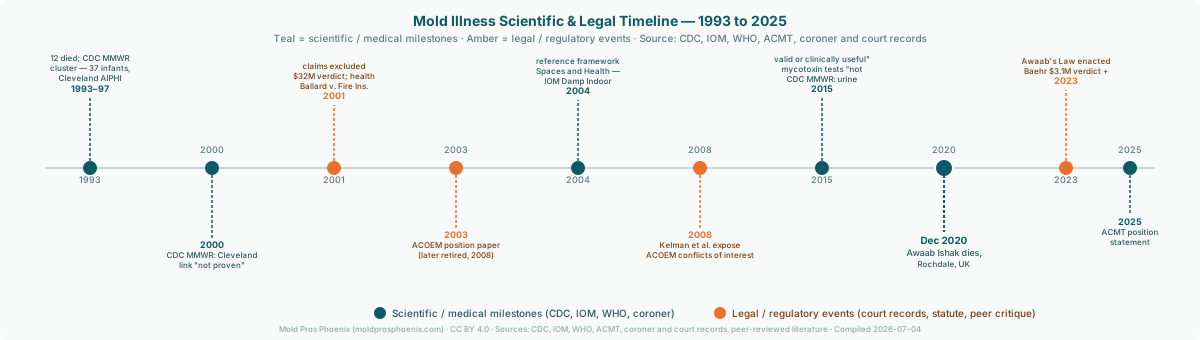
The timeline at a glance
Sources
Federal and agency sources
- CDC MMWR (1994) — original Cleveland AIPHI report. PubMed 7969010 — accessed 2026-07-04
- CDC MMWR (2000) — Cleveland AIPHI reanalysis. PubMed 11795499 — accessed 2026-07-04
- CDC MMWR Notes from the Field (2015), Use of Unvalidated Urine Mycotoxin Tests for the Clinical Diagnosis of Illness. cdc.gov/mmwr mm6406a7 — accessed 2026-07-04
- Overview of Cleveland AIPHI investigations. PMC1566217 — accessed 2026-07-04
- JAMA Pediatrics on AIPHI and Stachybotrys. jamanetwork.com — accessed 2026-07-04
Consensus and guideline documents
- Institute of Medicine (2004). Damp Indoor Spaces and Health. NCBI Bookshelf NBK215639. ncbi.nlm.nih.gov/books/NBK215639 — accessed 2026-07-04
- WHO Regional Office for Europe (2009). WHO Guidelines for Indoor Air Quality: Dampness and Mould. NCBI Bookshelf NBK143940. ncbi.nlm.nih.gov/books/NBK143940 — accessed 2026-07-04
- Institute of Medicine (2015). Beyond Myalgic Encephalomyelitis/Chronic Fatigue Syndrome. National Academies Press.
- ACMT (2025). Position Statement: Medical Toxicology Considerations in the Diagnosis and Treatment of Patients with Concerns About Mold-Related Inhalation Exposures. acmt.net — accessed 2026-07-04
Peer-reviewed studies and critiques
- Shoemaker RC, Hudnell HK (2004). Sick building syndrome in water-damaged buildings. Neurotoxicol Teratol.
- Shoemaker RC, House DE (2006). Sick building syndrome (SBS) and exposure to water-damaged buildings: time series study, clinical trial and mechanisms. Neurotoxicol Teratol 28(5):573-88.
- Shoemaker RC, House D, Ryan JC (2014). Structural brain abnormalities in patients with inflammatory illness acquired following exposure to water-damaged buildings: a volumetric MRI study using NeuroQuant. Neurotoxicol Teratol. PubMed 24946038 — accessed 2026-07-04
- Kelman B et al. (2008). ACOEM conflict-of-interest critique. Int J Occup Environ Health. tandfonline.com — accessed 2026-07-04
- Valent P et al. (2012). Consensus diagnostic criteria for mast cell activation syndrome (MCAS).
- Dooley, Vukelic, Jim (2024). Chronic inflammatory response syndrome: a review of the evidence of clinical efficacy of treatment. Ann Med Surg. PMC11623837 — accessed 2026-07-04
- Lewis L et al. (2005). Aflatoxin Contamination of Commercial Maize Products during an Outbreak of Acute Aflatoxicosis in Eastern and Central Kenya. Environ Health Perspect. PMC1314917 — accessed 2026-07-04
Legal, coroner, and public record
- Allison v. Fire Insurance Exchange, Texas Court of Appeals 2002. FindLaw — accessed 2026-07-04
- Insurance Journal, "Texas Jury Awards $32 Million in Mold Proliferation Case" (June 2001). insurancejournal.com — accessed 2026-07-04
- ACHR News, "Mold Lawsuit by Ed McMahon Settled for $7.2 Million" (May 2003). achrnews.com — accessed 2026-07-04
- HM Coroner for Greater Manchester North (Joanne Kearsley), Awaab Ishak inquest, November 15, 2022. Via Wikipedia — Death of Awaab Ishak, en.wikipedia.org/wiki/Death_of_Awaab_Ishak — accessed 2026-07-04
- UK Social Housing (Regulation) Act 2023 — Awaab's Law. UK statute.
- Texas Lawbook, Baehr v. Woods Comfort Systems verdict coverage (2023). texaslawbook.net — accessed 2026-07-04
- CNBC, "Toxic mold forced a Texas family to flee their home" (Dec. 15, 2021). cnbc.com — accessed 2026-07-04
- Shawn Ryan Show Ep. 318 — Candace Owens transcript. podcasts.happyscribe.com — accessed 2026-07-04
- Newsweek — Lauren Lowenstein (2024). newsweek.com — accessed 2026-07-04
- Newsweek — Laura Schaeffer (2025). newsweek.com — accessed 2026-07-04
- WBRC — Kendall and Stephen Early (Feb. 6, 2025). wbrc.com — accessed 2026-07-04
The evidence points to one first step
Whatever your read of the contested science, every framework on this timeline agrees on the first move: if you suspect mold, find out what's actually in your home. A professional inspection tells you what you're dealing with — before it gets worse.