How much does drywall mold removal cost in Phoenix?
Surface drywall mold removal runs $800–$2,500 for a single room. Once mold works through the paper face into the drywall core, the job shifts to cut-and-replace — demolition to reach it and rebuilding the wall after — and the cost climbs to $2,500–$20,000 depending on how much area is involved. The dividing line is whether the paper face has been breached. In Phoenix, the three sources that most often push mold through that line are AC air-handler condensate overflows, slab-leak moisture wicking up lower walls, and monsoon roof leaks above ceiling drywall.
Get my free drywall mold quote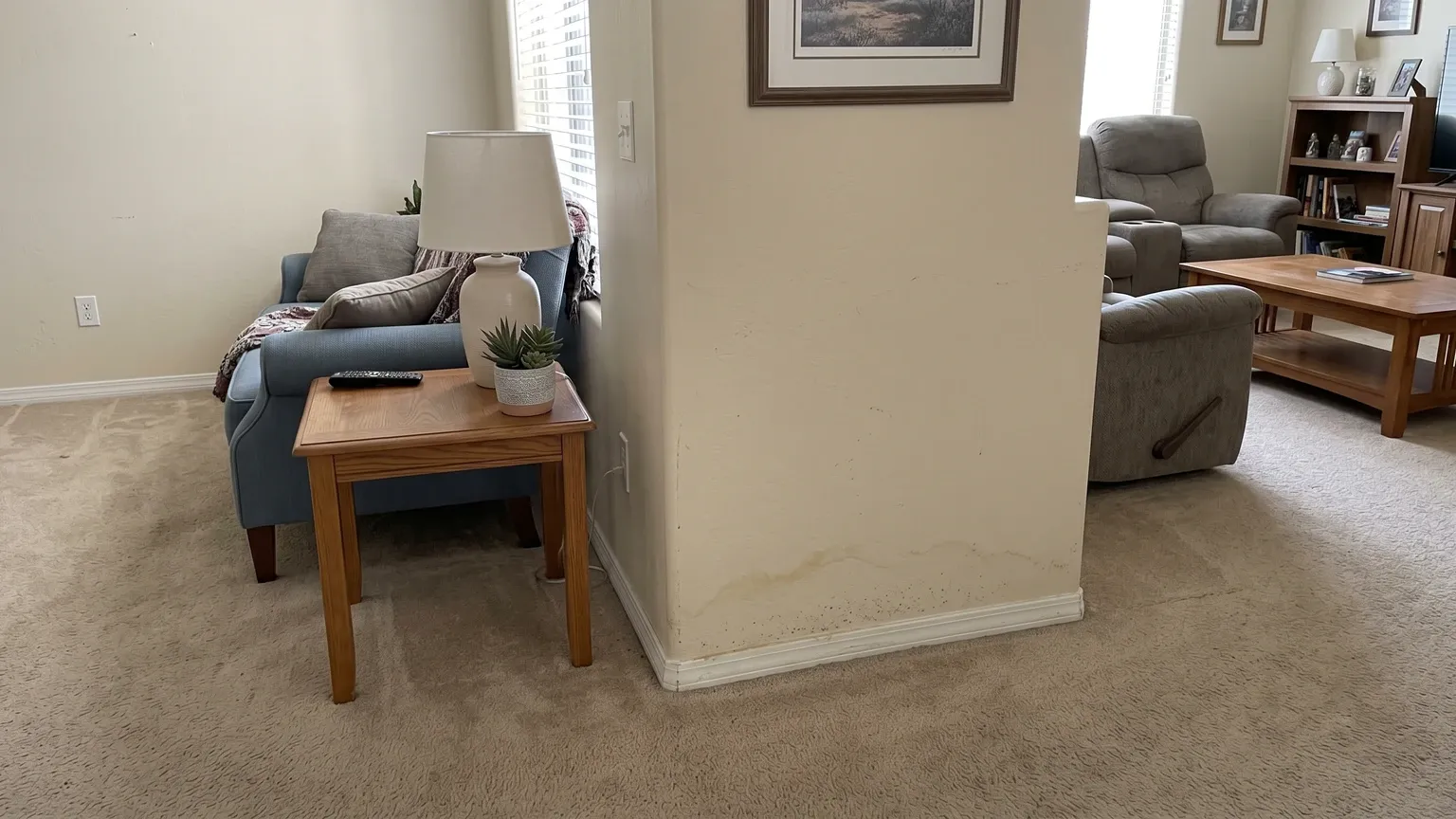
What drywall mold removal actually costs in Phoenix
These ranges come from HomeAdvisor (2026), Bob Vila (2024), SERVPRO (2026), and Fixr (2025), cross-checked against our own 30-company Phoenix pricing study. They are estimates — not quotes. Your actual number depends on whether the mold is surface-only or through the paper face, how much wall area is involved, and whether the moisture source needs a separate repair. See the full Phoenix mold removal cost breakdown for every scenario.
| Scope | Typical range | What it covers |
|---|---|---|
| Small surface spot (bathroom/closet, under ~10 sq ft) | $500–$800 | A small, contained spot on a hard surface. Under ~10 sq ft with the moisture already fixed, EPA says many homeowners can DIY — a floor, not a green light. |
| Single room / surface drywall | $800–$2,500 | One affected room — containment, surface drywall removal, drying. Mold only on the visible face. |
| Drywall — mold behind / inside the wall | $2,500–$20,000 | Once mold is through the back of the drywall it is cut-and-trash, not cleanable; demolition to reach it raises the rate and the band scales with area. National source range is $1,000–$20,000 for walls; behind-the-wall work sits in its upper half, so we floor it where surface work ends. |
A note on the per-square-foot rate you may see elsewhere: national cost guides publish a rough $10–$25/sq ft figure, but our 30-company Phoenix audit found this is national boilerplate that local companies never actually quote. Use it only to gauge scale — not as a price to expect. The per-scope bands above are the realistic starting points.
Why drywall mold cannot just be cleaned — the paper-face problem
Drywall is a gypsum core with a paper face bonded to each side. That paper is porous. When mold lands on it and finds moisture, the fungal roots (hyphae) grow through the paper and into the gypsum core within days. Once that happens:
- No surface cleaner reaches the colony inside the material.
- The EPA notes that absorbent, porous materials may have to be thrown away if they become moldy, because mold grows in and can't be fully cleaned out. Drywall's paper face is exactly that kind of material — so the standard remediation practice is to cut out and replace mold-colonized drywall rather than clean it in place.
- HEPA-wiping the visible surface removes what you can see but leaves the colony inside the core intact, where it regrows.
The practical question in every drywall mold job is therefore not "how bad does it look" but "has the paper face been breached." The answer to that question determines whether this is a surface job or a demolition-and-rebuild job — and cuts the cost range roughly in half or doubles it. For a detailed look at what the breach means and how to identify it, see our guide to mold on drywall.
The surface-vs-behind-the-paper split in practice
Surface-only mold — visible growth on the paper face, no penetration into the gypsum or the wall cavity behind — is a containment-and-removal job. The crew isolates the area, cuts out the affected panels, bags them, treats the framing, and the rebuilt drywall goes up. This is the $800–$2,500 range.
Behind-the-paper mold — once the colony is through the face and inside the wall — requires demolition to reach the source. Drywall panels are removed. Any insulation in the stud bay is bagged. The framing is inspected and treated. Then a separate reconstruction contract covers new drywall, tape, mud, and paint. The remediation alone sits in the $2,500–$20,000 band; the reconstruction is on top. That is why a "drywall mold job" that looks modest from the outside can produce invoices in the five-figure range once the wall is open.
The simplest field test before calling anyone: press on the drywall around the visible staining. Firm and solid suggests surface-only. Any softness or flex in the panel means moisture has been in the wall long enough to degrade the gypsum — and the colony is almost certainly behind the face. A mold inspection uses a moisture meter to confirm this without opening the wall.
Phoenix-specific drywall mold drivers
Three moisture sources account for most of the drywall mold jobs we see in the Phoenix metro. Each one tends to push mold through the paper face rather than leaving it surface-only, because they introduce moisture from behind or above the drywall — not from a surface spill in front of it.
AC air-handler condensate overflow onto ceiling drywall
Phoenix homes run their air conditioning six to eight months a year. Every air handler produces condensate — the water that condenses off the evaporator coil — which drains through a PVC line and empties into a drain or outside. When that condensate drain line clogs (algae, debris, a fitting that shifted), water backs up and overflows into the secondary drain pan. If the secondary pan is also cracked or missing — which is common on older units — water goes straight into the ceiling cavity below the air-handler closet.
Ceiling drywall sits directly below that water. It absorbs the moisture from above, which means the mold colony starts on the back of the drywall — the side you cannot see — and is often well established before any staining appears on the face. By the time a homeowner notices a water stain on the ceiling, there is a reasonable probability the drywall behind it is already colonized. This is a behind-the-paper job from day one.
Slab-leak moisture wicking up lower-wall drywall
The majority of Phoenix homes are slab-on-grade. Copper and CPVC supply lines run through or under that slab, and post-tension cable anchors run through it as well. A pinhole or fitting failure under the slab produces water that wicks up through the concrete and into the bottom plate of the wall above. The bottom several inches of drywall — and any baseboard it contacts — stay continuously damp from below.
Slab-leak mold almost always presents at the baseboard: a faint discoloration at the very bottom of the wall that grows upward over weeks and months. Because the moisture source is under the slab, the drywall is wet from behind first. By the time the paper face discolors visibly, the colony behind it is often 6–18 inches tall. After the plumber repairs the slab leak under a separate contract, the mold remediation scope is typically 1–3 feet of drywall at the base of one or more rooms — a job that usually lands in the $800–$2,500 range if caught early, or pushes higher if it spread to adjacent rooms before detection.
Monsoon roof leak above ceiling drywall
Phoenix's monsoon season (roughly July through September) delivers intense, short-duration storms that push wind-driven rain under roof transitions, valley flashing, and any penetration point that is not properly sealed. A small roof leak during a monsoon storm introduces water into the attic cavity, which then saturates ceiling drywall from above. Like the condensate scenario, the mold starts on the back face of the drywall before it shows on the ceiling. Monsoon roof leaks are also seasonal — a leak that goes unrepaired after one monsoon storm will repeat every storm season, giving the mold a recurring moisture source until the roof is fixed.
The roof repair (separate trade contract) is typically a few hundred dollars for minor flashing or sealant issues; it is the mold remediation and ceiling rebuild that runs the cost. A job caught after a single storm and repaired promptly usually stays in the surface-drywall range. A job that ran two or three monsoon seasons before discovery is a behind-the-wall job.
The costs that come on top of the mold removal
The mold crew price covers containment, removal, treatment, and drying. It does not cover everything involved in a complete repair. Budget for these separately when relevant:
- Fixing the moisture source — the AC condensate line repair, the plumber's slab-leak fix, or the roofer's flashing patch that stops the mold from returning. This is billed by the trade contractor — not the mold crew — and is frequently the largest single line on the whole job. The cost varies too widely to band here; get the trade quote on its own. Mold will return if the source is not fixed first.
- Water mitigation — if a pipe failure caused standing water or soaked a floor, water-damage restoration (extraction and structural drying) is a separate upstream service running $1,200–$6,000, billed before remediation begins.
- Reconstruction — any drywall, insulation, or baseboard removed to reach the mold has to be rebuilt. That is a separate contract from a drywall contractor, not part of the mold crew scope.
- Clearance testing — an optional post-remediation air test (typically $250–$500) that confirms the job passed before new drywall goes up. Useful after any behind-the-wall job.
Do not add all of these to get a total — most jobs involve only some of them. The mold guides hub has practical resources covering what each step involves and what to expect from the full process.
Can you remove drywall mold yourself?
The EPA's guidance is that a surface spot under about 10 square feet on a non-porous hard surface can be DIY-cleaned once the moisture is fixed. Drywall sits at the edge of that window. The paper face is porous, and mold that looks surface-level has often already penetrated into the gypsum. The practical DIY threshold on drywall is a firm, solid section with no softness, no smell after the surface dries, and a total affected area well under 10 square feet — with the moisture source already repaired.
Anything where the wall feels soft at all, where there is any smell after drying, or where you suspect behind-the-wall involvement warrants a professional assessment before you open any walls. Opening a mold-colonized wall cavity without proper containment can push spores through the whole room and into HVAC return air. A mold inspection tells you the actual scope before you decide on the approach.
How to get a real number for your drywall job
The $800–$2,500 surface range and the $2,500–$20,000 behind-the-wall range are starting points to sanity-check quotes — not substitutes for a real inspection. The actual cost depends on whether the paper face has been breached, how much area is affected, and what moisture source is driving it. The fastest way to know which scenario you are in is a free, no-obligation inspection that uses a moisture meter to identify the source and maps the affected area before anything is opened.
Get a real number for your drywall mold job
Surface or behind the paper face, AC condensate or slab leak — the actual cost depends on what an inspection finds. Tell us what you're seeing and we'll get you a free, no-obligation quote scoped to your specific situation.
Drywall mold removal cost questions
How much does drywall mold removal cost in Phoenix?
Surface drywall mold — where growth is only on the visible paper face — runs $800–$2,500 for a single room: containment, surface removal, and drying. Once mold has worked through the paper face and into the cavity behind the drywall, the job shifts to cut-and-replace: the contaminated panels are bagged and trashed, then rebuilt, and the cost band shifts to $2,500–$20,000 depending on how much wall is affected. The real driver is not the mold; it is the area and whether the paper face has been breached. Source: HomeAdvisor 2026, Bob Vila 2024, SERVPRO 2026, Fixr 2025.
Why can't you just clean mold off drywall?
Drywall has a paper face bonded to a gypsum core. The paper is porous — mold roots (hyphae) grow through it into the gypsum. Once that happens, no surface cleaner can reach the colony inside the core. The EPA notes that porous, absorbent materials may have to be thrown away when they become moldy, and drywall's paper face is exactly that kind of material — so the standard remediation practice is to cut out and replace mold-colonized drywall rather than clean it. A small surface spot that has not penetrated the paper (roughly under 10 square feet) can sometimes be DIY addressed, but the practical test is that the drywall must feel firm, must not be discolored on the back face, and the moisture source must already be fixed. If there is any softness, the material is trash.
What is the difference between surface drywall mold and behind-the-wall mold?
Surface mold sits on the paper face of the drywall — the layer you can see. A surface job runs $800–$2,500 because the crew can remove the affected panels, treat the framing, and rebuild without opening additional wall cavities. Behind-the-wall mold has grown from the back of the drywall into the stud bay — often fed by a pipe leak, a condensate drip, or a roof leak that introduced moisture from behind. Reaching it requires demolition: the drywall comes off, the insulation is bagged, and framing is treated or replaced. That demolition labor shifts the cost into the $2,500–$20,000 band, scaled to the area involved.
Can I remove drywall mold myself?
The EPA's general guidance is that a surface spot under about 10 square feet on a hard surface can be DIY-addressed once the moisture source is fixed — roughly the $500–$800 scenario if you hired it out. Drywall is a borderline case: the paper face is porous, and mold that looks surface-level may have already penetrated into the gypsum core. The practical DIY test is a firm, non-discolored section with the moisture already repaired. Any softness, any smell after drying, or any suspicion of behind-the-wall growth warrants a professional assessment. A mold inspection first tells you whether the scope is DIY-appropriate before you open any walls.
Does fixing the water source cost extra?
Yes — and it is frequently the largest single line on the whole job. The mold crew handles containment, removal, and treatment. The pipe repair, AC condensate fix, or roof patch that stopped the moisture reaching the drywall in the first place is a separate trade contract — a plumber, HVAC technician, or roofer billed independently. The cost model note is direct: mold will return if the moisture source is not fixed first. Get that trade quote separately before committing to the remediation scope.
Does insurance cover drywall mold removal in Arizona?
It depends on what caused the moisture. Arizona homeowner policies typically cover mold that followed a sudden, covered water event — a burst pipe, a supply-line failure behind a wall. They generally exclude mold from a slow or chronic leak, a condensate line that dripped for months, or deferred maintenance. The documented timeline of the damage matters as much as the cause. Get a remediation quote, document exactly what you find, then contact your insurer about your specific situation and policy language before committing to scope.