Free Arizona Mold Notice Letter Generator
Fill in the short form below and this free generator assembles a formal written mold notice you can print or copy — ready to hand-deliver or send by certified mail to your landlord, property manager, or HOA. The notice cites Arizona law accurately and is the first step your rights under A.R.S. § 33-1361 require before any remedy is available to you.
Generate your mold notice letter
This tool runs entirely in your browser. No information you enter is stored, sent, or shared with anyone.
This is a free template, not legal advice. For your specific situation, consult a licensed Arizona attorney or a free tenant-rights resource such as Community Legal Services of Arizona. Keep a copy of this notice and proof of delivery (certified mail receipt or dated hand-delivery note). Also see our guide: Mold in Your Arizona Apartment & Your Rights.
Why a written mold notice matters in Arizona
An oral complaint to your landlord — a text, a call, a conversation in the parking lot — does not start the legal clock. Under the Arizona Residential Landlord and Tenant Act (A.R.S. § 33-1361), your remedies for a landlord's failure to fix a habitability problem only become available after you deliver written notice that specifies the breach. Until then, your hands are legally tied. A formal written notice does three things:
- It puts the landlord on documented notice of the exact problem and date.
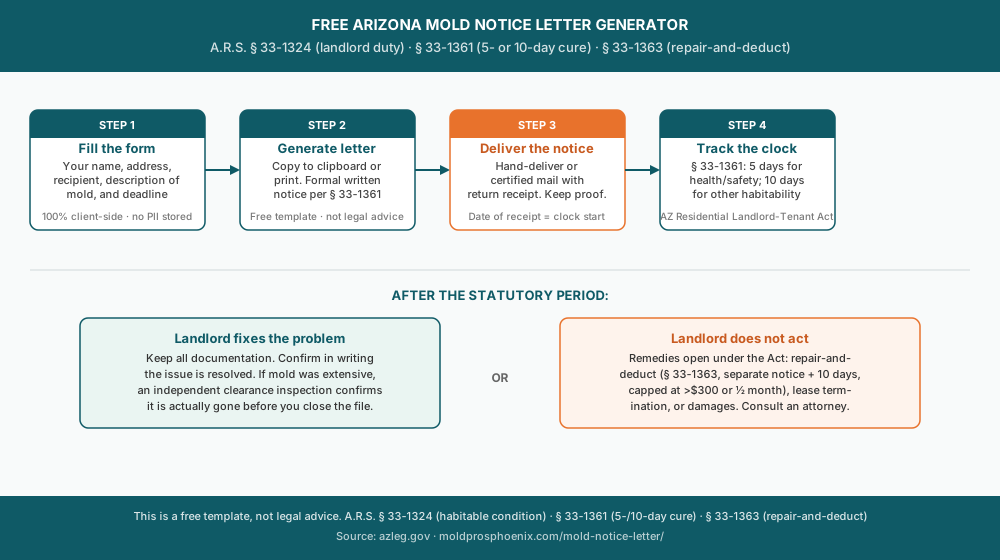
- It starts the statutory remedy period (5 days for health-and-safety conditions; 10 days for other habitability issues).
- It creates the paper trail you will need if the landlord does not act and you have to use your remedies or escalate to small-claims court or an attorney.
What Arizona law requires of a landlord
Arizona has no dedicated mold statute. Mold is handled under the general habitability duty in A.R.S. § 33-1324, which requires a landlord to:
- Keep the premises in a fit and habitable condition.
- Make all repairs necessary to maintain that condition.
- Maintain in good and safe working order the electrical, plumbing, heating, ventilating, and air-conditioning systems the landlord supplies.
- Comply with applicable building codes that materially affect health and safety.
Mold from a maintenance failure — a leaking pipe, an overflowing AC condensate line, a roof leak — fits cleanly inside that duty, even without a word about mold in the statute. The landlord who lets a leak sit until mold grows is very likely violating § 33-1324.
The three statutes you need to know
Three sections of the Arizona Residential Landlord and Tenant Act (A.R.S. Title 33, Chapter 10) cover most renter-mold situations. Here is what each one does:
| Statute | What it covers | What it means for you |
|---|---|---|
| A.R.S. § 33-1324 | Landlord's duty to maintain fit and habitable premises | The legal hook. Mold from a maintenance failure is a violation of this duty. |
| A.R.S. § 33-1361 | Tenant's written notice + landlord's cure window | Deliver written notice; landlord has 5 days for health-and-safety breach, 10 days for other habitability. This is what the generator produces. |
| A.R.S. § 33-1363 | Repair-and-deduct (a separate remedy) | A separate written notice and 10-day wait. Capped at the greater of $300 or half a month's rent. Licensed contractor required. Not the same as the § 33-1361 notice. |
One important clarification: § 33-1361 and § 33-1363 are separate procedures. Sending the notice this generator produces starts the cure clock under § 33-1361. Repair-and-deduct under § 33-1363 requires its own additional notice and waiting period and has a cost cap. Do not conflate them — doing so is a common mistake that can undermine your legal position.
How to document the problem before you send
A notice is only as strong as the record behind it. Before you send, do this:
- Take dated photos and video. Most smartphones embed GPS and timestamp in the file metadata. Capture the mold, any associated water staining, and the location in the room. More is better.
- Write down the timeline. When did you first notice the mold or smell? When did you first report it verbally? What happened after that? A one-page timeline is useful in any dispute.
- Note the source if visible. A dripping pipe, a stain on the ceiling from the unit above, or a wet area under the AC air handler is direct evidence that the problem is a maintenance failure, not tenant behavior.
- Save any related communications. If you already texted the landlord about a leak, screenshot those messages. They are evidence the landlord had prior notice of the underlying problem.
If the mold is hidden or you are not sure of the extent, a professional mold inspection in Phoenix can document it properly — including the type, location, and source — before you send notice. That documentation makes the notice harder to dismiss.
How to deliver the notice and keep proof
The date the landlord receives the notice is the date the clock starts. How you deliver it determines whether you can prove that date:
- Certified mail with return receipt requested is the standard. The postal service gives you a signed card showing the date of delivery. Keep it.
- Hand delivery with a witness works. Have someone present, and send a follow-up email the same day noting that you hand-delivered the letter, so you have a dated paper trail.
- Email only is not enough for formal legal notice in most situations, because delivery and receipt are harder to prove and the statute's intent is a physical written notice. Use email as a supplement, not a substitute.
Keep a copy of the exact letter you sent, the delivery receipt, and a record of when the deadline falls. If you do not hear anything by the deadline, that record is what you bring to an attorney or a tenant-rights organization.
What typically happens after the notice
In most cases, a landlord who receives a formal written notice citing Arizona law responds — either by scheduling a repair or by disputing the claim. Common outcomes:
- Landlord schedules the repair within the statutory period. Document the repair date and what was done. If mold was significant, confirm in writing that the work is complete. An independent clearance inspection — a follow-up mold inspection that tests air or surface samples after remediation — is the only way to confirm mold is actually gone and not just painted over.
- Landlord disputes responsibility. They may argue the mold is from tenant behavior (not ventilating, leaving moisture). Your dated photos and documented source (the leak, the AC line) are your rebuttal. This is the point to talk to an attorney.
- Landlord does not respond. After the statutory period expires with no meaningful action, your remedies under the Act open: repair-and-deduct under § 33-1363 (separate notice required), lease termination for material breach, rent withholding in certain situations, and a lawsuit for damages. Consult an attorney before taking those steps.
For a deeper look at the full Arizona tenant process and the remedies available to you, see our guide: Mold in Your Arizona Apartment & the Landlord Won't Fix It: Your Rights. It walks through every step of the playbook in detail, including the specific scenarios most common in Phoenix — AC condensate overflow, monsoon roof intrusion, and slab leaks.
If you need documentation of the mold before or after notice, a professional Phoenix mold inspection provides a written report with photos, species identification, and source attribution — exactly the kind of third-party documentation that supports a notice and is hard for a landlord to dismiss.
When to escalate: free resources in Arizona
A notice letter is the starting point, not the end. If the deadline passes with no action, or if the landlord disputes responsibility for a serious mold problem, here are Arizona resources that can help without cost:
- Community Legal Services of Arizona — free civil legal aid for low-income Arizonans, including landlord-tenant disputes.
- Arizona Department of Housing — Residential Landlord & Tenant Act — the state's official copy of the Act and tenant resources.
- Arizona State Legislature — A.R.S. Title 33 (Property) — the full statutory text so you can read § 33-1324, § 33-1361, and § 33-1363 yourself.
Browse the full Phoenix mold resource library for guides on mold identification, remediation, and costs — useful context whether you are a renter, owner, or landlord trying to understand what a proper mold repair actually involves.
Statute sources: A.R.S. § 33-1324 — Landlord duty to maintain fit and habitable premises; A.R.S. § 33-1361 — Noncompliance by landlord; tenant remedy; A.R.S. § 33-1363 — Tenant's remedy of repair and deduction for minor defects. All links to official Arizona State Legislature (azleg.gov).