How to Vet a Mold Contractor
Before you hire a mold company, a few checks tell you most of what you need: is it licensed with the Arizona ROC (there's no separate "mold license," but remediation is licensed contracting), does it carry insurance, will it put the scope in writing — and does it avoid the classic red flags the FTC and Arizona Attorney General warn about. Answer a few questions and this tool flags what to check. It scores your answers; it isn't legal advice or a judgment about any company.
Check a contractor
Good signs you reported
Questions to ask before you hire
This tool scores the answers you gave — it can't verify them, and it is not a legal opinion or a judgment about any specific company. Always confirm a contractor's license and complaint history yourself at roc.az.gov, and consult an attorney for legal questions.
The one thing to get right: Arizona licensing
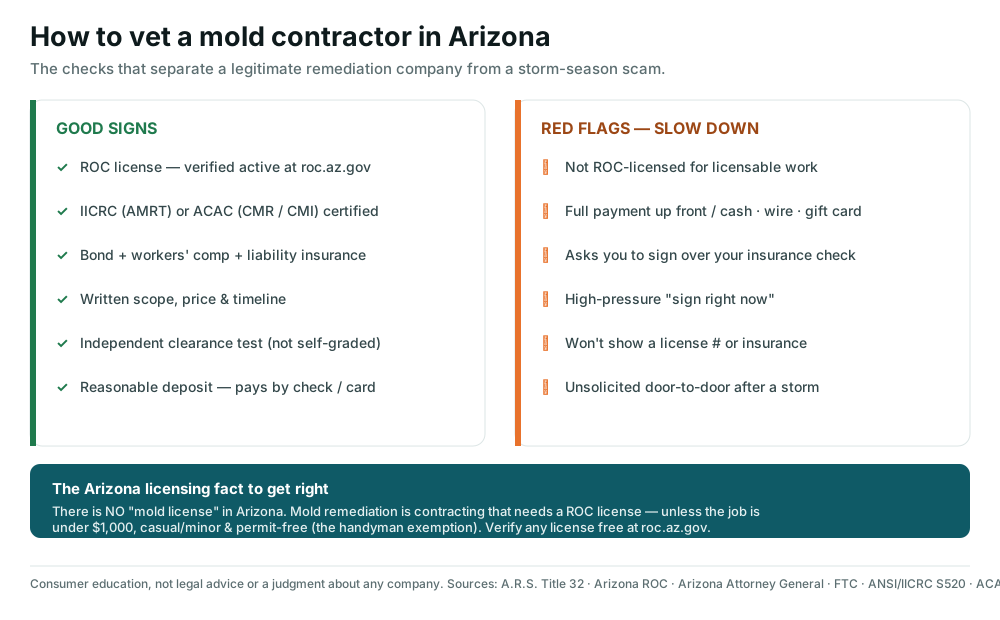
Arizona does not issue a "mold license." There is no state mold-remediation or mold-inspection license — so any company claiming a special "Arizona mold license" is describing something that doesn't exist. What Arizona does regulate is contracting. Removing water-damaged drywall, rebuilding, and altering the structure is contracting work, and under A.R.S. § 32-1151 it is unlawful to do it without an Arizona Registrar of Contractors (ROC) license unless the job is exempt.
The main exemption is the "handyman" rule in A.R.S. § 32-1121(A)(14): work whose total price — labor and materials combined — is under $1,000, is casual or minor, and needs no building permit. Most real mold-remediation jobs cost more than that or require a permit, so they fall outside the exemption and do need a licensed contractor. The practical takeaway: for anything beyond a tiny cleanup, confirm the ROC license — and you can do that free, along with any complaints, at roc.az.gov.
Serious red flags (slow down and verify)
- The company isn't licensed with the Arizona Registrar of Contractors. In Arizona there's no separate 'mold license,' but mold remediation is contracting work that requires a ROC contractor's license unless the job qualifies for the handyman exemption (under $1,000 total, casual or minor, and no building permit) — and most real remediation jobs exceed that. Doing licensable contracting work unlicensed is unlawful, so verify carefully at roc.az.gov. (A.R.S. § 32-1151 — Contracting without a license prohibited)
- They want full payment up front, or payment by cash, wire, gift card, or crypto, or they asked you to sign over your insurance check. The Arizona Attorney General says full payment should come only after the work is complete and verified, and the FTC flags exactly these payment demands as scam signals. Pay by check or credit card, and never sign your insurance check over to a contractor. (FTC — How To Avoid a Home Improvement Scam)
- They're using high-pressure, 'sign right now' tactics. The Arizona Attorney General advises not signing a contract under pressure — a legitimate company will give you time to compare quotes and think it over. (Arizona Attorney General — Consumer Alert: Beware of After-Storm Fraud)
- They won't give you a license number or proof of insurance. The FTC says to confirm a contractor's license and get proof of insurance before hiring — a refusal is a serious red flag, and you can look up the ROC license yourself at roc.az.gov. (FTC — How To Avoid a Home Improvement Scam)
- There's no written scope of work. The Arizona Attorney General is explicit that a legitimate contractor provides a written contract outlining the scope, cost, and timeline. Get it in writing before you pay anything. (Arizona Attorney General — Consumer Alert: Beware of After-Storm Fraud)
Worth confirming before you commit
- You're not sure whether they're ROC-licensed. That's easy to settle: search their business name or license number at roc.az.gov to confirm the license is active and see any complaints. (Arizona Registrar of Contractors — Verify a License)
- Insurance isn't confirmed. A licensed Arizona contractor must carry a bond and, with employees, workers' compensation; general liability isn't legally required but a solid remediation company usually carries it. Ask for proof before work starts. (A.R.S. § 32-1152 — Contractor bond requirement)
- You're not sure about insurance. Ask for proof of a contractor's bond, workers' compensation, and general liability — a legitimate company will provide it. (A.R.S. § 32-1152 — Contractor bond requirement)
- No IICRC or ACAC credential is confirmed. These are voluntary in Arizona, so their absence isn't disqualifying — but IICRC-certified (AMRT) technicians are trained to the ANSI/IICRC S520 standard, and ACAC offers third-party credentials (CMR / CMI). It's worth asking. (IICRC — ANSI/IICRC S520 Standard for Professional Mold Remediation)
- It's unclear whether an independent company does the final clearance test. Best practice under the S520 standard is that the firm doing the remediation shouldn't also grade its own work — an independent tester avoids that conflict of interest. Ask who verifies the job is done. (IICRC — ANSI/IICRC S520 Standard for Professional Mold Remediation)
- They quoted a price without inspecting. A credible remediation quote follows a look at the actual problem. Get the inspection first, and compare at least one more written estimate. (Arizona Attorney General — Consumer Alert: Beware of After-Storm Fraud)
- They showed up unsolicited, door-to-door — a common pattern after monsoon storms. It doesn't make them illegitimate, but the Arizona Attorney General warns to be extra careful with unsolicited storm-season offers: verify the license and don't sign on the spot. (Arizona Attorney General — Consumer Alert: Beware of After-Storm Fraud)
Good signs
- They're licensed with the Arizona ROC — a good sign. Still confirm the license is active and check for complaints at roc.az.gov. (Arizona Registrar of Contractors — Verify a License)
- You've identified this as a small job under the handyman exemption (under $1,000, casual/minor, no permit). That's legitimate — just make sure it truly meets all three, since most remediation work doesn't. (A.R.S. § 32-1121(A)(14) — Handyman exemption (under $1,000))
- They employ IICRC-certified (AMRT) technicians — trained to the recognized ANSI/IICRC S520 mold-remediation standard. (IICRC — ANSI/IICRC S520 Standard for Professional Mold Remediation)
- Insurance is confirmed. Good — a licensed Arizona contractor should carry a bond and workers' comp, plus general liability. (A.R.S. § 32-1152 — Contractor bond requirement)
- They provide a written scope of work — exactly what the Arizona Attorney General says a legitimate contractor does. (Arizona Attorney General — Consumer Alert: Beware of After-Storm Fraud)
- They support an independent clearance test — avoiding the conflict of a firm grading its own remediation. (IICRC — ANSI/IICRC S520 Standard for Professional Mold Remediation)
Questions to ask before you hire
- "What's your ROC license number?" — then verify status and complaints at roc.az.gov. (Arizona Registrar of Contractors — Verify a License)
- "Can I see proof of insurance?" — bond, workers' compensation, and general liability. (FTC — How To Avoid a Home Improvement Scam)
- "Are your technicians IICRC-certified (AMRT), or do you hold an ACAC CMR/CMI?" (IICRC — ANSI/IICRC S520 Standard for Professional Mold Remediation)
- "Will you put the full scope of work, price, and timeline in writing before I pay?" (Arizona Attorney General — Consumer Alert: Beware of After-Storm Fraud)
- "Who does the final clearance test?" — an independent company is best. (IICRC — ANSI/IICRC S520 Standard for Professional Mold Remediation)
- "What's the deposit, and how do you take payment?" — never full up front, and never by wire, gift card, cash, or by signing over your insurance check. (FTC — How To Avoid a Home Improvement Scam)
Vetting is one half of hiring well; fair pricing is the other. For how to read an estimate and spot fair Phoenix pricing, see the honest mold remediation quotes guide.
Frequently asked questions
Do you need a license to do mold remediation in Arizona?
There is no mold-specific license in Arizona — the state does not issue a "mold remediation license." But mold remediation is contracting work, and Arizona requires a Registrar of Contractors (ROC) contractor’s license for contracting unless the job qualifies for the handyman exemption: under $1,000 total (labor and materials), casual or minor, and needing no building permit. Most real remediation jobs exceed that, so they require a licensed contractor. You can verify any license free at roc.az.gov.
How do I check if a mold contractor is licensed in Arizona?
Search the company’s business name or license number free at the Arizona Registrar of Contractors (roc.az.gov). You’ll see whether the license is active, its classification and bond, the qualifying party, and any complaints or disciplinary history. The Arizona Attorney General directs consumers here to confirm a license is valid before hiring.
What certifications should a mold remediation company have?
Credentials are voluntary in Arizona, so their absence is not disqualifying — but the recognized ones are worth asking about. IICRC certifies technicians (the AMRT, Applied Microbial Remediation Technician) trained to the ANSI/IICRC S520 standard, the consensus standard for professional mold remediation. The ACAC (American Council for Accredited Certification) offers third-party credentials — the Council-certified Microbial Remediator (CMR) and Investigator (CMI).
What are the red flags of a mold remediation scam?
The FTC and Arizona Attorney General flag these: demanding full payment up front, or payment by cash, wire, gift card, or crypto; asking you to sign over your insurance check; high-pressure "sign right now" tactics; unsolicited door-to-door offers after a storm; quoting a price without inspecting; and refusing to give a license number or proof of insurance. None proves wrongdoing on its own, but each is a reason to slow down and verify.
Should the same company test and remediate the mold?
Best practice under the ANSI/IICRC S520 standard is no. The company doing the remediation should not also perform the final clearance test, because grading its own work is a conflict of interest. An independent tester or Indoor Environmental Professional handling the verification is the stronger arrangement.
Want a contractor that clears every check?
Get a free, no-obligation Phoenix mold assessment
Straight answers, a written scope, and no pressure — the opposite of the red flags above. Get a fast, free assessment of what you're dealing with and what it takes to handle it right.
Sources
- A.R.S. § 32-1151 — Contracting without a license prohibited
- A.R.S. § 32-1121(A)(14) — Handyman exemption (under $1,000)
- Arizona Registrar of Contractors — Verify a License
- A.R.S. § 32-1152 — Contractor bond requirement
- A.R.S. § 32-1158.02 — Post-storm residential contracts; 50% down-payment limit
- Arizona Attorney General — Consumer Alert: Beware of After-Storm Fraud
- FTC — How To Avoid a Home Improvement Scam
- FTC — How To Avoid Scams After Weather Emergencies and Natural Disasters
- IICRC — ANSI/IICRC S520 Standard for Professional Mold Remediation
- ACAC — Microbial (Mold) Remediation & Investigation Certifications