Documented mold illness cases: a sourced reference for journalists and researchers
This is a primary-source catalog of documented mold illness cases, outbreaks, legal verdicts, and institutional events. Every case carries a primary-source citation — a coroner's finding, a court record, a peer-reviewed publication, or a mainstream news report. It is not medical advice, not legal opinion, and not an editorial argument. It is the raw evidence underlying our companion piece, Is Mold Illness Real?, formatted so that journalists, researchers, homeowners, and attorneys can cite specific cases directly. For this same record organized by date, see our mold illness scientific timeline. Free to reference with attribution.

How to use this reference
Cite this as you would a research desk. Each case card is structured around four elements:
- What happened — the factual timeline, sourced to the primary record.
- Medically documented health facts — what was recorded in a coroner's report, a clinical file, or mainstream journalism. Patient-reported symptoms are labeled as such; judicial or pathological findings are labeled as such. These are not the same thing.
- Legal outcome — with explicit notation of what was and was not adjudicated. A settlement does not establish medical causation. A property verdict does not establish medical causation. These distinctions matter enormously for anyone citing these cases in a legal, journalistic, or academic context.
- Primary source URLs — every case cites the document it rests on. Where a case rests partly on a secondary summary (such as a Grok/AI summary of court records), that limitation is flagged.
What this reference establishes and what it does not: it documents that these cases exist in the record. It does not argue that all mold-illness claims are proven to a clinical or courtroom standard. The honest picture — which includes significant contested territory — is in our companion piece Is Mold Illness Real?. This page is the evidence; that page is the analysis.
For the data and methodology underlying Phoenix-specific mold risk, see our Phoenix Mold Risk by City dataset and research methodology page.
Fatal cases and outbreaks
Awaab Ishak — Rochdale, England (2017–2022)
What happened
Two-year-old Awaab Ishak lived in a social-housing flat managed by Rochdale Boroughwide Housing (RBH). His family began reporting mold to RBH in 2017. RBH failed to act adequately. Awaab was admitted to Royal Oldham Hospital on December 19, 2020, and died on December 21, 2020. He was two years old.
Medically documented findings
Post-mortem examination by Dr. Philip Lumb found Awaab's throat, windpipe, and airways swollen and congested, with evidence of fungus in his blood and lungs. A council building surveyor who inspected the flat two days after Awaab's death stated it was not fit for human habitation without repairs.
Senior Coroner Joanne Kearsley concluded the inquest on November 15, 2022. Her recorded cause of death:
"Acute airway oedema with severe granulomatous tracheobronchitis due to environmental mould exposure."
— Senior Coroner Joanne Kearsley, HM Coroner for Greater Manchester North, November 15, 2022
Legal and regulatory outcome
RBH's chief executive, Gareth Swarbrick, was dismissed. The UK Parliament passed Awaab's Law as part of the Social Housing (Regulation) Act 2023, requiring social-housing providers to remedy reported damp and mold within specified timeframes. Phase 1 rollout began October 27, 2025. It is now statute.
The Regulator of Social Housing investigated RBH and published findings of "widespread failings on damp and mould." The coroner's conclusion was based on pathology — fungal presence confirmed in blood and lungs, airway inflammation consistent with environmental mold exposure — not contested expert opinion on mechanism.
What this case establishes
This is the strongest single global citation for the proposition that residential mold exposure can be fatal. The causal finding rests on a coroner's legal conclusion supported by post-mortem pathology, confirmed by a formal regulatory investigation, and responded to by parliamentary statute. It requires no hedge on mechanism.
Primary sources: Wikipedia — Death of Awaab Ishak, en.wikipedia.org/wiki/Death_of_Awaab_Ishak (coroner's finding, regulatory action, Awaab's Law) · Lancet eClinicalMedicine editorial (2022), thelancet.com · Regulator of Social Housing, gov.uk · GCN Chambers inquest report, gcnchambers.co.uk — all accessed 2026-07-03
Kenya Aflatoxicosis Outbreak — Eastern and Central Kenya (April 2004)
What happened
In April 2004, one of the largest aflatoxicosis outbreaks on record struck rural Kenya. Aflatoxin B₁ — a mycotoxin produced by Aspergillus flavus and A. parasiticus — contaminated homegrown maize during a period of unusual storage conditions. Samples of the contaminated grain carried aflatoxin levels measured at up to 4,400 parts per billion — 220 times the 20 ppb Kenyan food safety limit. (The U.S. FDA's action level for total aflatoxins in human food is the same 20 ppb.)
Medically documented findings
The outbreak produced 317 cases and 125 confirmed deaths, for a case-fatality rate of approximately 39%. A case-control study confirmed household-level exposure to aflatoxin-contaminated maize as the independent risk factor. The clinical presentation was acute hepatitis progressing to fulminant liver failure. CDC and WHO investigators participated in the response.
What this case establishes — and what it does not
This is the clearest peer-reviewed proof that fungal mycotoxins can produce fatal acute human disease at measurable dose. It forecloses the argument that "mycotoxins don't affect humans." They demonstrably do, at sufficient concentration.
It does not establish that airborne mycotoxin inhalation in homes causes the same pathology at the concentrations typically measured in residential settings. Food-borne aflatoxicosis and hypothesized residential inhalation exposure are different exposure pathways at different concentrations. The distinction belongs in any citation of this case.
Primary sources: Lewis L et al. (2005), "Aflatoxin Contamination of Commercial Maize Products during an Outbreak of Acute Aflatoxicosis in Eastern and Central Kenya," Environ Health Perspect, PMC1314917 · Case-control study, PMC1314920 · CDC/WHO workgroup report — accessed 2026-07-03
Cleveland Infant Pulmonary Hemorrhage Cluster — Eastern Metropolitan Cleveland, Ohio (1993–1998)
What happened
Between January 1993 and December 1998, 37 infants in the Cleveland metropolitan area — predominantly African American families in older housing stock in eastern Cleveland — were diagnosed with acute idiopathic pulmonary hemorrhage and hemosiderosis (AIPHI). Twelve died; seven others were initially classified as SIDS. The cluster was concentrated in a specific geographic area with a high rate of home water damage.
The CDC investigation — two phases
A 1994 CDC MMWR initial report identified major home water damage as a risk factor. Subsequent work by the Rainbow Children's Hospital team — Dr. Dorr Dearborn and colleagues — found Stachybotrys chartarum in a higher proportion of case homes than control homes and proposed the mold as an etiologic factor. This work received national attention as an early claim that residential mold could cause infant fatalities.
In 1999 the CDC convened a review panel that found significant methodological shortcomings in the original investigation. The CDC's 2000 MMWR update concluded that "a possible association between acute pulmonary hemorrhage/hemosiderosis in infants and exposure to molds, specifically Stachybotrys chartarum, was not proven." The 2004 Institute of Medicine review categorized the evidence for AIPHI and Stachybotrys as "inadequate/insufficient" — the IOM's category for research where the base is too thin to draw a conclusion, not where a contrary finding has been made.
What this case establishes and what it does not
The Cleveland cluster is a landmark in pediatric mold research. It does not establish that Stachybotrys chartarum caused the deaths. The correct citation is: "A cluster of 37 infants with acute idiopathic pulmonary hemorrhage in Cleveland between 1993 and 1998 — 12 deaths — was investigated by CDC and Rainbow Children's Hospital researchers. Early work associated the cluster with water damage and Stachybotrys exposure; the CDC's 2000 reanalysis concluded the evidence was insufficient to prove the mold link; the 2004 IOM review classified the evidence as inadequate." Both halves of that sentence belong together.
Primary sources: Original 1994 CDC MMWR, PubMed 7969010 · CDC 2000 MMWR reanalysis, PubMed 11795499 · Overview of Cleveland investigations, PMC1566217 · JAMA Pediatrics on AIPHI and Stachybotrys, jamanetwork.com · IOM (2004), Damp Indoor Spaces and Health, NBK215639 — accessed 2026-07-03
Big verdicts and landmark legal cases
A preliminary note for anyone citing these cases: U.S. mold litigation has produced large verdicts and settlements — but the legal distinction between a property damage verdict and a judicial finding of medical causation is critical. Courts applying the Daubert standard (federal) or state equivalents (Texas's Robinson standard) have frequently excluded or limited expert medical testimony on mold-health causation because it did not meet the required scientific reliability threshold. This does not mean the illness did not occur; it means the gap between clinical observation and courtroom-admissible scientific proof has not been closed. The cases below are documented with this distinction explicit.
Ballard v. Fire Insurance Exchange — Travis County, Texas (Verdict June 1, 2001)
What happened
Mary Melinda Ballard, her husband Ronald Allison, and their three-year-old son Reese Allison lived in an 11,000-square-foot home in Dripping Springs, Texas. A 1998 bathroom plumbing leak caused hardwood floors to buckle; a flooring contractor warned Farmers-affiliated Fire Insurance Exchange about probable mold growth in December 1998, but the insurer failed to act. By early 1999 the family had become ill. In April 1999, on a Southwest Airlines flight, Melinda Ballard began coughing up blood; an air-quality expert seated nearby suggested toxic mold as a cause. The home was subsequently found to be extensively contaminated with Stachybotrys chartarum.
Reported symptoms
- Reese Allison (age 3 at time of onset): unexplained respiratory condition, seizures, coughing blood, equilibrium loss, severe digestive issues — documented in trial testimony and subsequent reporting.
- Ronald Allison: memory loss, breathing difficulty, cognitive decline described as Alzheimer's-like — documented in CBS News and Texas Monthly reporting.
- Melinda Ballard: coughing blood, chronic fatigue, dizziness, eye irritation upon entering specific rooms — documented in trial testimony and her own congressional testimony.
Jury verdict and appeal
On June 1, 2001, a Travis County jury returned a verdict of $32,147,525. The breakdown per Insurance Journal's cover story: $6.2 million actual damages, $12 million punitive damages, $5 million mental anguish, $8.9 million attorney fees. On appeal, the Texas Court of Appeals reduced the verdict to approximately $4 million net, with a confidential settlement following.
What the trial court did and did not find
This is the critical honest detail for citation purposes. Trial Judge John Dietz excluded the personal-injury and health-effects claims because the plaintiffs' medical expert testimony did not meet the Texas Supreme Court's Robinson reliability standard for scientific evidence — a standard roughly equivalent to the federal Daubert standard. The jury's award was for property damage and insurance bad-faith claims handling, not for judicially established mold-caused illness. Epidemiologist Robert Haley of UT Southwestern Medical Center, reviewing the proposed neurodegeneration and pulmonary hemorrhage attributions, described them as "purely conjectural." The verdict was landmark for insurance accountability; it was not a judicial finding that mold caused the Allison family's medical conditions.
Aftermath
Melinda Ballard testified before the U.S. House Financial Services Subcommittee's "Mold: A Growing Problem" hearing in 2002 and founded Policyholders of America. Melinda Ballard died in 2013. Ron Allison and Reese Allison both died in 2021.
Primary sources: Allison v. Fire Insurance Exchange, Texas Court of Appeals 2002, FindLaw · Insurance Journal cover story (June 2001), insurancejournal.com · Wikipedia — Melinda Ballard, en.wikipedia.org/wiki/Melinda_Ballard · Texas Monthly, "Mold Age," texasmonthly.com · CBS News, "An Insidious Mold," Jan. 31, 2002, cbsnews.com — accessed 2026-07-03
Baehr v. Woods Comfort Systems — Travis County, Texas (August 2023)
What happened
Kristina Baehr, then a DOJ attorney, lived in an Austin home with her husband and four young children. For approximately two years she experienced dizziness, blurred vision, profound brain fog, and exhaustion. Her description to CNBC: "drunken-like wooziness in the middle of the day." Her physician, Dr. Gabriela Pichardo, found elevated mycotoxin levels in her body. Home testing confirmed mold contamination.
Documented cause
Investigation identified two contributing failures. First: Woods Comfort Systems had installed an oversized HVAC unit in the home. An oversized unit short-cycles — it reaches the thermostat setpoint quickly, shuts off, and cycles on again — instead of running longer, more sustained cycles that allow the system to dehumidify properly. Short-cycling creates chronic condensation and elevated indoor humidity. Second: a faulty roof repair introduced additional moisture. Mold colonized the walls, HVAC system, and living spaces.
Symptoms across the household
- Kristina Baehr: dizziness, blurred vision, brain fog, exhaustion, morning skin rashes — documented in CNBC and Newsweek reporting.
- Four children: one son with sinus complications; one son with developmental delays; one daughter sleeping within feet of black mold behind a wall, exhibiting erratic mood swings and anxiety — documented in CNBC reporting.
Verdict
An Austin jury in August 2023 awarded approximately $3.1 million. Woods Comfort Systems was found 40% liable. The verdict included approximately $700,000 in exemplary damages and $390,000 in attorney fees. Multiple mainstream outlets — CNBC, Newsweek, the Texas Lawbook, Fox59 — covered the verdict. Kristina Baehr subsequently left DOJ and founded Just Well Law to represent mold-injured families.
Why this case matters specifically for Phoenix
The mechanism — an oversized, short-cycling AC unit creating chronic condensation and mold — is the same mechanism that operates in Phoenix homes throughout the May-to-September cooling season. Phoenix HVAC systems run near-continuously during summer; condensate drains that clog, overflow pans that back up, and ductwork with broken vapor barriers are standard hidden moisture sources in Valley homes. The Baehr verdict is not an exotic edge case. It is the AC-condensate mold vector, documented with a jury finding and an award. For more on this mechanism in Phoenix, see our mold inspection and remediation pages.
Primary sources: Texas Lawbook, verdict coverage (2023), texaslawbook.net · CNBC, "Toxic mold forced a Texas family to flee their home" (Dec. 15, 2021), cnbc.com · Newsweek (2024), newsweek.com — accessed 2026-07-03

Ed McMahon v. American Equity Insurance Co. — Beverly Hills, California (Settlement March 21, 2003)
What happened
Tonight Show sidekick Ed McMahon filed suit in April 2002, alleging toxic mold spread through his Beverly Hills home following a burst pipe that contractors and his insurer failed to properly remediate. Ed and wife Pamela became ill; household staff also became ill. McMahon attributed the death of his dog, Muffin, to the mold.
Outcome
On March 21, 2003, McMahon received a settlement of $7.2 million from multiple defendants — including the insurer, adjusters, and remediation contractors found to have allowed the mold situation to persist. Because the case settled, no medical-causation findings were entered on the record by a court. The $7.2 million represents contractor negligence and property damage liability, not a judicial finding that mold caused specific illness.
Primary sources: ACHR News, "Mold Lawsuit by Ed McMahon Settled for $7.2 Million" (May 14, 2003), achrnews.com · ABC News, abcnews.go.com — accessed 2026-07-03
Erin Brockovich — Agoura Hills, California (~2001–2003)
What happened
Environmental activist Erin Brockovich purchased a home in Agoura Hills with settlement proceeds from the PG&E case. Water damage caused Stachybotrys to colonize the walls. Her husband Eric Ellis and her 10-year-old daughter Elizabeth suffered respiratory problems; Brockovich described the episode as lasting approximately 18 months. Remediation cost exceeded $500,000.
Outcome
Brockovich settled with two parties for approximately $430,000, plus an undisclosed additional settlement from a third party. Because it was a settlement, no judicial finding on medical causation was entered. Brockovich testified in California state court urging mold legislation and later used the personal experience to shape her environmental advocacy work.
Primary sources: ABC News, "Real Brockovich Mad at Mold," abcnews.go.com · CBS News, "Silent Killers: Toxic Mold," cbsnews.com · Mold-Help.org, mold-help.org — accessed 2026-07-03
Public figure accounts
The following accounts come from named public figures who have spoken or testified publicly about their mold illness experiences. They are documented in mainstream media, court records, or congressional testimony. They are cited here as what they are: documented lived-experience accounts, not peer-reviewed clinical findings. The symptom clusters they describe are consistent with what the medical literature and legal record document in other contexts — but that consistency is not the same as clinical proof of causation.
Candace Owens — Stamford, Connecticut (Onset ~2015–2016, Lawsuit 2017)
What happened
Conservative commentator Candace Owens has spoken publicly about a mold illness episode she attributes to an HVAC leak in her Stamford, Connecticut apartment building. Her most detailed account is from the Shawn Ryan Show, Episode 318. She stopped paying $3,550 per month in rent in 2016 and sued her landlord in 2017, citing mold-related health issues.
Verbatim symptom account
Owens's words, as transcribed from the Shawn Ryan Show, Episode 318:
"I had head-to-toe overnight eczema. I had never had eczema. Athlete's foot. My eyes were red and just kept pussing."
— Candace Owens, Shawn Ryan Show Ep. 318
"The worst part was my brain… you can't think… if you ever had brain fog, imagine the most intense brain fog."
— Candace Owens, Shawn Ryan Show Ep. 318
She also described two asthma attacks requiring hospital-level care and a recovery period of approximately one year involving a strict low-sugar diet.
Legal outcome
Per a Grok summary of Stamford court records (note: this summary has not been independently verified against the original court docket at the time of this compilation — flag this limitation in any legal citation): Owens lost the case, not because her symptoms were disproved, but because she could not produce a qualifying medical expert witness to meet the court's evidentiary standard. She was ordered to pay approximately $17,719.90 in back rent plus approximately $3,300 in fees. The counterclaim confirms a mold-related dispute occurred in a Stamford court — the details of the legal outcome should be independently verified from the Stamford Superior Court docket before citation in a legal brief.
What to note in citation
Owens is politically polarizing; her case is documented here without editorial framing on that dimension. The symptom cluster she describes — rapid-onset eczema, eye discharge, athlete's foot, intense cognitive impairment, and severe asthma — tracks what both mainstream literature (atopic dermatitis exacerbated by mold, fungal skin infections in moisture-stressed conditions) and the contested CIRS cluster describe for mold-exposed patients. The legal loss reflects the state of expert-witness availability in mold-illness litigation, not a judicial determination that the symptoms did not occur.
Primary sources: Shawn Ryan Show Ep. 318 transcript, podcasts.happyscribe.com · Grok/X court records summary (not independently verified), x.com/grok · Owens Instagram reel, instagram.com — accessed 2026-07-03
Sandra Bullock — Lake Austin, Texas (~2004)
What happened
Bullock purchased a 10,000-square-foot Lake Austin home for $7 million and moved out after two nights, citing documented defects including water damage, a defective roof, wiring problems, holes in masonry, and toxic mold. She testified she never lived in the house.
Outcome
A jury returned a $7 million verdict against the builder. The case is documented in court records as a construction-defect and property-damage claim; the symptom story — because Bullock did not live in the home — is not the primary narrative here. The case documents mold as a documented construction defect warranting a multi-million dollar verdict.
Note: Specific court citation not independently verified at the time of this compilation. Aggregate celebrity-case sources reference this verdict; independent verification from court records is recommended before citation in a legal brief.
Recent journalism-documented individual cases
The following cases are documented in named mainstream outlets — Newsweek and a local ABC affiliate — with named individuals. They represent the "diagnostic odyssey" and "hidden residential mold" patterns that appear across the mold-illness literature. They are not peer-reviewed clinical case series; they are documented journalism. As with public figure accounts, they are cited as what they are.
Lauren Lowenstein family — Houston, Texas (Newsweek, 2024)
A 35-year-old Houston mother, her husband Logan, and two young sons. The family lived in their home for approximately five years before symptoms appeared; ERMI dust testing found elevated mold and inspection identified colonies under the master shower and in walls from HVAC condensation. Reported symptoms across the family included hair loss, insomnia, leg cramps, migraines, heart palpitations, fatigue, IBS, body hives, behavioral changes, brain fog, skin issues, depression, difficulty breathing, and severe allergies. Remediation cost approximately $135,000 for the original work and $150,000 in restoration; insurance covered approximately $3,000.
The HVAC-condensation mechanism identified — moisture from air conditioning intrusion accumulating inside wall cavities — is the same mechanism documented in the Baehr verdict and is a direct parallel to Phoenix HVAC-condensate mold scenarios.
Primary source: Newsweek (2024), newsweek.com — accessed 2026-07-03
Laura Schaeffer — Pennsylvania (Newsweek, 2025)
Schaeffer, 34, moved into a 100-year-old Pennsylvania farmhouse in her early twenties. It took approximately 12 years to receive a mold-related diagnosis. Documented symptoms during that period included UTI-like symptoms without confirmed infection, unexplained fevers, fatigue, cognitive fog, extreme alcohol sensitivity, frequent viral infections, severe menstrual pain, rectal bleeding, abdominal pain, diarrhea, heart palpitations, food sensitivities, air hunger, and weight loss. She underwent multiple colonoscopies, endoscopy, MRIs, CT scans, and a hysterectomy before mold was identified as a contributing factor.
Her treating physician, Dr. Ehsan Ali (internal/geriatric medicine), is quoted in the Newsweek piece: "Mold toxicity is real. It doesn't always look dramatic, but it can completely derail someone's life." Schaeffer reported verbatim: "I haven't had a single rectal bleeding flare in three months — after years of nearly constant suffering." The Schaeffer case exemplifies the "12-year diagnostic odyssey" pattern documented across multiple individual mold-illness accounts.
Primary source: Newsweek (2025), newsweek.com — accessed 2026-07-03
Kendall and Stephen Early — Hoover, Alabama (WBRC, 2025)
Kendall and Stephen Early purchased their Hoover home in 2022. One month after moving in, their daughter developed a persistent cough. Subsequently, Stephen developed adult-onset asthma. Kendall developed stroke-like symptoms including dizziness, balance problems, and seizures; she was initially evaluated for epilepsy and multiple sclerosis before mold was identified.
Testing found four types of toxic mold at 500 times normal levels, hidden in walls, roof decking, subfloor, and the HVAC system. The home was a total loss for the family; six-figure remediation costs were required just to make it livable; insurance excluded mold. The adult-onset asthma and stroke-like neurological presentation — documented in a mainstream local television news report — is consistent with the "newly reported asthma + neurological symptoms in previously healthy adults" pattern that appears across mold-illness accounts.
Primary source: WBRC, "Couple loses everything, experiences major health complications after toxic mold found in home" (Feb. 6, 2025), wbrc.com — accessed 2026-07-03
The ACOEM 2003 paper retirement — an institutional-integrity event
This is not a "case" in the sense of an individual illness story, but it is a documented institutional event with significant implications for how the mainstream skeptical position on mold-related illness should be cited.
In 2003, the American College of Occupational and Environmental Medicine (ACOEM) published a position paper that concluded: "Current scientific evidence does not support the proposition that human health has been adversely affected by inhaled mycotoxins in the home, school, or office environment." For the following several years, this paper was the most-cited institutional document used to oppose mold-illness claims in litigation and in medical contexts.
In 2008, Kelman B and colleagues published a peer-reviewed critique in the International Journal of Occupational and Environmental Health documenting undisclosed conflicts of interest between several of the paper's authors and insurance defense work. The critique identified that multiple authors had financial relationships with insurance-industry clients that were not disclosed in the paper.
ACOEM subsequently retired the paper from its active statement list. As of 2026, the 2003 ACOEM paper is not a current ACOEM position. The current mainstream toxicology position on this question is found in the American College of Medical Toxicology's 2025 position statement, which takes a substantially more specific and evidence-limited stance than the sweeping 2003 ACOEM conclusion.
The honest summary for citation purposes: the mainstream skeptical position has shifted since 2003. Anyone citing the ACOEM 2003 paper as the current mainstream view is citing a retired document with a documented conflict-of-interest history. This does not validate the CIRS clinical framework; it means the specific ACOEM 2003 paper cannot honestly be used as the settled mainstream position.
The current authoritative mainstream documents are the IOM 2004 report, the WHO 2009 guidelines, and the ACMT 2025 position statement. For context on what those frameworks accept and where they are uncertain, see our companion article Is Mold Illness Real?
Primary sources: Kelman B et al. (2008), Int J Occup Environ Health, tandfonline.com · NMHC overview of ACOEM statement history, nmhc.org · ACMT (2025) position statement, acmt.net — accessed 2026-07-03
Documented cases timeline
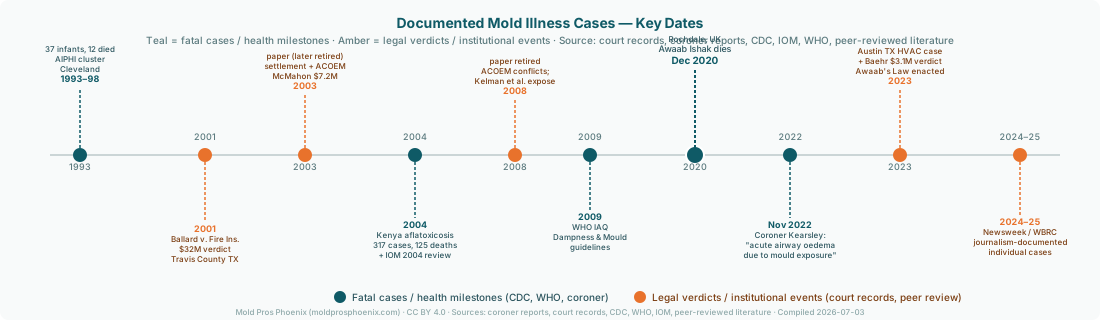
How to cite this reference
This reference is free to cite with attribution. Cite specific case cards directly. Every load-bearing fact has a primary source URL; cite from the primary source, not from this page, wherever possible — this page is a finding aid, not a primary source.
Mold Pros Phoenix. "Documented Mold Illness Cases: A Sourced Reference for Journalists and Researchers." moldprosphoenix.com. Published July 3, 2026. https://moldprosphoenix.com/documented-mold-illness-cases/
Attribution language: Source: Mold Pros Phoenix (moldprosphoenix.com). This reference is licensed CC BY 4.0 — free to cite with attribution.
For journalists: If you use material from this reference in an article or report, we ask only that you verify any legal claims against the primary court record (links provided in each case card) and flag any limitations we flag — particularly around the Owens legal outcome, which rests on an AI-generated court summary rather than a direct court docket pull.
For attorneys: This reference is a research starting point, not a legal brief. Case details — especially verdict amounts, reduction amounts, and specific judge and expert citations — should be verified against the primary court record before use in any legal proceeding.
For researchers: The research files underlying this reference are available at our data and sources page. Our full methodology for source selection and citation is at our methodology page. This reference and its companion articles Is Mold Illness Real? and the mold illness scientific timeline are also listed in our press and data assets alongside our Phoenix-specific mold risk data.
For related health guidance — the symptom picture and what to do about it — see our guides on what mold sickness actually feels like and whether black mold is dangerous.
Sources
Coroner and government records
- HM Coroner for Greater Manchester North (Joanne Kearsley), Awaab Ishak inquest, November 15, 2022. Via Wikipedia — Death of Awaab Ishak, en.wikipedia.org/wiki/Death_of_Awaab_Ishak — accessed 2026-07-03
- Regulator of Social Housing — investigation findings re Rochdale Boroughwide Housing. gov.uk — accessed 2026-07-03
- GCN Chambers inquest summary. gcnchambers.co.uk — accessed 2026-07-03
- UK Social Housing (Regulation) Act 2023 — Awaab's Law. UK government statute.
Court records and legal reporting
- Allison v. Fire Insurance Exchange, Texas Court of Appeals 2002. FindLaw — accessed 2026-07-03
- Insurance Journal, "Texas Jury Awards $32 Million in Mold Proliferation Case" (June 2001). insurancejournal.com — accessed 2026-07-03
- Wikipedia — Melinda Ballard. en.wikipedia.org/wiki/Melinda_Ballard — accessed 2026-07-03
- Texas Lawbook — Baehr v. Woods Comfort Systems verdict (2023). texaslawbook.net — accessed 2026-07-03
- ACHR News, "Mold Lawsuit by Ed McMahon Settled for $7.2 Million" (May 2003). achrnews.com — accessed 2026-07-03
Peer-reviewed and federal agency sources
- Lewis L et al. (2005). "Aflatoxin Contamination of Commercial Maize Products during an Outbreak of Acute Aflatoxicosis in Eastern and Central Kenya." Environ Health Perspect. PMC1314917 — accessed 2026-07-03
- Case-control study — Kenya aflatoxicosis. PMC1314920 — accessed 2026-07-03
- CDC MMWR (1994) — initial Cleveland AIPHI report. PubMed 7969010 — accessed 2026-07-03
- CDC MMWR (2000) — Cleveland AIPHI reanalysis. PubMed 11795499 — accessed 2026-07-03
- Overview of Cleveland AIPHI investigations. PMC1566217 — accessed 2026-07-03
- JAMA Pediatrics — AIPHI and Stachybotrys. jamanetwork.com — accessed 2026-07-03
- Institute of Medicine (2004). Damp Indoor Spaces and Health. NCBI Bookshelf NBK215639. ncbi.nlm.nih.gov/books/NBK215639 — accessed 2026-07-03
- WHO Regional Office for Europe (2009). WHO Guidelines for Indoor Air Quality: Dampness and Mould. NCBI Bookshelf NBK143940. ncbi.nlm.nih.gov/books/NBK143940 — accessed 2026-07-03
- Kelman B et al. (2008). ACOEM conflict-of-interest critique. Int J Occup Environ Health. tandfonline.com — accessed 2026-07-03
- ACMT (2025). Position statement on mold-related inhalation exposures. acmt.net — accessed 2026-07-03
- CDC MMWR (2015). "Use of Unvalidated Urine Mycotoxin Tests." cdc.gov/mmwr mm6406a7 — accessed 2026-07-03
- Lancet eClinicalMedicine editorial (2022) — Awaab Ishak and the politics of mould in the UK. thelancet.com — accessed 2026-07-03
Mainstream journalism sources
- CBS News, "An Insidious Mold" (Jan. 31, 2002). cbsnews.com — accessed 2026-07-03
- Texas Monthly, "Mold Age" (Skip Hollandsworth). texasmonthly.com — accessed 2026-07-03
- ABC News, "Real Brockovich Mad at Mold." abcnews.go.com — accessed 2026-07-03
- CNBC, "Toxic mold forced a Texas family to flee their home" (Dec. 15, 2021). cnbc.com — accessed 2026-07-03
- Newsweek — Lauren Lowenstein (2024). newsweek.com — accessed 2026-07-03
- Newsweek — Laura Schaeffer (2025). newsweek.com — accessed 2026-07-03
- WBRC — Kendall and Stephen Early (Feb. 6, 2025). wbrc.com — accessed 2026-07-03
- Shawn Ryan Show Ep. 318 — Candace Owens transcript. podcasts.happyscribe.com — accessed 2026-07-03
- Mold-Help.org — Erin Brockovich. mold-help.org — accessed 2026-07-03
- NMHC overview — ACOEM mold statement history. nmhc.org — accessed 2026-07-03
Mold in your Phoenix home is the first problem to solve
Whatever this evidence means for your specific situation, the first step is always the same: find out whether your home has a mold problem. A professional inspection tells you what you're dealing with — before it gets worse.