What Size Dehumidifier Do I Need?
Tell us the room size and how damp it feels and this free calculator gives you the pints-per-day range from the current Energy Star sizing chart. It also gives you the answer the retailer charts skip: in Phoenix's dry climate, your air conditioner may already be doing the job, so you might not need one at all.
Size your dehumidifier
This is a sizing guide based on the current Energy Star chart, not an exact engineering calculation, and not a diagnosis. Sizing depends on air-sealing, ceiling height, and use, so when you are between two sizes, go up. A dehumidifier treats humid air; it does not fix a leak or existing mold.
How dehumidifier sizing works
Dehumidifier capacity is measured in pints per day, which is how much water it pulls from the air in 24 hours. You size it two ways at once: how big the space is, and how damp it feels. Bigger and damper means more pints. There is no official "pints per square foot" formula (the "1 pint per 50 sq ft" line you will see is a rule of thumb, not a standard), so the honest output is a range, not a single number. When you land between two sizes, go up.
The point of sizing it right is not the number itself; it is the goal. The EPA says to keep indoor humidity below 60%, and "Indoor relative humidity (RH) should be kept below 60 percent -- ideally between 30 percent and 50 percent, if possible." A dehumidifier is just the tool for holding a space in that range when air conditioning alone can't.
Dehumidifier sizing chart (current Energy Star standard)
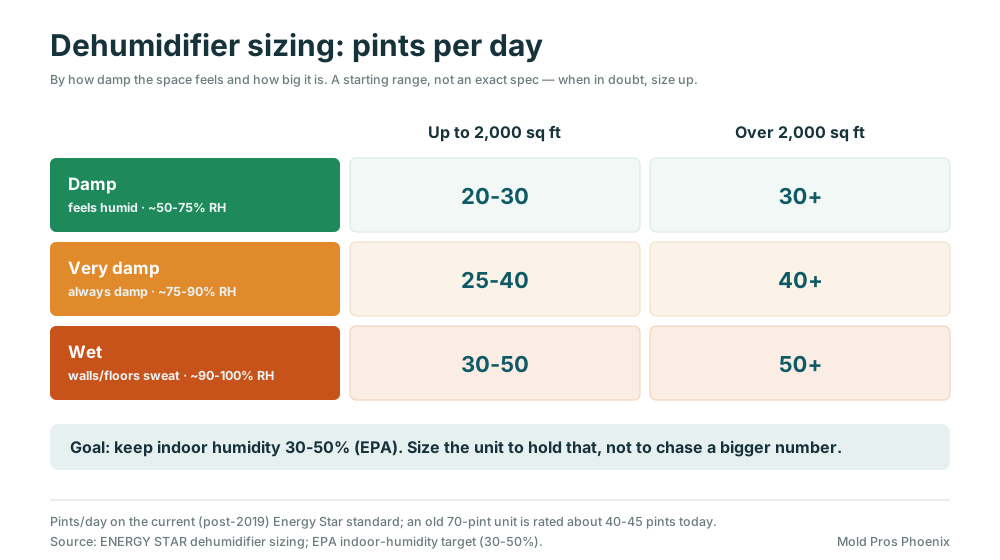
| How damp it feels | Up to 2,000 sq ft | Over 2,000 sq ft |
|---|---|---|
| Damp (about 50-75% RH) | 20-30 pints/day | 30+ pints/day |
| Very damp (about 75-90% RH) | 25-40 pints/day | 40+ pints/day |
| Wet (about 90-100% RH) | 30-50 pints/day | 50+ pints/day |
Dehumidifier pint ratings changed in 2019: the DOE test moved from 80°F to a cooler 65°F, so the same machine is now rated for fewer pints (an old 70-pint unit is rated about 40-45 pints today). Every number here uses the CURRENT (post-2019) standard. Don't compare it to an older unit's nameplate.
Will your AC already do the job?
Here is the part the retailer sizing guides leave out, because they are there to sell you a unit: in a dry desert climate, you often do not need a standalone dehumidifier at all. A normal refrigerated air conditioner removes moisture as it cools and drips it out the condensate line, which usually keeps a typical Phoenix home well under the EPA's 60% ceiling on its own (the evidence is in our guide on whether a dehumidifier helps with mold in Phoenix). A dehumidifier earns its keep in four specific situations:
- A normal refrigerated air conditioner dehumidifies as it cools — it drips the moisture out at the coil and down the condensate line. In Phoenix's dry season that is usually enough to keep a typical home well under the EPA's 60% ceiling without any separate dehumidifier.
- Evaporative 'swamp' coolers are the exception: they cool by ADDING moisture to the air, so they raise indoor humidity on purpose. When monsoon humidity climbs and the cooler stops keeping up, a dehumidifier (or switching to refrigerated AC) is what brings the room back down.
- During monsoon season (roughly July-September), outdoor humidity spikes and any roof or flood intrusion can push a closed room over 60% RH. That is the time of year a dehumidifier earns its keep in the Valley.
- A closed-up or snowbird home with the AC set high or off gets no dehumidification for months. A humidistat-controlled dehumidifier protects against musty buildup while you're away.
So before you buy: if you run refrigerated AC and the space only "feels a little humid," your money is better kept in your pocket. If you run a swamp cooler, it is monsoon season, the home sits closed up, or a specific room stays damp, a right-sized unit is worth it. And if walls or floors are actually sweating, that is a water problem a dehumidifier won't fix. To see whether your surfaces are at condensation risk, run the dew point calculator; for swamp-cooler homes specifically, see swamp cooler mold.
When a dehumidifier isn't the answer
A dehumidifier manages humidity in the air. It does not fix a roof leak, a slab leak, an AC condensate overflow, or mold that has already started. The EPA is blunt about the order of operations: "The key to mold control is moisture control." So if the dampness keeps coming back no matter how the dehumidifier runs, there is a water source to find and fix. If a space has been wet for more than a day or two, it is worth getting it checked before mold spreads. A Phoenix mold inspection finds the source and any growth before it gets expensive.
Sources (4): ENERGY STAR — Dehumidifiers (sizing chart) (2025); ENERGY STAR — Dehumidifier Testing and Capacity (2019 standard change) (2024); EPA — Mold Course, Chapter 2 (indoor humidity 30-50%) (2024); EPA — A Brief Guide to Mold, Moisture and Your Home (2024).