Does a Dehumidifier Help With Phoenix Mold?
A dehumidifier helps with mold only when humid air is the problem. It does not remove mold that is already there, and it does nothing for mold fed by liquid water, such as a slab leak, a condensate overflow or a roof leak. In Phoenix the outdoor air is usually dry enough that there is little for one to remove, October through May, and monsoon season is the real exception. Dry air does not make a home mold-proof.
Does a dehumidifier help with mold?
It depends on which kind of moisture is feeding the growth. There are two cases, and a dehumidifier handles only one.
Humid air. If a room sits at high relative humidity for long stretches, surfaces stay damp enough to grow mold. Pulling water vapor out of that air helps. This is the case dehumidifiers are built for.
Liquid water. A leaking supply line, a slab leak, a clogged AC condensate drain, a roof leak after a monsoon storm. Here the material is wet because water is arriving, not because the air is humid. A dehumidifier in the room is working on the wrong thing.
EPA’s brief guide to mold, moisture and your home puts the principle in one line: “The key to mold control is moisture control.” It lists dehumidifiers in the same breath as air conditioners: “Use air conditioners and/or de-humidifiers when needed.” The operative words are “when needed.” It also warns what happens when the source is skipped: “If you clean up the mold, but don’t fix the water problem, then, most likely, the mold problem will come back.”
None of this says Phoenix is safe from mold. Mold needs moisture at the surface of a material, and a hallway reading of 25% says nothing about the back of a wet wall. Our guide to the dry-air mold myth in Phoenix covers that in detail. The question here is narrower: is humid air something your home actually has?
What your thermostat setting decides
Indoor humidity depends on two things: how much water the air carries, and how cold the house is. Saturation vapor pressure falls as the air gets colder, so the same amount of vapor reads as a higher relative humidity at 72°F than at 78°F.
That gives a checkable threshold. For a given thermostat setting, there is a dew point below which the air physically cannot reach 60% relative humidity. We calculated it with the Magnus formula, es(T) = 6.112·exp(17.67·T/(T+243.5)) with T in °C, and RH = 100·es(Td)/es(T).
| Thermostat | Dew point at which indoor RH reaches 60% |
|---|---|
| 72°F | 57.4°F |
| 75°F | 60.2°F |
| 78°F | 63.0°F |
| 80°F | 64.9°F |
The working number for the rest of this page is 75°F, which gives about 60°F. If the water in your air has a dew point under that, a 75°F house cannot reach EPA’s 60% ceiling from that air alone. Our dew point calculator runs the same kind of calculation for your own readings.
Eight months of the year, the outdoor air has little to remove
We took the dew point record for Phoenix Sky Harbor from two NOAA NCEI sources: the 1991-2020 U.S. Climate Normals (hourly, GHCN station USW00023183) and the Integrated Surface Database’s routine hourly observations for calendar years 2021 to 2025 (ISD station 72278023183, WBAN 23183, counting routine FM-15 reports that passed NCEI quality control). Then we compared each hour against that 60.2°F line. One limit to note up front: the ISD archive we pulled ends on 26 August 2025, so every September-to-December figure below covers 2021 to 2024.
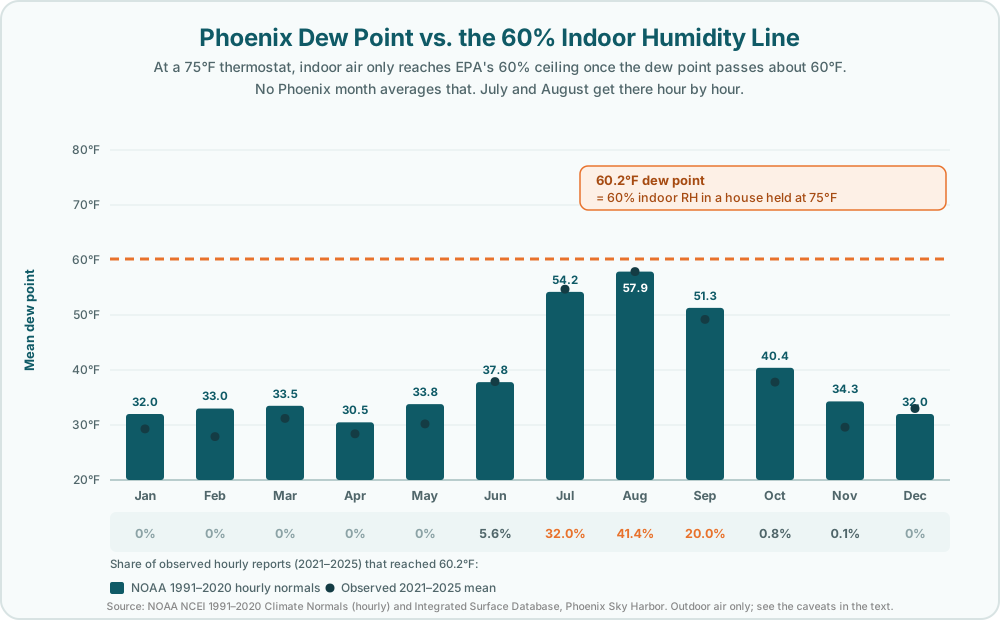
The result is lopsided:
- Annual normal mean dew point: 39.3°F. At a 75°F thermostat, air at that dew point reads about 28% relative humidity indoors, if the house adds no moisture of its own. That is below the floor of EPA’s ideal 30 to 50 percent band, before any dehumidifier runs.
- October through May: 26 of 26,898 hourly reports, or 0.10%, reached 60.2°F. January, February, March, April, May and December had none at all.
- Normal mean dew points for those eight months run from 30.5°F (April) to 40.4°F (October), which is 19% to 29% RH indoors on that same no-added-moisture basis.
EPA’s mold course makes the mechanism explicit: “One function of the building heating, ventilation and air conditioning (HVAC) system is to remove moisture from the air before the air is distributed throughout the building”. A refrigerated AC is already running a dehumidifier on your behalf, and in a climate where the incoming air is dry, it has little to do.
Read the first caveat before leaning on this. The numbers convert an outdoor dew point into an indoor RH by assuming the indoor air carries the same amount of water as the outdoor air. A real house adds moisture (showers, cooking, laundry, plants, pool evaporation, an evaporative cooler) and a refrigerated AC takes it out. These figures are a baseline set by the climate, not a measurement of anyone’s indoor air. Your own hygrometer beats every number on this page.
July and August are a different question
That is only half the year.
Across July and August in 2021 to 2025, 2,643 of 7,229 hourly reports, or 36.6%, reached 60.2°F or higher, the dew point at which outdoor air alone would put a 75°F house at 60% RH. August alone was 1,461 of 3,533 (41.4%), and July 1,182 of 3,696 (32.0%). Across all five years, 3,445 of 40,585 reports (8.5%) crossed the line, and 93% of those crossings fall in July, August and September. That 8.5% carries the partial 2025 noted above; a complete 2025 would put it nearer 8.3%. Our earlier desert mold paradox analysis found the same monsoon moisture surge at the same station.
The normals understate this. They are 30-year smoothed averages. They put only 2.2% of annual hours at or above 60.2°F; the observations put it at 8.5%. The smoothed hourly normals top out near 61°F, but the observed peak for 2021 to 2025 was 75.0°F on 2021-07-04. At a 75°F thermostat, outdoor air alone at that dew point is 100% relative humidity.
It also varies from year to year. The share of hourly reports at or above the line ranged from 4.2% in 2023 to 13.5% in 2021. One caution on that range: 2025 holds only 5,663 reports against roughly 8,730 for the other years, because the archive stops in late August, so the yearly figures are not perfectly comparable. Treat it as a range, not a trend. The practical reading is that “do I need one” is a per-season question, not a permanent answer. Our Phoenix mold risk calendar lays out the same seasonal pattern month by month.
The full monthly record
Both series, month by month. The middle column is what outdoor air at that dew point would read indoors at a 75°F thermostat if the house added no moisture of its own; a real house always adds some.
| Month | Normal mean dew point (1991-2020) | Indoor RH at 75°F, outdoor air alone | Observed hours at or above 60.2°F (2021-2025) |
|---|---|---|---|
| January | 32.0°F | 21% | 0% |
| February | 33.0°F | 21% | 0% |
| March | 33.5°F | 22% | 0% |
| April | 30.5°F | 19% | 0% |
| May | 33.8°F | 22% | 0% |
| June | 37.8°F | 26% | 5.6% |
| July | 54.2°F | 48% | 32.0% |
| August | 57.9°F | 55% | 41.4% |
| September | 51.3°F | 44% | 20.0% |
| October | 40.4°F | 29% | 0.8% |
| November | 34.3°F | 23% | 0.1% |
| December | 32.0°F | 21% | 0% |
Dew points are NOAA NCEI 1991-2020 hourly normals for Phoenix Sky Harbor; the last column is our count of ISD hourly observations, and because the archive stops on 26 August 2025, the September-to-December figures cover 2021 to 2024.
Do I need a dehumidifier in Phoenix? When one is the right buy
Four situations hold up most often. Outside them, buying a dehumidifier for mold in a Phoenix home is usually solving a problem the house does not have.
1. Monsoon weeks. The data above. If a hygrometer in your home reads over 60% during July through September and you have ruled out a leak, the likely explanation is humid outdoor air getting in faster than your AC removes it, and a dehumidifier is a fair response. A reading over 60% on its own does not establish that: indoor sources, an evaporative cooler and a leak evaporating into the room all produce the same number, which is why the three conditions below start with the water.
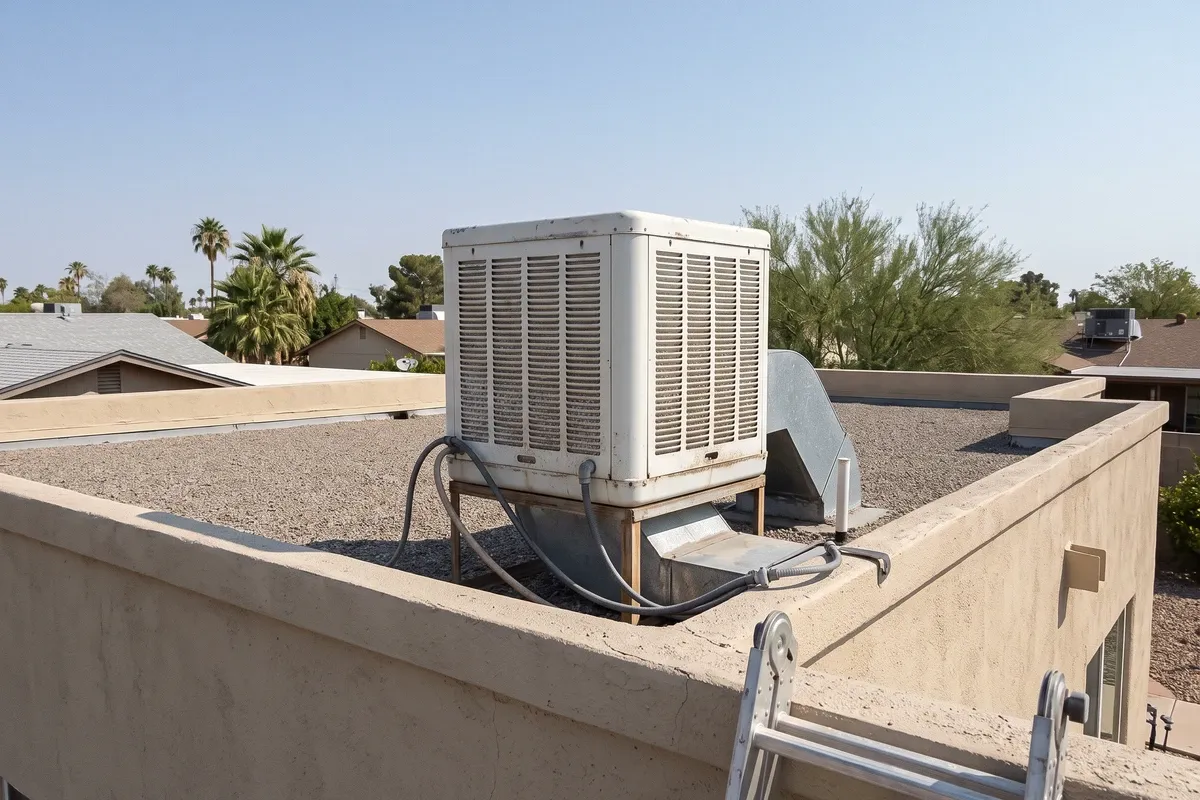
2. An evaporative-cooled home. A swamp cooler cools by adding water to the air. That is the opposite of what a refrigerated AC does, and it is why the NOAA baseline above does not describe these homes. See swamp cooler vs AC in Phoenix for how the two systems change indoor humidity.
3. A closed-up or snowbird home. A house with the AC set high or off for the summer loses the dehumidifying work the AC normally does. This agrees with what we already say elsewhere: the snowbird summer-home checklist and our guide to vacant-home mold insurance in Arizona both recommend a dehumidifier at about 55% for a vacant summer home. The climate baseline here assumes a cooled, occupied house, which is exactly what a closed-up home stops being.
4. The drying window after a water loss. EPA’s mold course notes that “Commercial firms that do mold remediation work or work on water- and fire-damaged buildings often use large fans, dehumidifiers and other equipment to dry wet buildings and items quickly before mold has a chance to grow.” That is professional drying equipment on a wet building. It is not the same thing as running a retail unit as a standing humidity policy. EPA’s timeline for this is short: “It is important to dry water-damaged areas and items within 24-48 hours to prevent mold growth.”
The three-condition dehumidifier test
The federal Building America guide to whole-house dehumidification gives retrofit criteria worth borrowing. It says to “Add dehumidification to an existing home if indoor relative humidity levels exceed 60%”, “if moisture issues are apparent, such as mold, mildew, or occupant complaints of humidity”, and where “no water leakage or water intrusion sources are found.”
Read that as three conditions, all of which have to be true:
- Measured indoor relative humidity is above 60%.
- Moisture symptoms are apparent: mold, mildew or complaints of humidity.
- No water leak or intrusion has been found.
The third condition carries the weight. If a leak is the cause, the answer is to fix the leak, and a dehumidifier only hides the pattern while the material stays wet.
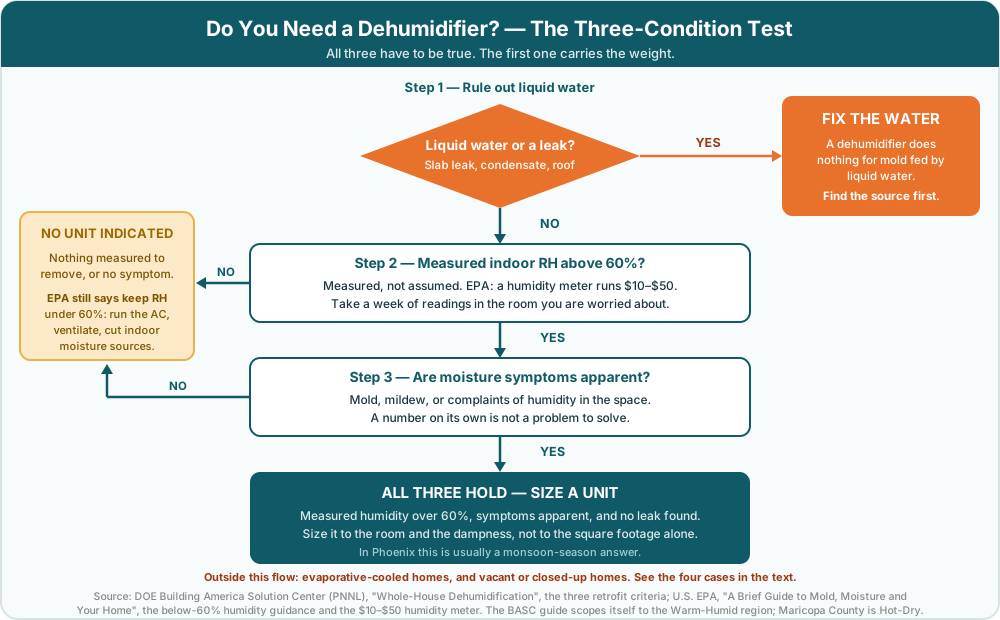
One caution on scope. That resource guide scopes itself to the Warm-Humid region, “all of climate zone 1, all of climate zone 2A, and portions of climate zone 3A.” Maricopa County sits in a different region. The DOE and PNNL county table assigns it to Hot-Dry, which the report defines as “A hot-dry climate is generally defined as a region that receives less than 20 in. (50 cm) of annual precipitation and where the monthly average outdoor temperature remains above 45°F (7°C) throughout the year.” So the whole-house guide is not written for a climate like Phoenix’s, and it does not address Phoenix at all. That is a limit on its scope, not federal permission to skip a dehumidifier here.
Measure first. EPA notes that “Relative humidity can be measured with a moisture or humidity meter, a small, inexpensive ($10-$50) instrument…”. A week of readings in the room you are worried about, taken across a few days of different weather, answers condition one for the cost EPA states.
If all three conditions hold, size it properly. Our dehumidifier size calculator turns room size and conditions into a pint rating. For the broader routine of keeping a Phoenix home out of trouble, see mold prevention in Phoenix.
What a dehumidifier will not fix
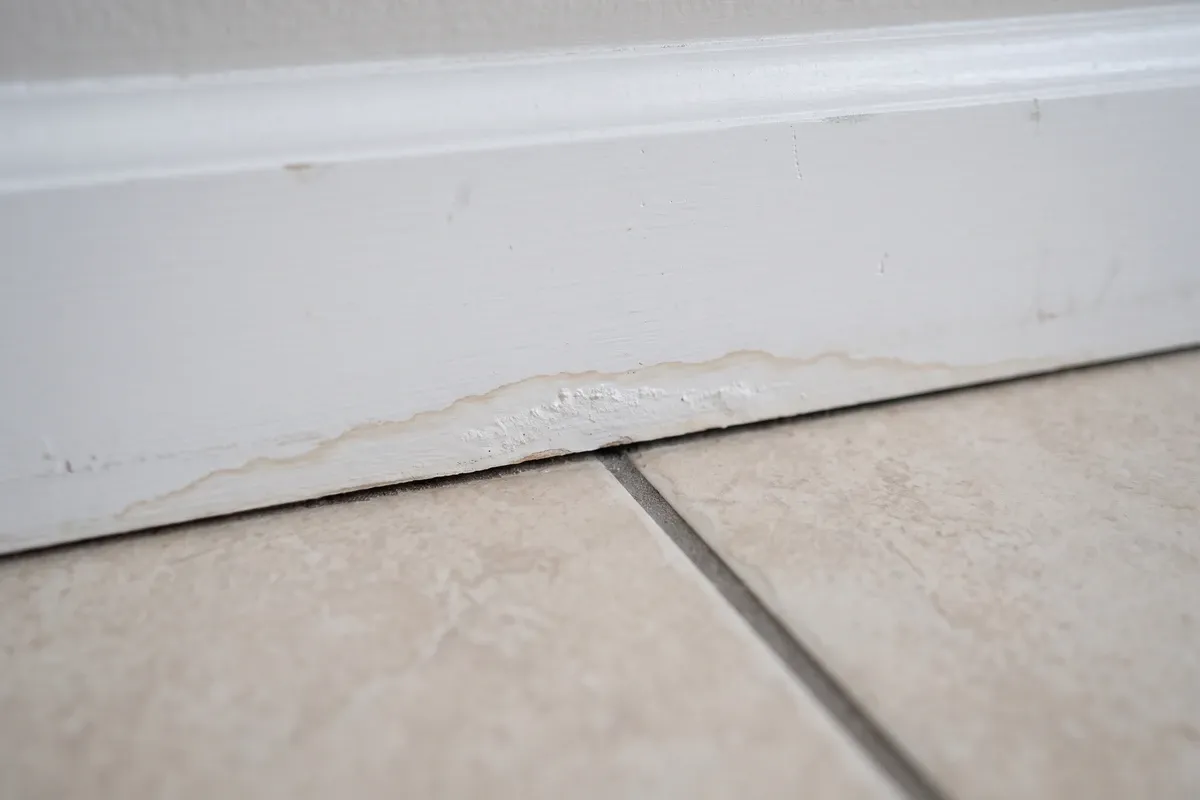
- A slab leak. Water coming up under flooring keeps the material wet no matter how dry the room air is.
- AC condensate overflow. A clogged drain line or full pan puts liquid water into a closet, ceiling or wall.
- Roof or window intrusion. Monsoon water reaching attic sheathing or drywall is a repair job.
- Growth that is already established. A dehumidifier does not remove what is there. EPA’s line applies: cleanup without fixing the water problem means the mold will most likely come back.
If a stain keeps returning, a musty smell stays after the room dries out, or a space has been wet for more than a day or two, get the source found before spending money on equipment. A mold inspection in Phoenix is built for that: finding where the water is coming from and whether anything is growing. The mold guides hub has the rest of the reading.
Sources
- U.S. EPA — A Brief Guide to Mold, Moisture and Your Home: the moisture-control principle, the “when needed” guidance on air conditioners and de-humidifiers, the below-60-percent humidity guidance (ideally 30 to 50 percent), the cleanup-without-fixing-the-water statement, the 24-48 hour drying window, and the $10-$50 humidity meter.
- U.S. EPA — Mold Course, Chapter 2: the HVAC moisture-removal function, the 60 percent ceiling and 30 to 50 percent ideal band, and professional use of fans and dehumidifiers to dry wet buildings.
- DOE Building America Solution Center (PNNL) — Whole-House Dehumidification: the three retrofit criteria and the Warm-Humid scope statement.
- DOE Building America Best Practices Series (PNNL and ORNL) — Guide to Determining Climate Regions by County, December 2007: Maricopa County classified Hot-Dry, and the hot-dry definition.
- NOAA NCEI — 1991-2020 U.S. Climate Normals (hourly, GHCN station USW00023183) and Integrated Surface Database routine FM-15 observations passing NCEI quality control (ISD station 72278023183, WBAN 23183), Phoenix Sky Harbor, calendar years 2021 to 2025 (the ISD archive ends 26 August 2025): the monthly dew points and hourly counts. The indoor-RH conversions are our own calculation using the Magnus formula and rest on the outdoor-equals-indoor assumption stated above.