The Desert-Mold Paradox: When Phoenix Homes Actually Get Mold (a federal-data analysis)
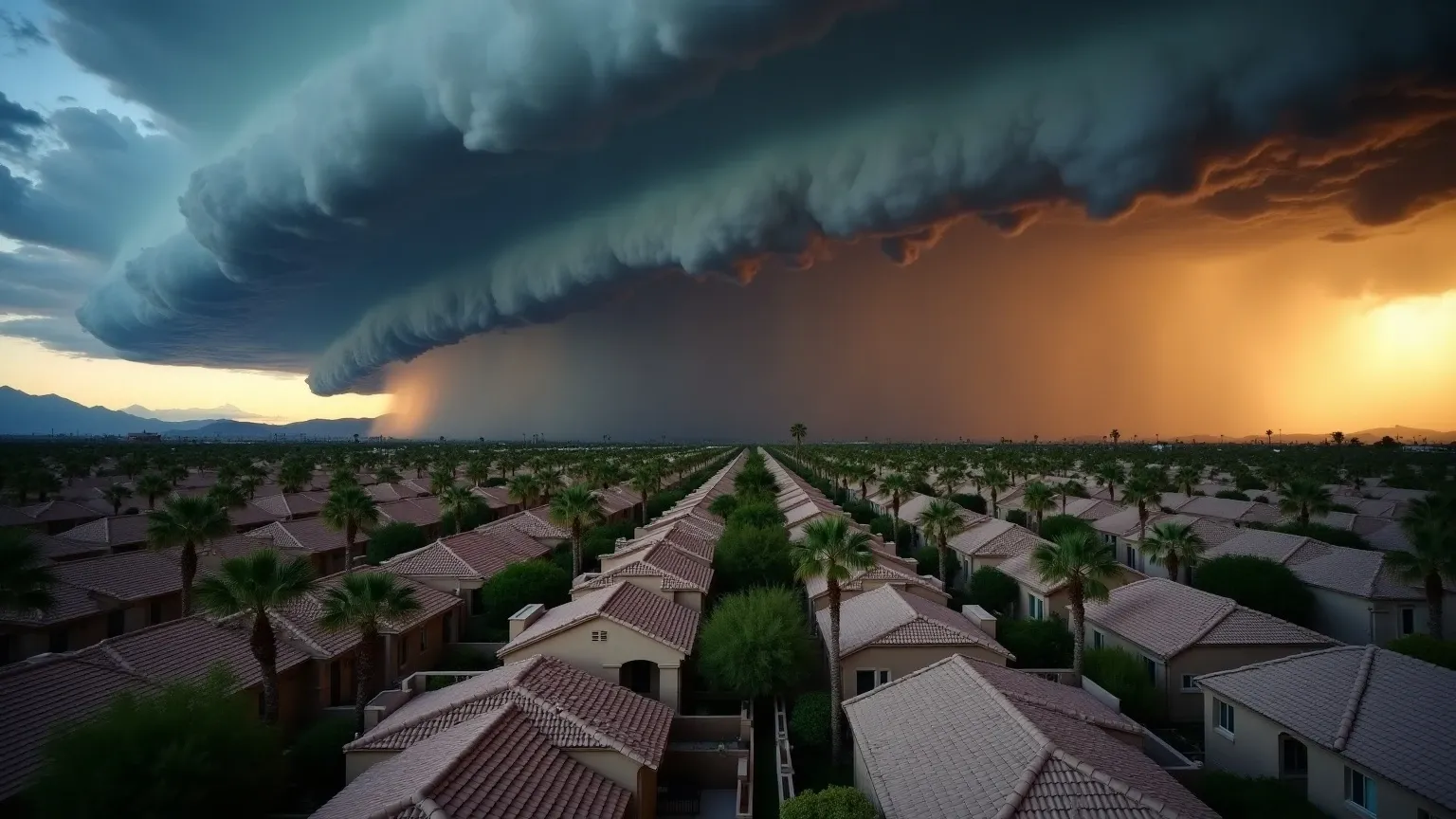
Phoenix’s mold risk is not spread evenly across the year the way it is in a humid climate. It is compressed into the roughly 15-week monsoon — June 15 to September 30 — when four things spike at once: outdoor moisture jumps about 2.5×, home AC systems go from condensing essentially zero water to their annual peak, flood-insurance claims run about 23× the dry-season rate, and wet materials stop drying inside the EPA’s 24-to-48-hour window. The desert doesn’t prevent mold. It front-loads the start of the mold season into one window — the stretch when new growth is most likely to begin. (Mold that gets going doesn’t vanish when the air dries back out; more on that below.)
An original analysis by Mold Pros Phoenix — built entirely on public federal data. The methods, limitations, and underlying datasets are published in full below, so anyone can check the work.
The paradox
“You can’t get mold in the desert” is one of the most repeated beliefs about Phoenix homes, and it is wrong — but the usual rebuttal is also incomplete. Most corrections simply note that mold is a moisture problem rather than a humidity problem and leave it there. True, but it skips the more useful question: if desert homes get mold, when do they get it, and why then?
This analysis answers that question with federal data. It does three things no templated “mold in the desert” page does. First, it builds an original psychrometric model of what a Phoenix air conditioner actually does to water across the year. Second, it pulls and aggregates every Maricopa County federal flood-insurance claim back to 1978 to show the real seasonality of rain-driven water intrusion. Third, it lines those up against published federal health-and-housing surveys to confirm the desert is not mold-immune. The result is a single, specific finding: in Phoenix, the season when mold gets started is not the year — it is the monsoon.
Finding 1 — The hidden water: what a Phoenix AC actually does
Start where most Phoenix homeowners never look — inside their own air conditioner.
In a humid climate, an AC is a dehumidifier as much as a cooler: it runs cold coils that pull liquid water out of the air all summer, which is why a Houston or New Orleans system drips a steady stream of condensate. In Phoenix, for most of the year, that barely happens. We modeled a typical Phoenix central AC using a standard steady-state moisture balance (the method is in the Methodology below), and the result is striking: the system condenses about 0 gallons per day for roughly nine months, October through June. The desert air is so dry that it rarely reaches the cooling coil’s dew point, so the AC does almost pure sensible cooling — it drops the temperature without wringing out water. That matches HVAC field experience, where dry-climate units are known to produce very little condensate.
Then the monsoon arrives and the picture flips. Condensate appears almost entirely in three months: about 2.1 gal/day in July, a peak of about 3.8 gal/day in August, and about 0.9 gal/day in September. Put another way, essentially 100% of a home’s annual AC condensate forms in July through September. Across a full year the model puts a typical home at about 210 gallons (a sensitivity range of 155–258 gallons across realistic infiltration and internal-moisture assumptions — and the monsoon-concentration finding holds in every case).
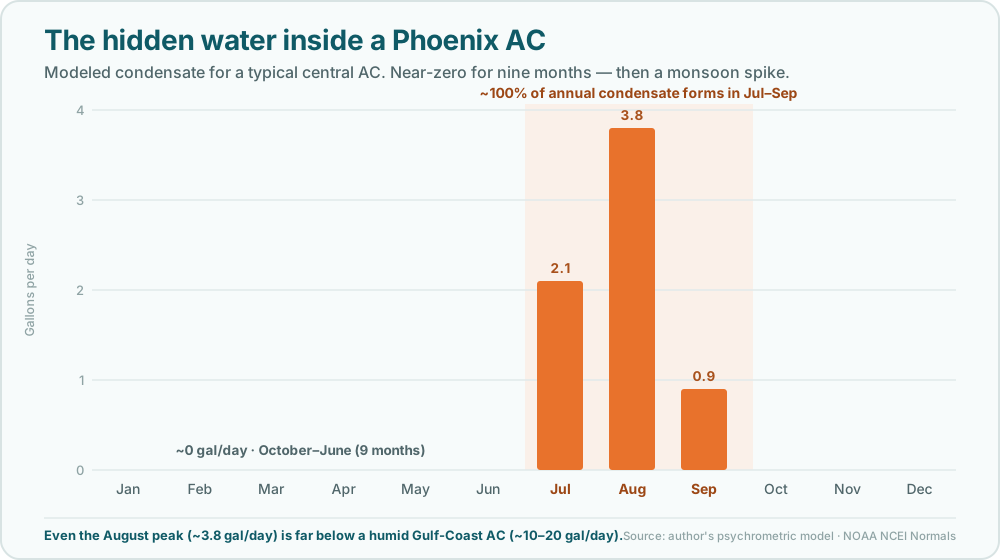
Scale that to the metro and it becomes a genuinely large hidden water source. With roughly 1.62 million air-conditioned homes in the Valley (1.88 million MSA households, about 86% with central AC), the model implies about 340 million gallons of AC condensate per year across Phoenix — essentially all of it during the monsoon.
Here is the part that matters for mold, and it cuts against the obvious read. Even at its August peak of about 3.8 gal/day, a Phoenix AC produces far less condensate than a humid Gulf-Coast unit, which can run 10–20 gal/day. So the Phoenix mold danger from air conditioning is not the volume of water — it’s the timing plus the failure mode. A condensate drain line that clogs with dust and algae, or a rusted drain pan, sends that monsoon-season water somewhere it shouldn’t go: into a ceiling cavity, down a wall, across an attic floor. Out of sight, it can sit there past the 24-to-48-hour window and grow mold. The water volume is small; the consequence of misdirecting it is not.
The reason the timing lines up so tightly with the rest of this report is the outdoor air itself. The humidity ratio — the actual mass of water in the outdoor air — jumps about 2.5× from May to August. Mean dew point roughly triples, from around 34 °F in the dry months to about 58 °F in August. That is the same moisture surge that loads the cooling coil, and, as the next finding shows, it is the same surge that puts water on roofs and into walls.
Finding 2 — When the Valley actually floods
If AC condensate is the moisture source hiding inside the house, rain-driven intrusion is the one hiding in plain sight — and to measure its real seasonality, we went to the most complete public record of Valley water damage that exists: federal flood-insurance claims.
We pulled and aggregated every Maricopa County claim ourselves from the OpenFEMA database. The dataset is 2,630 Maricopa County NFIP flood-insurance claims from 1978 to 2025, totaling about $26 million paid. The seasonality is not subtle. 58% of all claims occurred in July, August and September, and 58.3% fell within the exact June 15 to September 30 monsoon window. A single peak monsoon month carries about 23.5× the claims of a typical pre-monsoon month — 565 claims in August against an average of roughly 24 per month across April, May and June. The pre-monsoon stretch (April plus May plus June combined) accounts for just 2.7% of all claims. And 53% of claims are coded “accumulation of rainfall or snowmelt” — i.e., water that built up faster than it could drain, exactly the kind of event that soaks building materials.
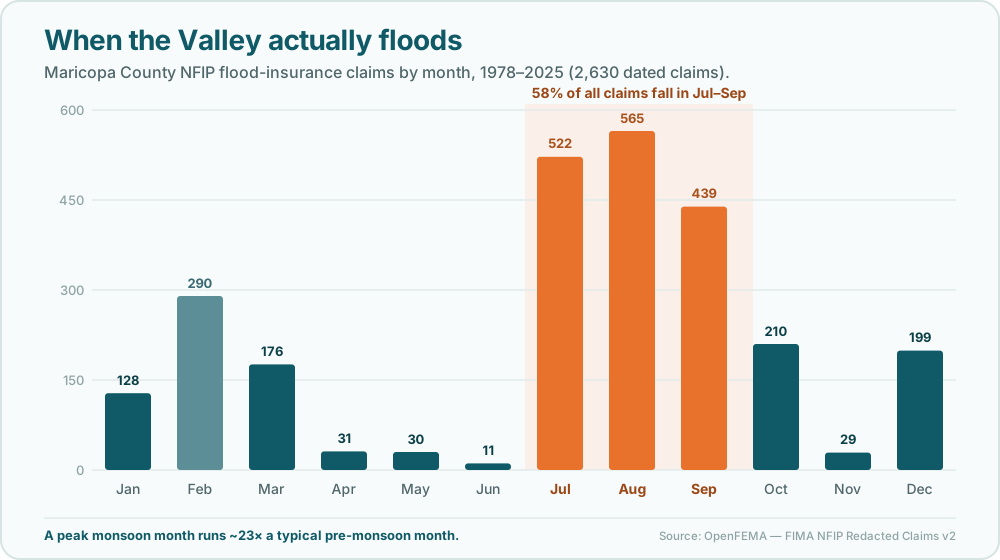
Three honest nuances belong with this data. First, NFIP records are insured flood losses only, so they undercount total water intrusion — most monsoon roof leaks and street-flooding events never become a federal flood claim. We are not using this as a count of how much water gets into Phoenix homes; we are using it as a well-sourced, decades-deep proxy for the timing and seasonality of rain-driven intrusion, which is the upstream driver of post-flood mold. Second, Phoenix has a real secondary winter wet season — you can see the smaller February bump (290 claims) in the chart, driven by Pacific frontal storms in late winter and autumn — but the monsoon dominates by a wide margin. Third, the dates and ZIP codes are insurer-reported, with the ordinary imperfections that implies. None of those caveats move the headline: Valley flooding is a summer phenomenon, and so is the water intrusion that precedes mold.
The convergence
Put the two original findings next to the climate record and the centerpiece of this report appears: four independent moisture signals all spike in the same 15-week window. They are not loosely correlated. They peak in the same month.
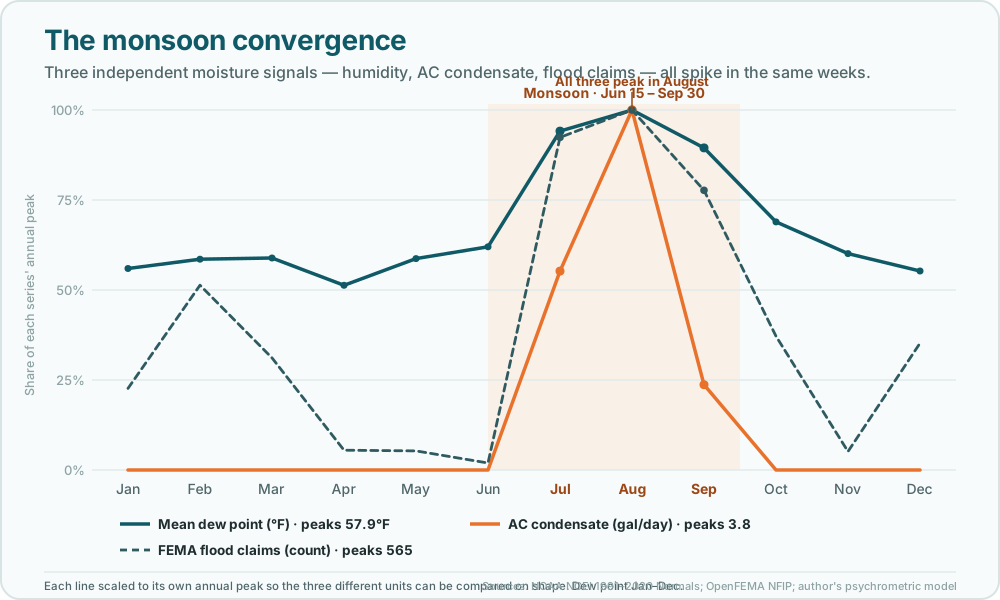
The four-way convergence, stated plainly:
- Outdoor moisture jumps about 2.5× from May to August (mean dew point roughly triples to about 58 °F), wetting roofs, walls, and the air the AC has to cool.
- AC condensate goes from essentially zero to its annual peak of about 3.8 gal/day in August — the home’s own hidden water source switching on.
- Flood-insurance claims run about 23× the dry-season rate, with 58% of all Maricopa claims landing in July–September.
- Wet materials stop drying inside the EPA’s window. When humidity is at its annual high, materials that get wet — from a roof leak, a condensate overflow, a flooded room — are far less able to dry within the 24-to-48-hour period the EPA identifies as the threshold before mold typically begins to grow.
Any one of these alone would raise mold risk. The desert-mold paradox is that all four arrive together, in one compressed window, in a climate everyone assumes is too dry for mold. That convergence — not the annual average humidity, which is genuinely low — is what makes the late-summer Valley a mold environment for the homes where water gets loose.
Finding 3 — The desert is not mold-immune
The convergence explains when. But it is worth confronting the underlying myth directly with measured evidence, because the strongest version of “you can’t get mold in the desert” claims that desert homes simply have less mold, period. The published federal record says otherwise. We did not re-analyze this restricted microdata ourselves — these are published findings from federal surveys — but they all point the same way.
- EPA / HUD American Healthy Homes Survey + ERMI. The Environmental Relative Moldiness Index work by Vesper et al. (2011) found that water-damage-associated indoor molds are “national in scope” — not systematically lower in the desert Southwest. Only the outdoor mold groups are lower in arid regions. The indoor mold that affects homes tracks indoor moisture, not the dryness of the air outside.
- NHANES. National allergy-sensitization data analyzed by Salo et al. found that mold and Alternaria allergy sensitization does not differ significantly by U.S. census region. People in dry regions are sensitized at broadly the same rates as people in humid ones.
- Institute of Medicine / National Academies (2004). The CDC-sponsored report Damp Indoor Spaces and Health concluded that essentially all of the 100-million-plus U.S. homes experience excess dampness or leaks at some point, and that dampness and mold are linked to respiratory effects such as coughing, wheezing, and worsening of asthma.
Read together, the measured evidence and our climate-and-flood analysis tell one consistent story. Outdoor desert air is dry; indoor moisture is not governed by it. Household mold is driven by water that gets into the building — and in Phoenix, the data shows that water arrives on a schedule.
Does the mold go away when the desert dries out?
Short answer: no — and because the “15-week” framing can hide it, it’s worth stating plainly. The monsoon is when mold is most likely to start. It is not a window mold politely confines itself to. Two things carry the risk into the other nine months.
The science here is the EPA’s, not ours. The agency states flatly that “it is impossible to get rid of all mold and mold spores indoors” — spores are always present, and they simply “will not grow if moisture is not present.” That cuts both ways: dry a surface out and growth stops, but “dead mold may still cause allergic reactions,” so “it is not enough to simply kill the mold, it must also be removed.” Drying is not remediation. (Source: EPA, A Brief Guide to Mold, Moisture and Your Home.)
So read this report the right way. The ~15 weeks is the ignition season — the time to get ahead of new growth. The rest of the year is when you find and remove anything that already started, and stay alert to the indoor leaks that don’t wait for the monsoon. A concentrated risk is easier to prevent; it does not make existing mold disappear.
What it means for a Phoenix homeowner
The practical upshot is genuinely good news, because a concentrated risk is a manageable one. To stop new mold, you are not fighting the whole year — you are getting ahead of one window. (The exceptions, from the section above: mold that already started, and year-round indoor leaks. Those don’t wait for the monsoon.)
- Clear the AC condensate drain line before the monsoon. This is the driver most tied to how Phoenix homes actually run, and the line that overflows into a ceiling or wall is the failure mode that turns a small amount of water into a full mold remediation job. Have it cleared before mid-June, when condensate switches on.
- Dry any water intrusion within 24 to 48 hours. After a monsoon roof leak or a flooded room, the EPA’s window is short but real: materials dried inside it usually don’t grow mold. During the monsoon, with humidity at its annual peak, materials dry slower — so move faster.
- Treat the risk as seasonal, and act before mid-June. The single most useful thing this analysis offers a homeowner is timing. The work to do — checking the roof and flashing, clearing the condensate line, grading water away from the foundation — should happen in spring, before the four signals converge.
If you want the room-by-room and driver-by-driver picture behind this timing, our companion 2026 Phoenix Mold Risk Report maps the seasonal calendar and the five physical moisture drivers, and Phoenix mold statistics covers how common reported mold actually is across the metro. The myth itself gets the full treatment in mold in the desert. If you’ve already found mold or can smell it but can’t see it, the right first step is to confirm the moisture source, which is what a professional mold inspection is built for. The full library of Phoenix mold guides covers each growth type and room in depth.
Methodology
This report combines two original analyses of public federal data with a review of published federal findings. Everything here is reproducible from the cited sources and the datasets linked below.
Psychrometric model (Finding 1). Humidity ratios were computed per the ASHRAE Handbook—Fundamentals, Chapter 1, using W = 0.621945·pw/(P − pw), with saturation vapor pressure from the Arden Buck (1996) equation. Climate inputs are the NOAA NCEI 1991–2020 Climate Normals for Phoenix Sky Harbor (station GHCND:USW00023183), with monthly mean dew point derived from the NCEI hourly normals; barometric pressure is 97.6 kPa at the station’s 1,086 ft elevation. AC condensate is the difference between incoming and setpoint moisture across a steady-state home moisture balance: internal latent generation (~20 lb/day per ANSI/ASHRAE Standard 160-2009b) plus infiltration (~0.4 ACH) against an indoor setpoint of 75 °F / 50% RH, with a coil apparatus dew point of ~52 °F. The annual sensitivity range (155–258 gallons) spans infiltration of 0.25–0.6 ACH and internal moisture of 15–24 lb/day. Metro scaling uses ~1.88 million MSA households at ~86% central-AC prevalence (EIA RECS 2020, regional).
Flood-claim aggregation (Finding 2). We queried the OpenFEMA “FIMA NFIP Redacted Claims v2” public API for all Maricopa County, Arizona claims (1978–2025), then aggregated by month of loss. Monsoon-window figures use the National Weather Service Phoenix standard of June 15 – September 30. NFIP covers insured flood losses only and is used here as a proxy for the timing of rain-driven water intrusion, not its absolute magnitude.
Measured-evidence review (Finding 3). The American Healthy Homes Survey / ERMI, NHANES, and Institute of Medicine findings are published federal results, cited in place. We did not re-analyze that restricted microdata ourselves.
Downloadable data
The underlying datasets are public so anyone can check or extend the analysis:
- AC condensate by month: phoenix-ac-condensate-by-month.csv — monthly temperature, dew point, humidity ratio, and modeled condensate.
- Maricopa flood claims by month: maricopa-nfip-claims-by-month.csv — NFIP claim counts and share of dated claims by month.
Suggested citation
Mold Pros Phoenix (2026). The Desert-Mold Paradox: When Phoenix Homes Actually Get Mold. moldprosphoenix.com/guides/desert-mold-paradox/
Limitations
Transparency is the point of this report, so its limits are stated as plainly as its findings.
- The psychrometric model is order-of-magnitude, not a measurement. It is a standard steady-state model built from published ASHRAE methods and NOAA normals, with explicit assumptions and a stated sensitivity range — not metered data from real homes. The headline finding it supports is the monsoon concentration of condensate, which holds across the full sensitivity range; treat the specific gallon figures as modeled estimates.
- Flood claims are an insured-loss proxy. NFIP data captures only insured flood losses and undercounts total water intrusion. It is used for the seasonality of rain-driven intrusion, which it documents well over nearly five decades, not for the absolute level of water damage. Dates and ZIPs are insurer-reported.
- The drying window is an indicator, not a predictor. The EPA’s 24-to-48-hour threshold describes when materials generally begin to grow mold; it does not predict whether any specific home will. Real outcomes depend on the material, the temperature, and how completely it dried.
- The measured-evidence findings are cited, not re-derived. We did not re-analyze the AHHS/ERMI, NHANES, or IOM microdata; we report their published conclusions.
- This is not peer-reviewed academic research. It is a transparent, reproducible analysis of public federal data, published with its methods, limitations, and datasets so it can be checked. It is not a clinical or engineering study, and nothing here is medical advice; for health questions about mold exposure, consult the CDC and a medical professional.
Sources
- NOAA NCEI — 1991–2020 U.S. Climate Normals, Phoenix Sky Harbor (GHCND:USW00023183): monthly temperature and dew point inputs. U.S. Climate Normals
- OpenFEMA — FIMA NFIP Redacted Claims v2: source for all 2,630 Maricopa County flood-claim records (1978–2025). FIMA NFIP Redacted Claims v2
- ASHRAE Handbook—Fundamentals — psychrometric methods (humidity ratio, Ch. 1). ASHRAE Handbook
- Arden Buck (1996) — saturation vapor pressure equation used for dew-point conversions. Arden Buck equation
- ANSI/ASHRAE Standard 160 — moisture-design loads (internal latent generation). Standards and Guidelines
- U.S. EPA — the 24-to-48-hour drying window to prevent mold growth. A Brief Guide to Mold, Moisture and Your Home
- EPA / HUD — Vesper et al. (2011) — ERMI / American Healthy Homes Survey: water-damage molds are national in scope. ERMI study (PMC)
- Institute of Medicine / National Academies (2004) — Damp Indoor Spaces and Health. National Academies
- U.S. EIA — Residential Energy Consumption Survey (RECS) 2020: central-AC prevalence for metro scaling. RECS
- NWS Phoenix — Arizona monsoon defined as June 15 – September 30. National Weather Service Phoenix