The 2026 Phoenix Mold Risk Report
The belief that “you can’t get mold in the desert” is a myth. Per the EPA, mold grows on building materials that are not dried within 24 to 48 hours — so what matters is moisture control, not the ambient humidity outside. And Phoenix produces wet-material events on a predictable seasonal schedule. This report maps when, and why.
Key findings
The data points below are the quote-ready core of this report. Each is drawn from a public source, cited in full in the Sources section at the end.
- Phoenix gets roughly a third of its annual rain in a few summer weeks. The National Weather Service defines the monsoon as June 15 – September 30, and Phoenix averages about 2.43 inches of rain in that window — ≈ one-third of its annual precipitation, concentrated into a short, intense stretch (per NWS / 12News).
- It is hot enough that AC almost never stops. July and August average highs sit near 106 °F, and cooling demand runs from late May into October (per Climate of Phoenix). Continuous cooling means continuous condensate.
- Pools are everywhere — and they hold water against foundations. An aerial-imagery analysis found roughly 27.6% of Phoenix properties (257,983 of 933,745) have a pool, and Phoenix ranks #1 among US metros for pool prevalence, ahead of Miami (per Vexcel and LendingTree).
- Mold needs about a day, not tropical humidity. Per the EPA, if wet materials are dried within 24 to 48 hours, in most cases mold will not grow — and “the key to mold control is moisture control” (per EPA).
- The drivers stack in late summer. Monsoon intrusion (Jun 15 – Sep 30) overlaps peak AC condensate season (late May – October), so the risk window is concentrated, not constant.
Methodology, stated plainly
This report analyzes National Weather Service monsoon data, Phoenix climate and cooling patterns, EPA mold-growth thresholds, and common Valley building characteristics to map when and where Phoenix-metro homes face elevated mold risk. It analyzes public data; it is not a survey of individual homes. No homes were inspected or tested for this report, and none of the figures here describe how many Phoenix homes actually have mold. What the public data does support is a clear, defensible picture of the conditions under which Phoenix homes get mold — the timing, the physical drivers, and the home types most exposed. Where a source gives a range, we present the range rather than a single tidy number.
The desert myth vs. the science
Start with the single most important fact, because it dismantles the myth on its own: mold is a moisture problem, not a humidity problem.
Per the EPA’s A Brief Guide to Mold, Moisture and Your Home, mold needs moisture to grow, it grows on materials that stay wet, and if wet or damp materials are dried within 24 to 48 hours, in most cases mold will not grow. The EPA’s blunt summary: “The key to mold control is moisture control.”
Read that carefully and the desert defense falls apart. The dry air outside a Phoenix home does very little for a piece of drywall that is wet behind the wall because an AC condensate line has been dripping into the cavity. The relevant question is never “how humid is Phoenix?” It is “did this material get wet, and did it stay wet past about two days?” When the answer is yes — and in Phoenix it regularly is — mold grows here exactly as it does in Houston or Seattle.
That reframing is what the rest of this report is built on. The Valley’s dry climate is real, but it is the outdoor climate. Indoors, behind walls, in attics, and under floors, Phoenix supplies wet materials on a schedule. The health stakes are ordinary mold stakes: per the CDC, mold exposure can cause coughing, congestion, and throat or eye irritation, and people with asthma, allergies, or weakened immune systems face higher risk. The point of mapping the risk is to catch the moisture inside that 24-to-48-hour window — before it becomes a remediation job.
The Phoenix Mold Risk Calendar
Mold risk in Phoenix is not spread evenly across the year. It is concentrated, and the concentration follows the weather and the thermostat.
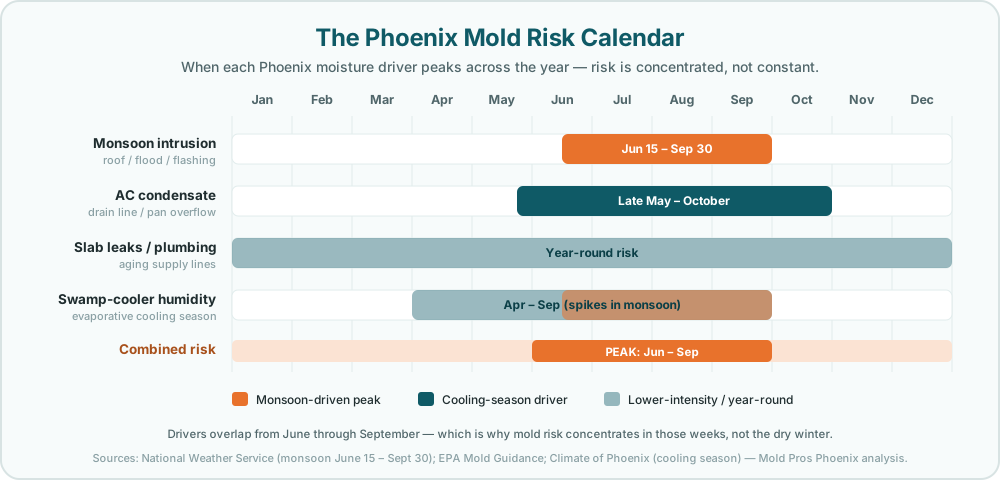
Three patterns drive the calendar:
Monsoon intrusion peaks June 15 – September 30. The National Weather Service standardized the monsoon season to those fixed dates in 2008, with the first real impacts usually arriving in early July. Into that short window Phoenix packs about 2.43 inches of rain — roughly a third of its annual total. It arrives fast and hard, which is exactly the kind of water that finds failed roof flashing and pools against foundations.
AC condensate peaks late May – October. This band overlaps the monsoon almost entirely, and that overlap is the core of the calendar. When the single wettest stretch of the year lands on top of the season when cooling equipment is producing the most condensate, the two largest moisture drivers run at once.
Slab leaks and plumbing are year-round. A pinhole leak in a supply line does not care what month it is. This driver runs flat across the calendar, which is why a musty smell in February is just as worth investigating as one in August.
The takeaway is operational: if you are going to inspect a roof, clear a condensate line, or check grading, the time to do it is spring — April or May — before the June-through-September stack arrives.
The 5 moisture drivers
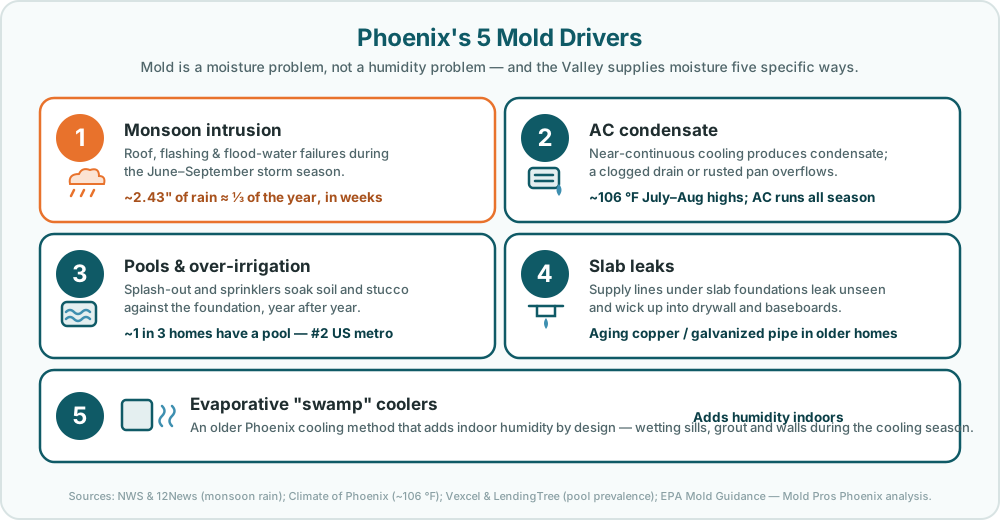
Underneath the calendar are five specific drivers. Each is a real, locatable source of water inside a Phoenix home, and each maps to how the Valley is built and cooled.
1. Monsoon intrusion
Phoenix concentrates roughly a third of its annual rainfall into the monsoon window. Per NWS data reported by 12News, the season runs June 15 – September 30 and averages about 2.43 inches of rain — ≈ one-third of the year’s precipitation, delivered in a handful of storms.
That delivery pattern is the problem. Many Phoenix homes have flat or low-slope roofs that pond water under an intense downpour, and water finds failed flashing around vents and AC penetrations first. Once water is on the roof deck or in a wall cavity, the EPA’s 24-to-48-hour clock starts. The mechanics, room by room, are covered in our guide to attic mold, which is where monsoon roof intrusion most often shows up.
2. AC condensate
With July and August average highs near 106 °F (per Climate of Phoenix), air conditioning in Phoenix runs nearly continuously from late May into October. Phoenix cooling demand is among the highest in the country and rising with the urban heat island. Every hour that equipment runs, it condenses water out of the indoor air and routes it through a drain line.
Two failure points turn that normal process into mold: the condensate drain line, which clogs with dust and algae over time, and the drain pan, which rusts through on older units. When either fails, water lands on a ceiling, in an attic, or down a wall — and because the failure is out of sight, it often runs for weeks. This is the driver most directly tied to how Phoenix homes operate, which is why it is the one we flag first when someone reports a musty smell that strengthens when the AC kicks on.
3. Pools & over-irrigation
Phoenix has an unusual amount of water sitting in and around its yards. An aerial-imagery analysis by Vexcel found roughly 27.6% of Phoenix properties (257,983 of 933,745) have a pool, and LendingTree ranks Phoenix #1 among US metros for pool prevalence, ahead of Miami (32.7% vs. 30.6% of homes). Call it roughly one in three homes.
Pools themselves do not grow mold — but splash-out against exterior block, sprinkler heads angled at stucco, and drip lines run too close to the foundation all keep soil and walls damp. In a wetter climate that water would be unremarkable. In Phoenix it is a persistent foundation-moisture source that, over years, can wick into the structure. Where a raised foundation is involved, that same over-watering feeds crawl space mold.
4. Slab leaks
Most post-1960 Valley homes are slab-on-grade, with water supply lines running under or through that concrete slab. When an aging copper or galvanized line develops a pinhole leak, the water has nowhere to drain — it wicks up into drywall, baseboards, and flooring from below. This is the quiet, year-round driver on the calendar. There is no storm and no season; there is just a slow leak and a musty smell that builds over months. Because the source is hidden under the slab, slab leaks are one of the clearest cases for a professional mold inspection with a moisture meter rather than guesswork.
5. Evaporative “swamp” coolers
Evaporative coolers — the older Phoenix cooling method still in use on many homes and outbuildings — cool air by adding water to it. They raise indoor humidity by design. During the cooling season, and especially when monsoon moisture is already in the air, a swamp cooler can leave sills, grout, and walls damp enough to grow surface fungus. This is more often the cause of surface growth than deep structural mold, and telling those two apart is its own skill — covered in our guide to mold vs. mildew.
Risk by home type and neighborhood
The drivers above do not hit every Phoenix home equally. Two general building patterns shape where the risk lands. (These are patterns, not measured percentages — we are describing how the Valley was built, not testing individual homes.)
Slab-on-grade homes (most post-1960 construction). The majority of Valley homes built since 1960 sit on a poured concrete slab. For these homes the dominant hidden driver is the slab leak — a supply-line failure under the foundation that wicks moisture up into the living space with no visible entry point — alongside AC condensate from attic-mounted air handlers.
Older Central and South Phoenix homes (pre-1960). Pre-1960 bungalows in neighborhoods like Willo, Coronado, and Garfield more often have crawl spaces and aging copper or galvanized plumbing now decades past its expected life. That combination — an accessible cavity under the house plus old supply lines — is a different risk profile, weighted toward crawl-space and plumbing-driven mold.
Pool-dense areas. Layered on top of foundation type is pool density. With roughly one in three Phoenix homes holding a pool, neighborhoods built around pool living concentrate the over-irrigation and splash-out driver — more standing water and irrigation against more foundations, year-round.
None of this means a given home has mold. It means that if a home is going to develop mold, its foundation era and its surroundings are a strong tell for which of the five drivers is most likely behind it.
What it means, and how to cut your risk
The practical conclusion of this report is encouraging: because Phoenix mold risk is concentrated and source-driven, it is also largely preventable. The EPA’s 24-to-48-hour window is short, but it is a window — and most of the five drivers can be cut off before the season stacks. Working off the calendar:
- Clear your AC condensate drain line before summer. Have it cleared in April or May, before cooling season ramps. This is routine HVAC maintenance, and it heads off the driver most tied to how Phoenix homes run.
- Inspect roofs and flashing before the monsoon. Check flat and low-slope roofs and the flashing at every penetration before June 15. Hairline cracks that stay dry all winter are the ones that leak in the first heavy storm.
- Grade and aim water away from the foundation. Slope soil away from the house, and point sprinklers and drip lines away from stucco and block. This blunts both the pool/irrigation driver and monsoon pooling.
- Fix any leak fast — inside the 24-to-48-hour window. A fresh ceiling stain caught within a day is a small repair. The same leak ignored until it smells musty is a remediation job. After heavy monsoon storms, look at your ceilings. A persistent musty smell with no visible source — especially one that worsens when the AC runs — is the signature of a hidden slab or condensate leak and is worth tracing; our guide to a musty smell in the house walks through how.
If you have already found mold, or you can smell it but can’t see it, the move is to confirm the moisture source first — that is what a professional inspection is built for. We handle mold across the Phoenix metro, from AC condensate overflows to monsoon roof intrusion and hidden slab leaks. You can get a free, no-obligation quote using the form below, browse our Phoenix mold removal overview for the full range of Valley conditions, or see how mold removal actually works step by step. For more on any single growth type or room, the full library of Phoenix mold guides is the place to start.
Sources
This report is an analysis of the following public sources. Every figure above is drawn from one of them.
- National Weather Service / 12News — Arizona monsoon defined as June 15 – September 30 (standardized 2008); Phoenix averages ~2.43 inches of monsoon rain, ≈ one-third of annual precipitation. What the monsoon is and is not (12News)
- Vexcel — Aerial-imagery analysis: 257,983 of 933,745 Phoenix properties (~27.6%) have a pool. How many pools are in Phoenix
- LendingTree — Phoenix ranks #1 among US metros for swimming-pool prevalence (ahead of Miami, 32.7% vs. 30.6%). Cities with the most swimming pools
- Climate of Phoenix (Wikipedia) — July–August average highs near 106 °F; cooling demand among the highest in the US. Climate of Phoenix
- U.S. EPA — Mold grows on materials not dried within 24–48 hours; “the key to mold control is moisture control.” A Brief Guide to Mold, Moisture and Your Home
- U.S. CDC — Mold exposure can cause coughing, congestion, and throat or eye irritation; higher risk for people with asthma, allergies, or weakened immunity. Mold and Your Health