Phoenix Mold Statistics: How Common Is It, Really? (2023 Federal Data)
Here is the honest headline, and it may surprise a mold company for publishing it: about 1.9% of occupied Phoenix-metro homes reported mold in 2023 — below the 2.9% national rate. That is roughly 37,700 households. So mold here is real, but it is less common than average, concentrated in a few rooms, and driven by moisture events, not desert air.
Key findings
These are the quote-ready core of this report. Every figure comes from the U.S. Census Bureau / HUD American Housing Survey (AHS) 2023, cited in full in the Sources section.
- Phoenix reports less mold than the country, not more. About 1.9% of occupied Phoenix-Mesa-Scottsdale homes reported mold larger than a sheet of paper in the prior 12 months (90% CI 1.3%–2.6%), versus 2.9% nationally (CI 2.8%–3.1%) — roughly 37,700 households (per AHS 2023).
- Phoenix also leaks less than average. Inside water leaks were reported at 7.6% of Phoenix homes (vs 8.4% nationally) and outside leaks at 6.4% (vs 8.8%) — both below the U.S. rate (per AHS 2023).
- The bathroom is the #1 spot. Among occupied Phoenix homes, 1.1% reported bathroom mold — more than any other room — followed by another room (0.55%), kitchen (0.42%), bedroom (0.30%), and living room (0.23%) (per AHS 2023).
- Basements: 0.0%. No measurable basement mold, because Phoenix homes almost never have basements — a local-build detail that shapes where mold can hide here (per AHS 2023).
- Older homes leak more. Inside-leak rates fall on a clean gradient by housing age — about 8.8% for homes built before 1980 down to 4.6% for homes built 2010 or later (per AHS 2023).
- Air conditioning is nearly universal. About 97% of occupied Phoenix homes have central A/C — so the question is rarely whether a home has AC, but whether its condensate is being managed (per AHS 2023).
Methodology, stated plainly
This report re-analyzes the U.S. Census Bureau / HUD American Housing Survey (AHS) 2023 National Public Use File for the Phoenix-Mesa-Scottsdale metro (CBSA 38060; 1,476 occupied interviews). “Reported mold” is the AHS screener — visible mold larger than an 8.5×11-inch area in the prior 12 months — taken as “yes” to any of the six room follow-ups. Estimates are weighted to households using the AHS final weight, with 90% margins of error computed from the survey’s 160 replicate weights. Our national figure matches the Census Bureau’s published verification estimate. Figures are self-reported by occupants, not inspector-verified, and the size threshold excludes small spots — so these are conservative.
A few honest limits worth stating up front. The Phoenix sample is large enough for the headline rates but small for fine cuts: the mold-by-room figures and the mold-by-age figures sit on small cells, so we present the by-age numbers as directional only (pre-1980 mold runs around 2.9% versus lower for newer homes), and we lean on the much steadier leak-by-age gradient to tell the “older homes” story. We deliberately did not publish a “musty smell” statistic — the AHS has no clean musty-smell variable — nor a mold rate for room air conditioners, where the sub-sample is too small to mean anything. When a number could not be trusted, we left it out.
The headline finding: real, but below average
Start with the number that does the most work: Phoenix reports less mold than the nation, not more.
About 1.9% of occupied Phoenix-Mesa-Scottsdale homes reported visible mold in the prior 12 months, against a national rate of 2.9%. The confidence intervals do not overlap — Phoenix at 1.3%–2.6%, the U.S. at 2.8%–3.1% — so this is a real gap, not survey noise. For a metro this size, 1.9% still translates to roughly 37,700 households reporting mold in a single year. That is a lot of homes. It is just fewer, per capita, than the country as a whole.
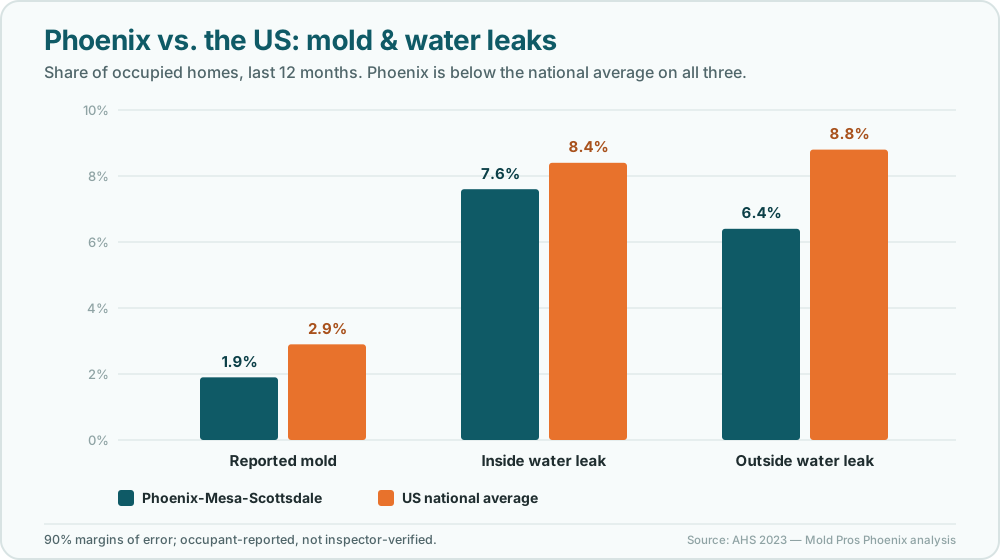
Why would the desert come in under average? The leak data points to the answer. Phoenix homes reported inside water leaks at 7.6% (versus 8.4% nationally) and outside leaks at 6.4% (versus 8.8%). If mold tracks water intrusion — and it does — then a metro with fewer reported leaks should report less mold. Phoenix gets its moisture in concentrated bursts (a monsoon, a slab leak, an overflowing condensate pan), not as the steady, year-round ambient humidity that feeds mold across the Gulf Coast and Southeast. Less constant dampness, fewer leaks, less mold.
That is the honest frame, and it cuts both ways. “You can’t get mold in the desert” is still a myth — 37,700 homes a year is not zero, and the EPA is blunt that the key to mold control is moisture control, with humidity just one moisture source alongside the leaks and condensation that drive most Phoenix cases. But Phoenix is also not a mold capital. The accurate picture sits in between: mold here is real, fixable, and predictable, because it follows specific water events rather than the weather.
Where Phoenix mold actually shows up
If mold here follows water rather than air, the rooms it appears in should be the wet rooms. They are.
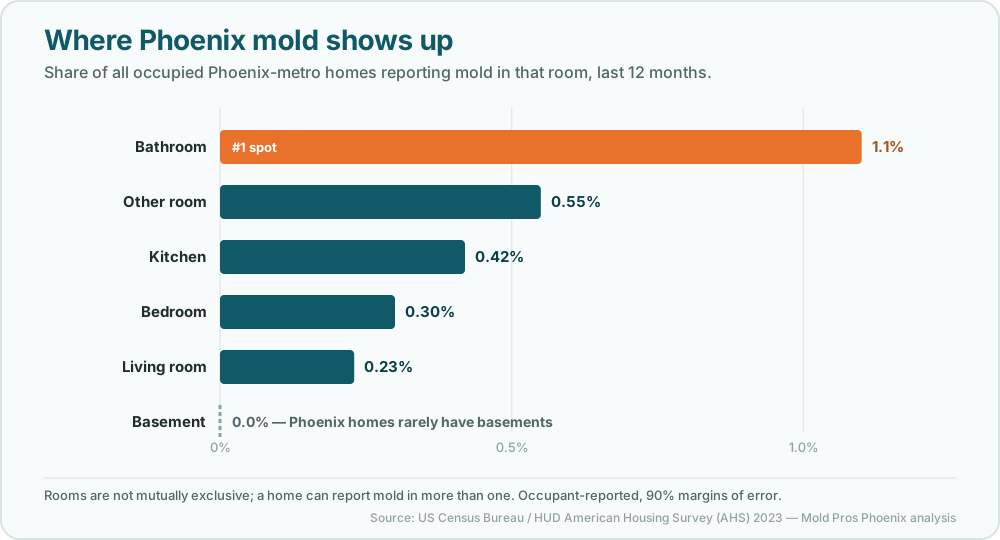
The bathroom leads at 1.1% of all occupied homes — the single most common room, and no surprise: it is the room with the most routine water exposure, day in and day out. Behind it come another/other room (0.55%), the kitchen (0.42%), a bedroom (0.30%), and a living room (0.23%). The bedroom and living-room numbers are the tell that mold here is not purely a plumbing-fixture story — those rooms catch ceiling stains from roof and condensate intrusion above them, and wall moisture from slab leaks below.
The most Phoenix-specific data point is the one at the bottom of the chart: basements register 0.0%. That is not a rounding artifact so much as a building fact. Phoenix homes are overwhelmingly slab-on-grade; basements are rare in Valley construction. Whole categories of mold problem that dominate older Midwestern and Eastern housing stock — the damp, below-grade basement — barely exist here. It is a small reminder that local building patterns, not just climate, decide where mold can and cannot hide. (These room figures sit on small samples, so read them as the shape of the problem, not precise rates.)
The leak-and-age story: older homes leak more
The cleanest secondary pattern in the data is about age. Older Phoenix homes leak more — and where there is more water, there is more of the risk that precedes mold.
Inside water-leak rates fall on a steady gradient as homes get newer: roughly 8.8% of homes built before 1980 reported an inside leak, dropping to about 4.6% for homes built 2010 or later. That is close to a halving across the age range, and it lines up with plain physics — older supply lines, older roofs, older fixtures, and more decades of wear. The mold-by-age numbers move in the same direction (pre-1980 homes report mold around 2.9%, newer homes lower), but those cells are small, so we treat age-versus-mold as directional and let the much steadier leak gradient carry the point.
This is the practical heart of the report. A Phoenix mold problem is far more likely to be a plumbing-and-building-age problem than a climate problem. An older home with aging copper or galvanized lines, a roof that has weathered a few monsoons, and an AC system that has run a few too many summers is the profile most exposed — not because Phoenix is humid, but because that home has more places for water to get loose. And nearly all of those homes share one trait: about 97% of occupied Phoenix homes have central air conditioning, so AC condensate is a near-universal moisture source worth keeping an eye on, whatever the home’s age.
How this connects to when and why Phoenix mold happens
This report answers one question: how common is mold in Phoenix, and where does it show up? The answer is “less common than average, concentrated in wet rooms and older/leak-prone homes.” But it deliberately does not cover when mold risk peaks across the year, or the physical mechanics of why — the monsoon, the AC condensate cycle, the slab leaks, the pools.
That companion picture lives in our 2026 Phoenix Mold Risk Report, which maps the seasonal risk calendar and the five specific moisture drivers behind Valley mold. Read together, the two reports give the full shape of the problem: this one is the how-common-and-where (federal survey data on actual reported mold), and the Risk Report is the when-and-why (the weather, climate, and building mechanics that produce it). Where this report shows the bathroom and older homes lead, the Risk Report explains the monsoon-and-condensate timing that drives the moisture in the first place.
What it means for a Phoenix homeowner
The takeaway from the federal data is, on balance, reassuring — and actionable:
- Don’t panic, but don’t dismiss it. At roughly 1.9% of homes, mold is below the national rate, so the desert is not a mold trap. But 37,700 homes a year is real, and “we live in a dry climate” is not a reason to ignore a stain or a smell.
- Watch the wet rooms first. The bathroom is the #1 reported location, with kitchens close behind. If you are going to check anywhere, start where the survey says mold actually shows up.
- Treat age and leaks as your real risk signal. Older homes leak roughly twice as often as new ones. If your home predates 1980, its plumbing and roof — not the weather — are the variables to watch.
- Mind the AC. With central air in about 97% of Phoenix homes, a clogged condensate line or rusted drain pan is one of the most common ways water gets loose indoors. It is cheap to check and easy to miss.
If you have found mold, or you can smell it but can’t see it, the right first move is to confirm the moisture source — which is exactly what a professional mold inspection is built for. We handle mold across the Phoenix metro, from bathroom and kitchen growth to hidden slab and condensate leaks. You can get a free, no-obligation quote using the form below, see how mold removal actually works step by step, or read our Phoenix mold removal overview for the full range of Valley conditions. For the seasonal side of the story, start with the 2026 Phoenix Mold Risk Report, and the full library of Phoenix mold guides covers each growth type and room in depth.
Sources
This report is a re-analysis of the following public sources. Every figure above is drawn from the American Housing Survey microdata or its official documentation.
- U.S. Census Bureau / HUD — American Housing Survey (AHS) 2023, National Public Use File. Source microdata for all Phoenix-Mesa-Scottsdale (CBSA 38060) estimates: reported mold, water leaks, mold by room, and central-air prevalence; weighted to households with 90% margins of error from 160 replicate weights, validated against the Census Bureau’s published national verification estimate. AHS 2023 National Public Use File (PUF)
- U.S. HUD — Cityscape, “Musty Smells, Mold, and Moisture in the U.S. Housing Stock.” Peer-reviewed methodology for using the American Housing Survey’s mold and moisture items, which informed how the screener and room follow-ups are interpreted here. Cityscape Vol. 23 No. 1, Chapter 8 (PDF)
- U.S. EPA — “A Brief Guide to Mold, Moisture and Your Home.” Source for the EPA’s core position that the key to mold control is moisture control, including keeping indoor humidity low. EPA Brief Guide to Mold, Moisture and Your Home