Does UV Light Kill Mold? Only What It Directly Reaches
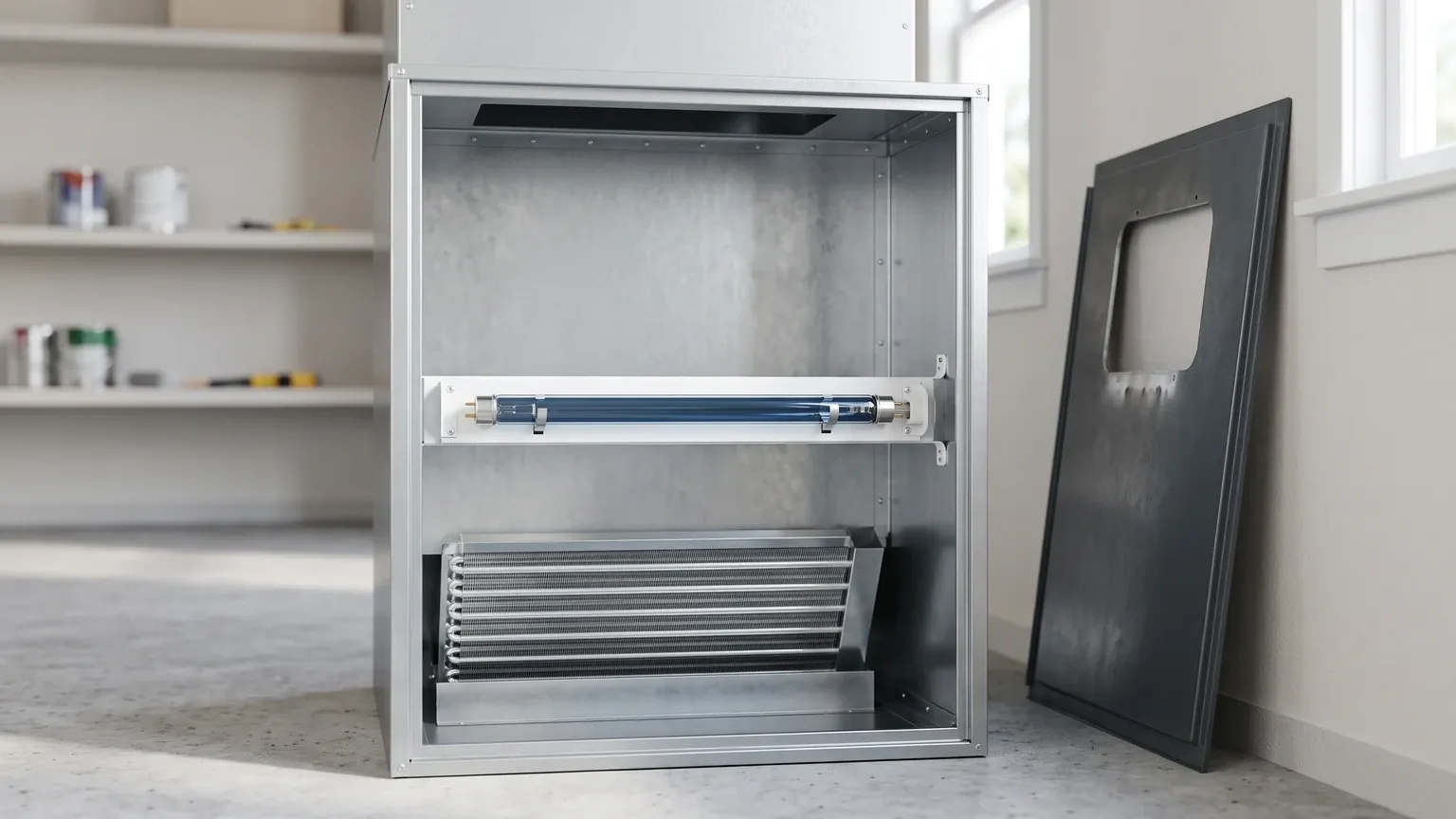
UV-C kills mold it directly reaches. EPA says a properly designed UVGI cleaner may destroy some molds on moist HVAC surfaces like cooling coils and drain pans, but that typical home units have limited effectiveness in killing bacteria and molds. ASHRAE explains why surfaces are easier: a coil gets continuous exposure, while air passing a lamp gets seconds or fractions of a second, and fungal spores are the most UV-resistant group ASHRAE ranks. Neither reaches mold inside a wall.
Does UV light kill mold?
Yes, in the narrow sense that UV-C is germicidal. ASHRAE defines the UV-C band as 100 to 280 nm. The question most homeowners are really asking is different: will the lamp an HVAC contractor is quoting protect my house from mold?
The EPA has one short page on it. It says that if properly designed, ultraviolet germicidal irradiation (UVGI) cleaners “may destroy indoor biological pollutants such as viruses, bacteria, and some molds that are growing on the moist interiors of HVAC surfaces (e.g., cooling coils, drain pans, or ductwork).” Then it adds the limit: “But typical UVGI cleaners used in homes have limited effectiveness in killing bacteria and molds.”
The scope is easy to get wrong. EPA’s limit is not about treating air specifically; it covers typical UVGI cleaners used in homes, coil lamps included. EPA’s own dividing line is design quality: “if properly designed” on one side, “typical” home units on the other. ASHRAE’s engineering chapter explains why surface work is the easier of the two jobs. That is physics, not evidence that a given residential lamp reaches a dose that works.
We cover the sunlight version of this question in does the Arizona sun kill mold. This page is about lamps: in-duct tubes, coil lamps and “UV air purifiers.”
Why the answer splits in two: exposure time, and the intensity it forces you to buy
The clearest explanation comes from the ASHRAE Handbook (2020 HVAC Systems and Equipment, Chapter 17, “Ultraviolet Lamp Systems”), the engineering reference for this equipment. It says:
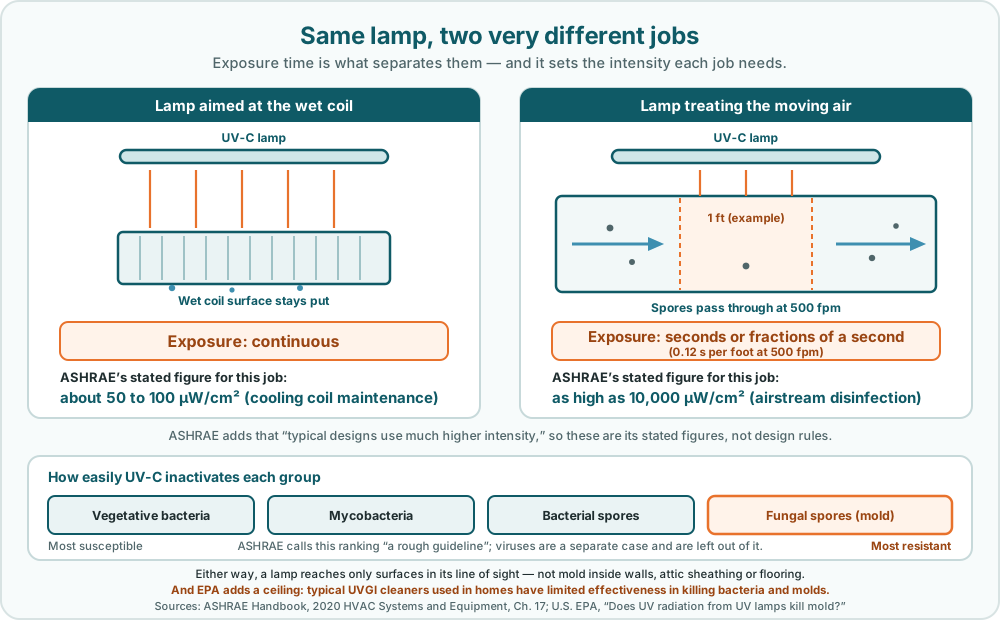
“A key difference between surface decontamination and airborne inactivation of organisms is exposure time. Residence time for in-duct devices is on the order of seconds or fractions of seconds. In a moving airstream, exposure time is limited by the effective distance in which the average irradiance was calculated; for instance, at 500 fpm, 1 ft of distance takes 0.12 s.”
So a lamp that treats air has a tiny window. ASHRAE continues that methods against an airborne threat “must be effective in seconds or fractions of a second, depending on the device’s characteristics,” and that “high UV intensity and/or more in-line depth to extend exposure time of the airstream is generally required.” Note the two levers: intensity, or a deeper irradiated zone. Then the other half: “Conversely, when irradiating surfaces in an HVAC system, exposure time is typically continuous, so much lower levels of UV intensity are required.”
That is the whole idea. A wet coil sits in front of a lamp all day. A spore in the airstream is past it in a fraction of a second — ASHRAE’s 0.12 s is the time to cross one foot at 500 fpm, so the real figure depends on how deep the irradiated zone is, which is why ASHRAE gives the range as “seconds or fractions of seconds.”
The two halves are not independent, either. ASHRAE defines UV dose as the “Product of UV irradiance and exposure time on a given microorganism or surface.” Cut the time and the only way back to the same dose is intensity — which is exactly what ASHRAE prescribes for air.
ASHRAE puts figures on the two jobs: “UV-C intensity in a system can be as high as 10,000 µW/cm2 for airstream disinfection, or about 50 to 100 µW/cm2 for cooling coil maintenance, although typical designs use much higher intensity.” ASHRAE gives these while discussing how UV-C degrades nearby materials, not as design targets. And if real coil designs run “much higher,” as that sentence says they do, the printed gap is not the design gap.
Why mold is the hardest of the groups ASHRAE ranks
ASHRAE ranks organisms by how easily UV-C inactivates them: “vegetative bacteria are the most susceptible to UV-C, followed by the Mycobacteria, bacterial spores, and, finally, fungal spores, which are the most resistant.”
Two cautions from the same passage. The ranking “should only be used as a rough guideline,” because in each group an individual species “may be significantly more resistant or susceptible than others.” And spore-forming bacteria and fungi “also have vegetative states, which are markedly more susceptible to inactivation than the spores themselves.” Viruses are left out of the ranking as “a separate case,” because their susceptibility range is broader still.
To represent that group, ASHRAE’s Table 1 names Aspergillus versicolor, Penicillium chrysogenum and Stachybotrys chartarum — species chosen as stand-ins for fungal spores generally, not as a finding about any particular house. They are all indoor-relevant genera, and Stachybotrys chartarum is the one sold as “black mold.” Our black mold guide covers what that label does and does not mean.
EPA, writing specifically about home units, points the same way: “Effective destruction of some viruses and most mold and bacterial spores usually requires much higher UV exposure than is provided in a typical home unit.”
You cannot design to a mold number
You will see precise-sounding UV figures online. ASHRAE explains why to distrust them: “Values of k vary over several orders of magnitude, depending on organism susceptibility, and values reported in the literature for the same microorganism sometimes differ greatly.” Its own example notes that reported values for a single bacterium differ, and it blames measurement conditions “(in air, in water, on plates).”
Chapter 17 does carry one affirmative finding on in-duct air. Reporting an Air-Conditioning and Refrigeration Technology Institute project, ASHRAE says: “The data indicate that UV-C systems can be used to inactivate a substantial fraction of environmental bioaerosols in a single pass of air through a duct.” That covers environmental bioaerosols as a class rather than mold specifically, and it is not a percentage anyone can hold a seller to.
What does not exist is a reliable single number for an in-duct lamp to hit against mold. Figures circulate anyway — a minute here, ninety minutes there — and a seller quoting one is quoting a number the engineering literature does not settle. That is reason enough to be skeptical of any quote promising a specific percentage of mold killed in your air.
Where a coil lamp has a real target in a Phoenix air handler
The surface EPA names is the moist interior of cooling coils and drain pans. In Phoenix, an air conditioner is cooling for much of the year, and while it does, the evaporator coil and condensate pan are wet. That makes a coil lamp’s target surface a real one here. A lamp aimed at the coil gives the continuous exposure ASHRAE says surface work depends on.
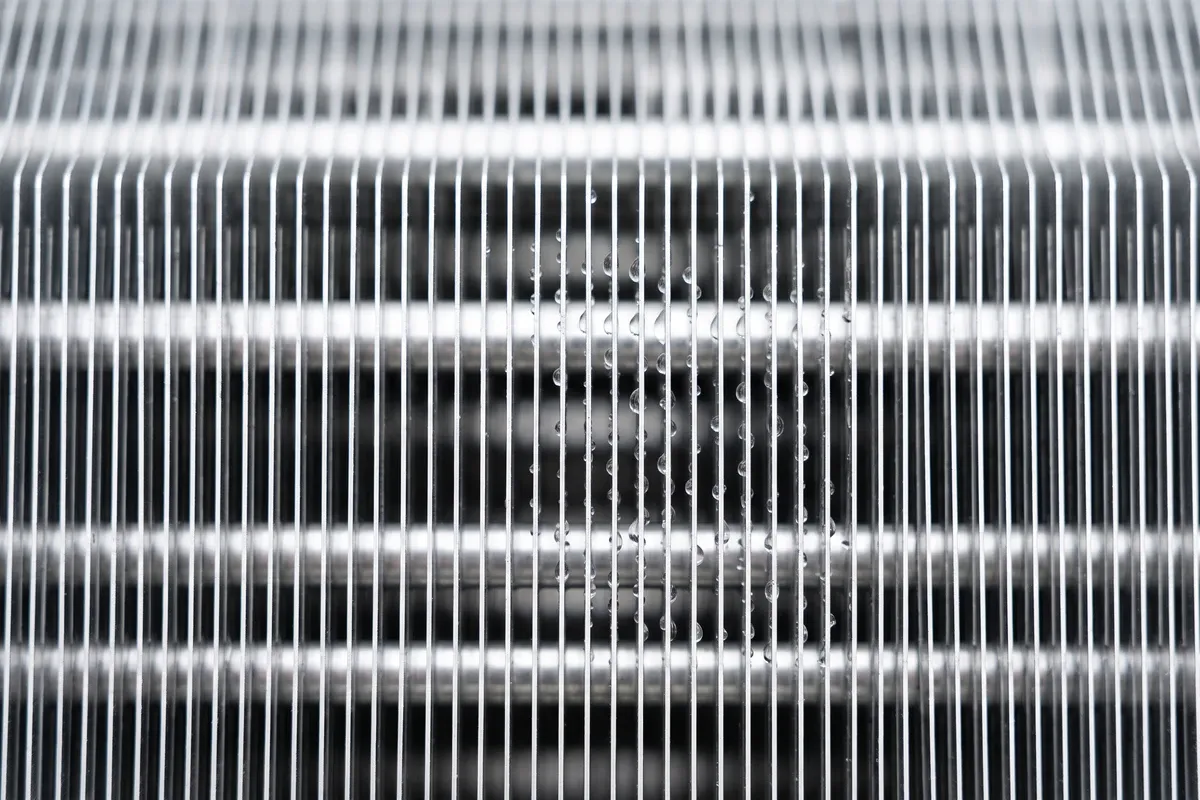
It is also where a lot of Valley mold starts. The AC condensate system, with its pan and drain line, is one of the main mold sources in Phoenix homes. A lamp does nothing about a clogged line. If water backs up, the drainage fault is the problem and the lamp is decoration. Our clogged AC drain line guide covers the fix that has to come first, and mold in your AC and air vents covers what the growth looks like.
If there is already visible growth on the coil, the pan or the ducts, no lamp will clear it. That is remediation work, and our HVAC and air duct mold removal page sets out how it is scoped.
A coil lamp is a narrow tool for a surface that stays wet. It is weakest where it is marketed hardest, in the claim that it cleans the air in your house.
What a UV lamp cannot reach
ASHRAE is direct: “UV-C energy does not normally penetrate through solid substances and is attenuated by most materials.”
Light travels in straight lines and stops at surfaces. Mold on the paper face of drywall behind a leaking wall, on attic roof sheathing after a monsoon leak, under flooring over a slab leak, behind cabinets near a plumbing line, or in the pads of a swamp cooler is not in the lamp’s line of sight. A lamp inside an air handler sits in a different part of the house from every one of those.
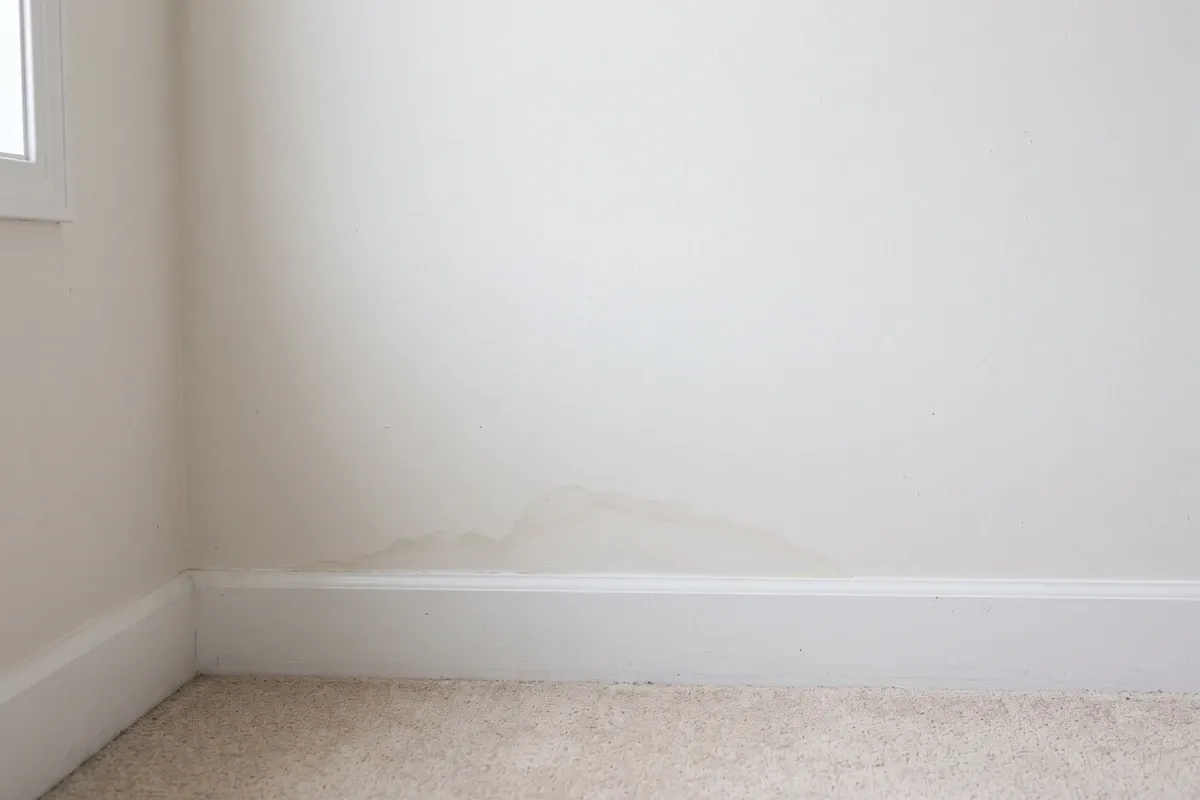
Killing is also not the same as removing, and EPA draws a conclusion from that which belongs on any UV quote: “dead mold spores can still produce allergic reactions, so UVGI cleaners may not be effective in reducing allergy and asthma symptoms.” Our guide to whether dead mold needs to be removed goes through why removal, not just killing, is the standard.
The same logic shows up in a neighboring question. We cover the machine that fills a room with gas in does ozone kill mold. Writing about portable air cleaners and furnace/HVAC filters rather than UV lamps, EPA says such devices “may remove some of the particles generated by mold,” but “they will not resolve a mold and moisture problem.” A device treats the air. The water is the cause.
The costs nobody quotes you: filter media, foam and ozone
Two side effects are rarely on the quote.
Materials near the lamp. ASHRAE says UV-C damages some HVAC parts: “For many HVAC components, such as certain filter media and insulation or gasket foams, degradation can be rapid and severe, destroying the material.” It singles out synthetic filters: “Of particular concern are many types of synthetic media filters, which may degrade rapidly.” There is an exception: “many filters of a woven or ‘laid up’ glass media (e.g., HEPA filters) maintain integrity with intensive UV-C exposure.” And “Inorganic materials such as glass, glass fibers, and metal are not affected by UV-C exposure.”
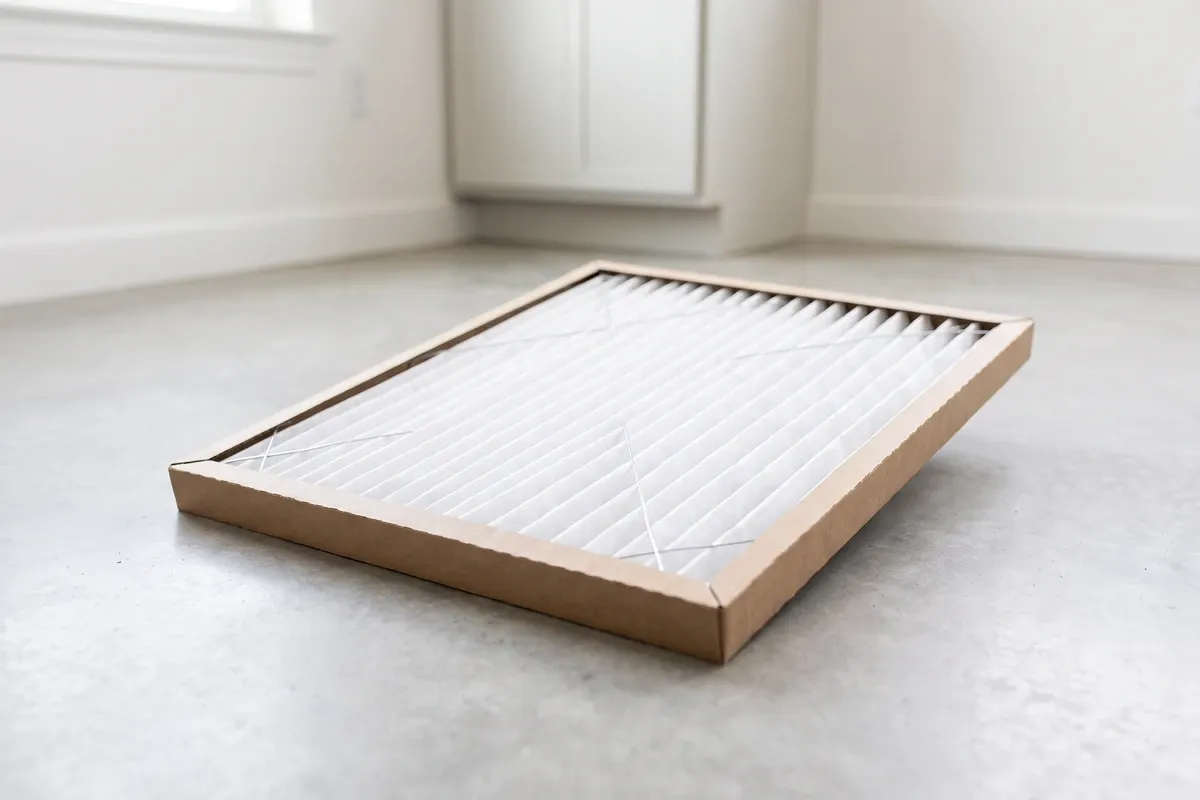
The coil case degrades far more slowly, though: “Lower doses of UV-C exposure to organic materials, or those typically sized for cooling coil surface treatment, showed much slower rates of degradation.” ASHRAE adds that “[a]lthough UV-C photodegradation is of concern, with the selection of the proper material or metallic shielding of other components, the problem is significantly reduced and components can be expected to meet product design life.”
It even gives the rule of thumb: “As a simple, practical approach, it is wise to shield all organic material components within about 5 ft of the UV lamp.”
So this is a design detail to check, not a reason to walk away. The concrete question for an installer: what sits within about five feet of this lamp, and is any of it synthetic media, insulation or gasket foam?
Ozone. EPA’s guide to home air cleaners says: “Note that in some cases, air cleaners that contain electrostatic precipitators, ionizers, UV lights without adequate lamp coatings, and plasma air cleaners may have the potential to emit ozone.” It adds: “Ozone is a lung irritant.”
ASHRAE fills in the detail that makes EPA’s caveat usable. Radiation below 200 nm, which it calls vacuum UV, “will produce ozone (O3) in air” — but “most UV-C lamps used for HVAC applications are treated with an interior coating that prevents any vacuum UV (200 nm and below) from being emitted from the lamp, so ozone production is not an issue.”
So the two sources are not in conflict: EPA’s warning is about lamps without adequate coatings, and ASHRAE says most HVAC UV-C lamps carry one. That makes the coating the question worth asking, rather than ozone in the abstract. EPA also notes the California Air Resources Board and the Association of Home Appliance Manufacturers keep lists of air cleaners “that have been tested and shown to emit little or no ozone.”
So should you buy one? An honest decision framework
Start with the ceiling EPA puts on the whole category: “typical UVGI cleaners used in homes have limited effectiveness in killing bacteria and molds,” and because dead spores still provoke reactions, “UVGI cleaners may not be effective in reducing allergy and asthma symptoms.” Nothing below lifts that ceiling. Within it, a coil lamp is a defensible modest add-on, and it is not a mold fix. Here is how that sorts out.
It is a reasonable add-on when:
- The coil or drain pan has a recurring growth history.
- The drainage has been fixed first and is staying clear.
- The lamp is aimed at the coil, not sold as a whole-house air cleaner.
- The lamp coating is confirmed, or the unit is on a CARB or AHAM tested list.
- Nearby synthetic filter media, insulation or foam is shielded or replaced with glass-based material.
It is not the right buy when:
- It is being sold as the fix for a musty smell.
- There is visible mold on a wall or ceiling.
- A drainage fault, leak or condensate overflow is still active.
Questions worth asking before you sign a quote:
- What is the lamp aimed at: the coil and pan, or the air?
- Is the condensate drain clear, and who confirmed it?
- What synthetic filter media, insulation or gasket foam sits within reach of the lamp?
- Does the lamp carry the interior coating that blocks the sub-200 nm band?
- What happens to the lamp’s job if the drain clogs again?
If a seller cannot answer the first question plainly, that tells you something about the quote. And if you decide the answers do not justify the price, you have lost nothing: the cheap, effective steps are the ones above the lamp — clearing the line and keeping the coil clean.
A lamp is never a substitute for fixing the water. If there is already growth on the coil, the pan or the ductwork, that is a cleaning job rather than a lighting one, and our HVAC and air duct mold removal page covers how it is scoped and priced. The mold guides hub lists the rest of our guides.
Sources
- U.S. EPA — Does ultraviolet (UV) radiation from UV lamps kill mold?: the “may destroy” statement for moist HVAC surfaces, the “limited effectiveness” statement for typical home UVGI cleaners, the higher exposure needed for most mold spores, and that dead mold spores can still produce allergic reactions.
- ASHRAE — ASHRAE Handbook, 2020 HVAC Systems and Equipment, Chapter 17, “Ultraviolet Lamp Systems”: the exposure-time passage and 0.12 s figure, the two intensity figures with their caveat, the susceptibility ranking and Table 1, the k-value variability passage, the penetration passages, and the material-degradation passages. ASHRAE defines UV-C as 100 to 280 nm.
- U.S. EPA — Guide to Air Cleaners in the Home: ozone emission from UV lights without adequate lamp coatings, ozone as a lung irritant, the CARB and AHAM tested-device lists, and the statement that portable air cleaners and furnace/HVAC filters will not resolve a mold and moisture problem.