Dirty Sock Syndrome: Why AC Smells Like Socks
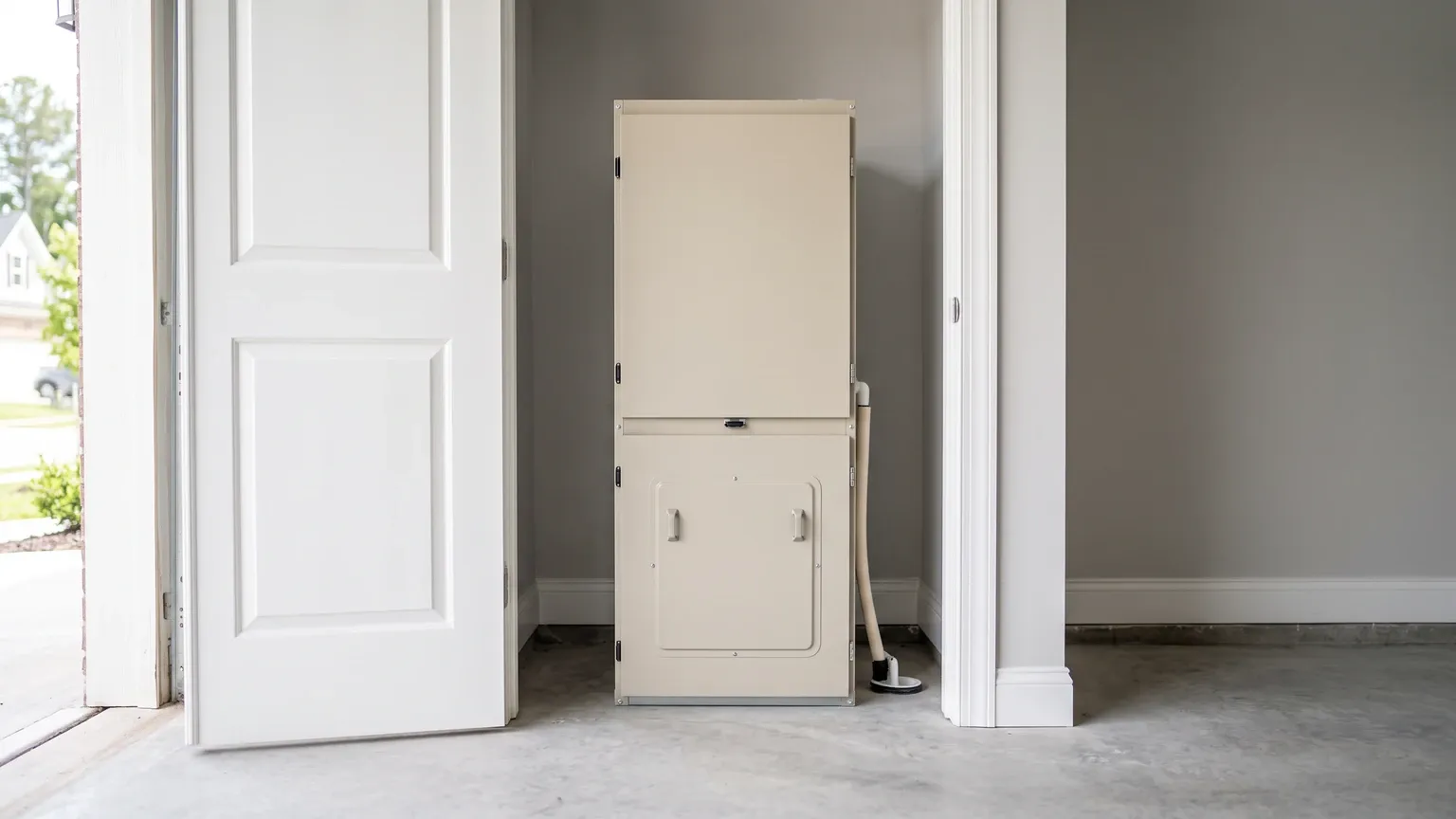
Dirty sock syndrome is the HVAC trade’s name for a musty, sour smell when a system first runs in heating mode. The trade attributes it to microbial growth on the indoor coil; no specific organism has been identified as the source of the dirty-sock odor. In Phoenix the window would be narrow: the first heat calls of the season, in November and to a lesser extent October.
What “dirty sock syndrome” actually is
The name is a trade nickname, not a diagnosis. HVAC contractors use it for an odor homeowners describe as damp socks, gym socks or feet, noticed at the vents in the first minutes of a heating cycle and often gone after that.
The trade publication ACHR News ran a 2006 piece on the problem and put it plainly: “No one seems to know for sure what causes it, but nearly everyone agrees it is likely bacteria related.” By 2014 the same publication reported a firmer position: “Twenty plus years of data collection from numerous investigations has manufacturers, academia, and practitioners in agreement that the dirty sock odor can only be the result of microbial activity,” citing ASHRAE handbooks for the view that the odor “stems from the decay of accumulated organic debris by microorganism activity.”
Worth knowing who wrote that: the 2014 article is by Forrest Fencl, and its own author note describes him as “The president of UV Resources,” a company that sells UV-C lamps. The same note credits him as an ASHRAE Fellow and a co-author of several ASHRAE Handbook chapters on ultraviolet treatment, and the piece concludes that UV-C lamps are “currently the best solution to provide 24/7 cleaning of coils and drain pans.” Both things are true, and both matter when you read it. We cite it for the cause, which the 2006 article points at too, and not for the remedy — EPA puts a much narrower limit on what a typical home UV lamp does, which we cover in does UV light kill mold. So the cause is agreed at the level of a category, microbial activity. What is still missing is narrower: no specific organism has been identified as the source of the dirty-sock odor, and we found no peer-reviewed study that tested that odor in a residential heat pump running in heating mode.
The working explanation is a microbial film on the indoor coil. If you want to place that inside the bigger picture, our overview of mold in your AC and air vents covers the system, and our guide to what mold smells like covers telling smells apart.
Why does the smell show up when the heat comes on, even though you call it the AC?
The short version, if the trade’s explanation holds: a heat pump reverses in winter, so the indoor coil that ran cold and wet all summer becomes a warm surface, and the film that built up on it gives off the smell in the first minutes of a heat call. That is also why people call it an AC smell — in a heat pump, the air conditioner and the heater are the same machine.
In a heat pump, the same indoor coil that chills the air in summer works as a warm surface in winter, because the system runs in reverse. A coil that spent the cooling season wet and cold becomes a coil that is warm.
ACHR News reported in 2006 that “the problem seems to be limited to heat pumps,” and gave a temperature explanation. In its words, “In most gas-fired furnaces, the coil temperatures exceed 160°F, a temperature that would kill most microbial life. But in heat pumps, the typical coil temperatures during heating cycles is between 120 and 130°, a temperature that seems ideal for the supposed microorganism to thrive.” Those temperatures are what that trade publication reported in 2006, in the same article that says the cause is not known. We cannot confirm them independently, so read them as the trade’s explanation and not as measured fact about your equipment.
If the explanation holds, the timing makes sense. The biofilm builds while the coil is wet, then the first heat call warms it, and the smell rides the first air out of the vents.
There is a second pattern in the trade literature that matters more in a desert than the first-heat-call story alone. The 2014 article, in a list of what it says residential contractors have written, reports that “The problem mostly occurred during ‘shoulder’ seasons like fall and spring, when the units would be used for heating at night and cooling during the day.” On our reading, a Phoenix October is that description almost exactly.
One peer-reviewed finding points the same way, though it is about cooling rather than heating. Pei and Sun, writing in Sustainability in 2023, measured odor from building air conditioners and identified the odor compounds by gas chromatography and olfactometry. Their conclusion: “reducing the residual condensed water in air conditioners may be the key to control odor emission before purification.” That is a different mode and a different climate from a Phoenix heat call, but it ties the smell to water left on the coil.
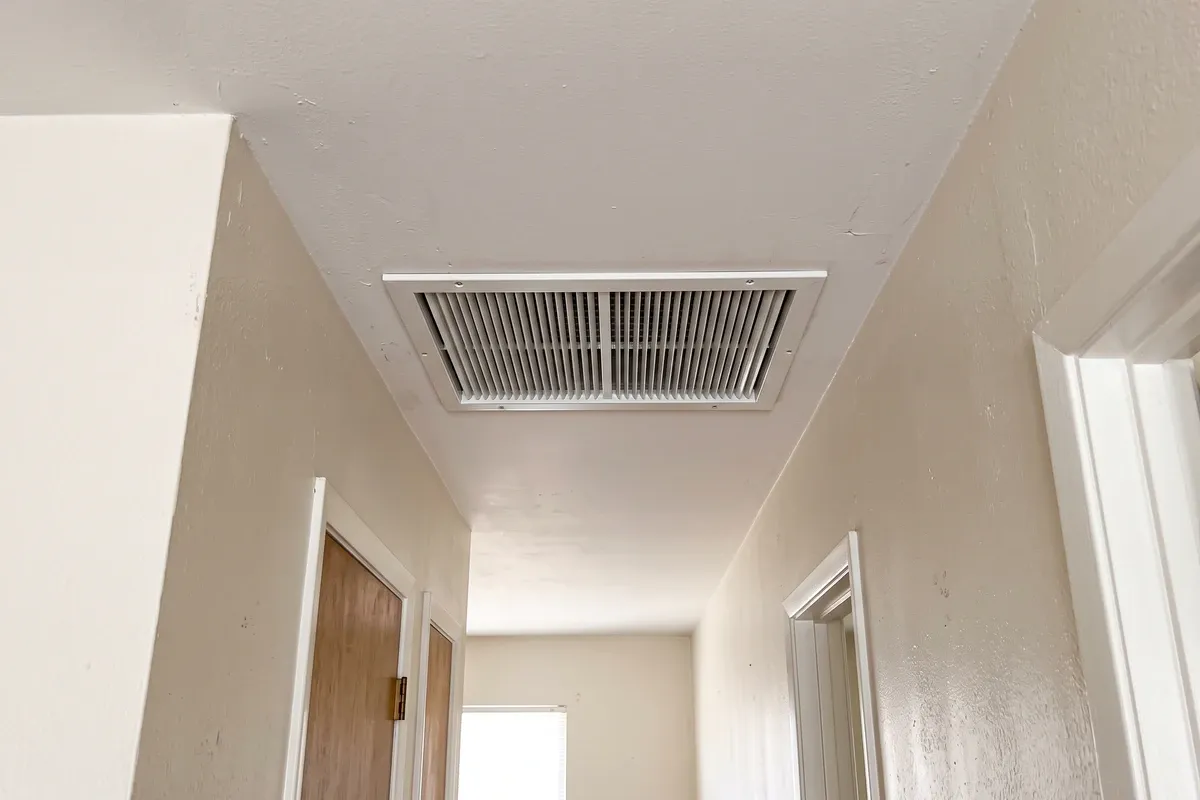
The Phoenix version would be an October-November problem, not a year-round one
The standard story runs into the Valley’s weather here. Houston contractor David Debien told ACHR News that the problem is “unique to very hot, very humid conditions.” Phoenix is very hot, and humid only for part of the year. The same 2006 article also reports a case in Boston, which undercuts the idea that it belongs to one climate. Debien’s condition is a fair objection in a desert climate.
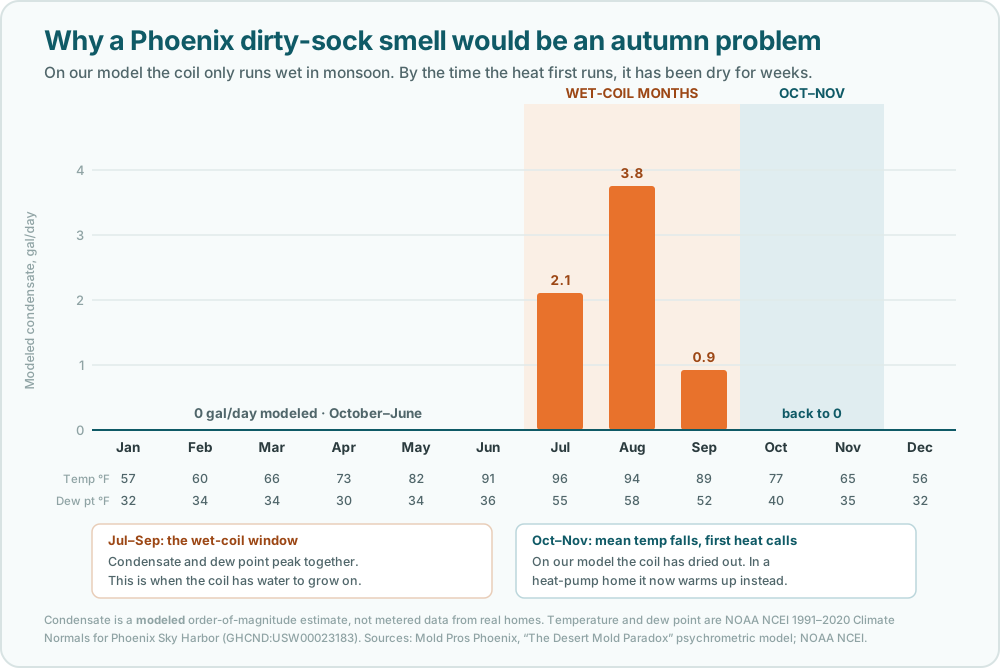
Our own psychrometric analysis of Phoenix AC condensate models how much water a Phoenix air conditioner pulls off its coil each month. It is modeled, an order-of-magnitude estimate built from NOAA 1991-2020 Climate Normals for Phoenix Sky Harbor, and not metered data from real homes. On that model, mean dew point is 54.5 °F in July and 57.9 °F in August, and modeled condensate runs about 2.1 gallons per day in July, about 3.8 in August and about 0.9 in September. In October the mean dew point drops to 39.9 °F and modeled condensate drops to zero. It stays at zero through June.
So a Phoenix coil is not perpetually damp. On our NOAA-based model it carries condensate for roughly three months a year, July through September, and none at all from October through June. That would put the first heat calls of October and November on a coil that has been dry for weeks. Those condensate figures are modeled, not metered. That matters because a 2020 Indoor Air study (Bakker et al.) of 40 large commercial air conditioners, drawn from warm-humid and hot-dry climates, found that coil bacterial and fungal communities were significantly affected by outdoor climate “through differences in dew point that result in increased moisture (condensate) on coils.” That is commercial equipment, not a house, and it did not measure Phoenix. It does support the logic: dew point drives condensate, and condensate shapes what lives on the coil.
Put those together and the Valley prediction is narrow. A biofilm would build during the monsoon-loaded months, the coil would dry out in October, and the first heat calls would arrive as the mean temperature falls to 77.4 °F in October and 65.1 °F in November. Debien described the trigger as “this short cycle of hot and cold,” in Houston, where “many days you’ll need heat when you wake up in the morning, but by afternoon the air conditioner will be on.” Phoenix shoulder season produces the same back-and-forth. That is our reading of how the trade’s mechanism would map onto our own data, not something anyone has measured here.
| Month | Modeled condensate (gal/day) | Mean dew point (°F) | Mean temp (°F) |
|---|---|---|---|
| July | about 2.1 | 54.5 | 95.5 |
| August | about 3.8 | 57.9 | 94.4 |
| September | about 0.9 | 51.8 | 89.2 |
| October | about 0 | 39.9 | 77.4 |
| November | about 0 | 34.8 | 65.1 |
| December–June | about 0 | 29.7–35.9 | 55.8–91.4 |
Condensate is a modeled, order-of-magnitude estimate, not metered data from real homes. Temperature and dew point are NOAA NCEI 1991–2020 Climate Normals for Phoenix Sky Harbor (GHCND:USW00023183). Source: our psychrometric analysis of Phoenix AC condensate.
Is it mold or bacteria? (and why the answer changes what you should buy)
The closest thing to a measurement of what lives on a real cooling coil is a pair of papers from Bakker and colleagues. The 2018 study in Indoor Air sampled 25 air conditioning units in the “humid, subtropical climate of Southern CT” and 15 in the “hot-summer Mediterranean climate of Sacramento.” These were commercial units, not residential, and neither place is a hot-arid climate. Its median results: bacteria on the coils at 1.2 × 10⁷ cells/m² and fungi at 7.6 × 10⁵ spore equivalents/m². That is bacteria ahead by more than an order of magnitude across those 40 commercial units. The paper also reported “median unit concentrations ranging three orders of magnitude for bacteria and seven orders of magnitude for fungi” from unit to unit, and named “the nominal efficiency of upstream filters” and “coil moisture” among the dominant factors.
Two limits belong with that. It counted what was on coils; it did not test which organism makes a smell. And it does not tell you what is on a Phoenix house’s coil.
Cars show a similar pattern. A 2020 mSphere study of automobile air conditioners, with samples from South Korea, China, the United States, India and the United Arab Emirates, found “the extraordinary dominance of Methylobacterium species in EC biofilms,” and said these communities affect “malodor.” That is car air conditioning, not a house, and we cite it only as a hint that the organisms dominating a wet evaporator surface are biofilm formers. Park and colleagues measured the community, not the smell. We cover the genus in our pink film in the shower guide.
Why this changes what you buy. ACHR News noted that “One manufacturer recommends coating coils with a mold preventative, but, since the problem is generally thought to be bacterial, it’s difficult to see how that will help.” That was one trade writer’s view in 2006, but the logic holds up: if the smell is mostly a bacterial biofilm, a product sold as a mold treatment may be aimed at the wrong target. It is a reason to ask any seller what exactly the treatment is meant to remove, and why.
If you heat with a gas furnace instead
Heat pumps are common in Arizona but not universal. Federal data from the EIA’s 2020 Residential Energy Consumption Survey put a central heat pump as the main heating equipment in 25% of Arizona homes (0.67 of 2.68 million), roughly double the 13% national share. A furnace was the main equipment in 55%, and 86% of Arizona homes use a central air conditioner. Those are Arizona statewide figures. We have no Phoenix-metro figure.
So most Arizona homes do not match the heat pump pattern. If yours heats with a furnace, remember what ACHR News reported: in most gas-fired furnaces the coil temperatures exceed 160°F. That is a trade-press figure, but if it describes your equipment, it points away from the heat-mode explanation above.
A musty smell in a furnace home deserves its own diagnosis, and it is usually a moisture question: a drain pan, a drain line, damp insulation. Start with our guide to the musty smell in a house and the clogged AC drain line guide, which cover that ground.
The one test you can do before you call anyone
The useful observation is the pattern. Notice whether the smell appears only in the first several minutes of a heat cycle and then fades, or whether it stays. Write down the month and whether it happened with the system in heat or in cool. That is information to hand to whoever services the system, not a diagnosis. A short-lived smell fits the pattern described above; it does not rule out a moisture problem.
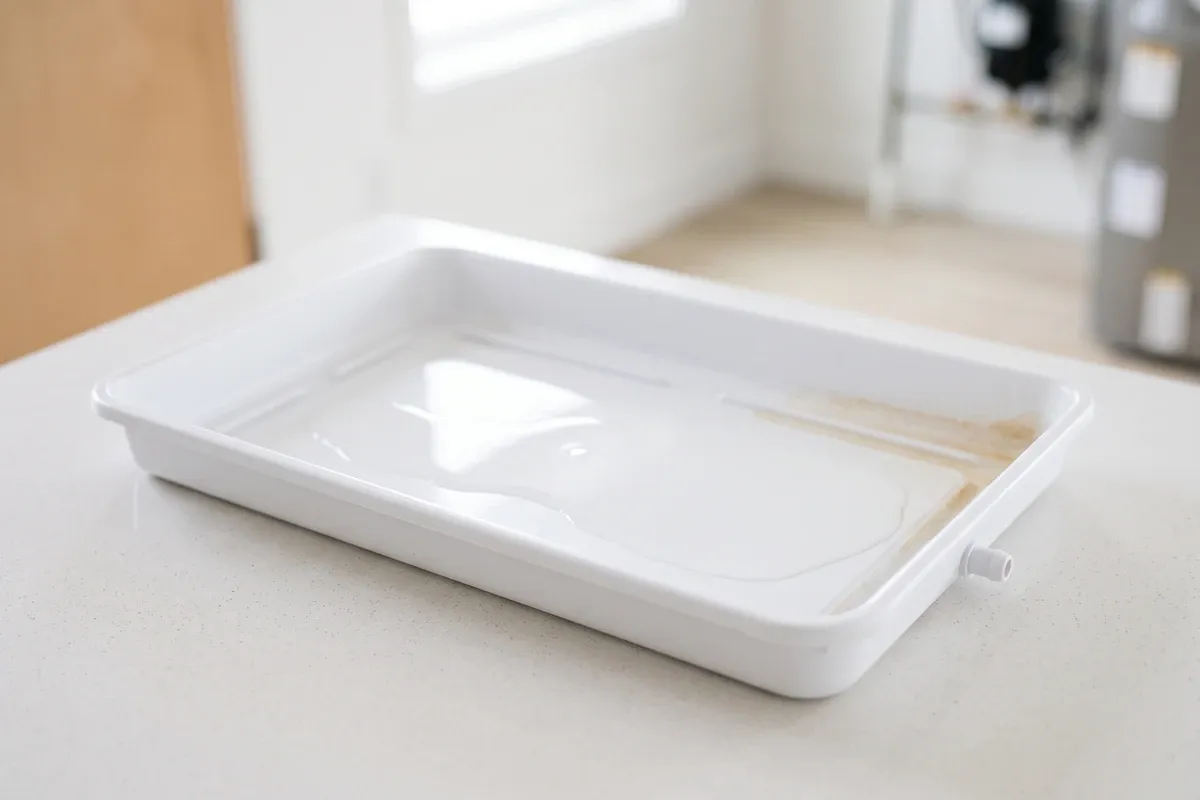
Then look at the drain pan, if it is accessible and the system is off. EPA’s duct-cleaning document says: “Make sure the condensate pan drains properly. The presence of substantial standing water and/or debris indicates a problem requiring immediate attention.” It also says to make sure “drain pans slope toward the drain.” A pan that is simply damp is a different thing from one holding water and debris. If you cannot reach it, that is useful to know too; EPA says air handlers “should be constructed so that maintenance personnel have easy, direct access to heat exchange components and drain pans.”
What actually fixes it, and what gets sold instead
Work in this order: (1) have the cooling coil and drain pan checked and cleaned, (2) match the filter to the rating your equipment manufacturer specifies, (3) consider duct cleaning only against EPA’s as-needed bar, (4) ask hard questions about biocides, coil coatings and UV add-ons, (5) replace wet or moldy duct insulation rather than cleaning it, and (6) fix the moisture source, because EPA says growth recurs if the cause is not corrected.
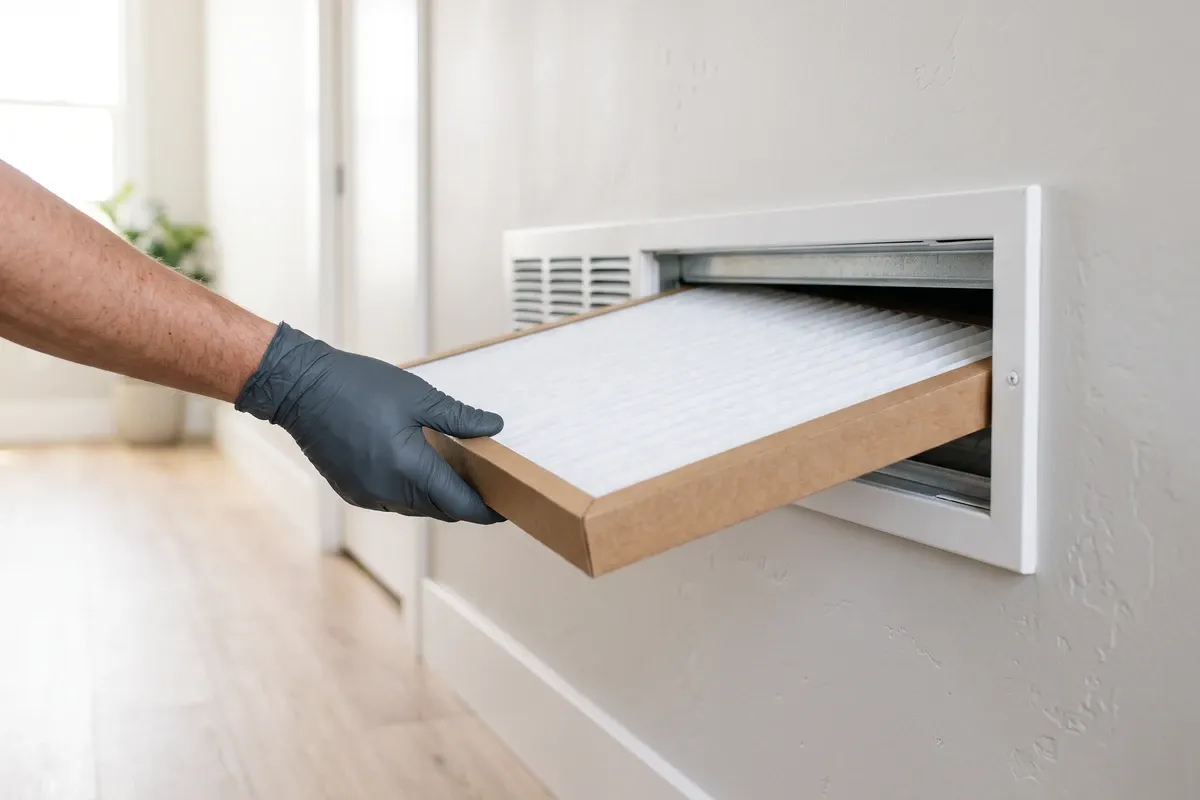
1. The coil and the drain pan. EPA is blunt about where to look: “Pay particular attention to cooling coils, which are designed to remove water from the air and can be a major source of moisture contamination of the system that can lead to mold growth.” It adds: “When having your heating and cooling system maintained or checked for other reasons, be sure to ask the service provider to clean cooling coils and drain pans.” EPA also says “Research suggests that condensation (which occurs when a surface temperature is lower than the dew point temperature of the surrounding air) on or near cooling coils of air conditioning units is a major factor in moisture contamination of the system.” Our page on what coil and drain-pan cleaning actually involves explains how that work is scoped.
2. The filter. This is the one cheap lever the coil studies point at, though only in commercial equipment. The 2020 Bakker study associated “low efficiency upstream filters (MERV 8)” with “a greater abundance of pathogenic bacteria and medically relevant fungi” on commercial coils, and the 2018 study named upstream filter efficiency as a dominant factor. That was commercial equipment, so it does not tell you which filter to buy for a house. Use the filter rating your equipment manufacturer specifies, and do not jump to a much denser filter on your own, because a filter that restricts airflow causes its own problems.
3. Duct cleaning, only against EPA’s bar. EPA says “Duct cleaning has never been shown to actually prevent health problems” and “EPA does not recommend that air ducts be cleaned except on an as-needed basis because of the continuing uncertainty about the benefits of duct cleaning under most circumstances.” That is not a claim that cleaning is worthless. EPA sets a bar: consider it if “There is substantial visible mold growth inside hard surface (e.g., sheet metal) ducts or on other components of your heating and cooling system.” It also advises: “Many sections of your heating and cooling system may not be accessible for a visible inspection, so ask the service provider to show you any mold they say exists.”
4. Be careful with biocides and coatings. EPA states: “No products are currently registered by EPA as biocides for use on fiberglass duct board or fiberglass lined ducts so it is important to determine if sections of your system contain these materials before permitting the application of any biocide.” And: “While the targeted use of chemical biocides and sealants may be appropriate under specific circumstances, research has not demonstrated their effectiveness in duct cleaning or their potential adverse health effects.” That is the point the 2006 trade article was making about coil coatings. UV lamps are the other common add-on; we cover them in does UV light kill mold.
5. Wet or moldy insulation is a different job. EPA says “If you have insulated air ducts and the insulation gets wet or moldy it cannot be effectively cleaned and should be removed and replaced.”
6. Fix the cause. EPA’s recurrence rule applies to every option above: “If the conditions causing the mold growth in the first place are not corrected, mold growth will recur.”
Is dirty sock syndrome dangerous?
The smell alone does not tell you what you are breathing, and nobody can diagnose a person from an odor. What the smell is a reason to check, on the trade’s explanation, is the coil and the drain pan — surfaces that have been wet. That is a maintenance question worth acting on.
The federal guidance here is about the water, not the odor. EPA says “Moisture should not be present in ducts” and that “Controlling moisture is the most effective way to prevent biological growth in air ducts.” That is the part a homeowner can act on.
If anyone in the home has symptoms they think are tied to the smell, that is a question for a doctor, not for an HVAC quote. An inspection can find water; it cannot diagnose a person. Our guide to who is most at risk from mold covers the groups that general guidance treats as more vulnerable.
When this is not dirty sock syndrome
A smell that is brief, comes at the start of a heat cycle and fades is a maintenance signal. These are not that:
- A smell that lasts the whole cycle, or is present with the system off.
- Visible growth on a register, around the air handler or on nearby surfaces.
- Water staining on a ceiling or wall near the equipment.
- A wet drain pan, an overflow, or standing water and debris in the pan.
- Wet insulation near the coil. EPA says to “Check any insulation near cooling coils for wet spots.”
- Anyone in the home with symptoms that seem tied to the smell.
Each of those points to a moisture source. If you are in this list, finding the water comes before any odor treatment. Symptoms are a question for a doctor; an inspection finds water, it does not diagnose a person. Our HVAC and air duct mold removal page covers what inspection and cleaning involve, and air quality testing covers what a test can and cannot tell you about the air.
Sources
- ACHR News — Jack Sine, “A New Solution Found for Dirty Sock Syndrome”, March 13, 2006: the statement that the cause is not known and is likely bacteria related, the heat pump and coil-temperature reporting, and the Debien quotes. Trade press quoting a named contractor, not a standard or peer-reviewed study. The article is also framed around a coil-coating product and carries homeowner testimonials; we cite it for the uncertainty and the coil temperatures, and it argues against coatings in the passage we use.
- ACHR News — Forrest Fencl, “Dirty Sock Syndrome: What It Is, How to Prevent It”, September 8, 2014: the industry-agreement statement on microbial activity as the cause. The article’s author note describes Fencl as president of UV Resources, a UV-C lamp manufacturer, and also as an ASHRAE Fellow and co-author of several ASHRAE Handbook chapters on ultraviolet treatment. The piece recommends UV-C; we cite it for the cause and the shoulder-season pattern, not the remedy.
- U.S. EPA — Should You Have the Air Ducts in Your Home Cleaned?: all EPA quotations on duct cleaning, cooling coils, drain pans, insulation, biocides and recurrence.
- Bakker A, Siegel JA, Mendell MJ, Peccia J. “Building and environmental factors that influence bacterial and fungal loading on air conditioning cooling coils.” Indoor Air, 2018. doi:10.1111/ina.12474. Commercial units in Connecticut and Sacramento.
- Bakker A, Siegel JA, Mendell MJ, Prussin AJ, Marr LC, Peccia J. “Bacterial and fungal ecology on air conditioning cooling coils is influenced by climate and building factors.” Indoor Air, 2020. doi:10.1111/ina.12632. Forty large commercial units, warm-humid and hot-dry climates.
- Park C, Jung HS, Park S, Jeon CO, Park W. “Dominance of Gas-Eating, Biofilm-Forming Methylobacterium Species in the Evaporator Cores of Automobile Air-Conditioning Systems.” mSphere, 2020. doi:10.1128/msphere.00761-19. Automobile air conditioning, not a house.
- Pei J, Sun L. “Odor from Building Air Conditioners: Emission Characteristics, Odor Compounds and Influencing Factors.” Sustainability 15(2):1495, 2023. doi:10.3390/su15021495. Building air conditioners in cooling mode, not a residential heat pump in heating mode.
- U.S. EIA — Residential Energy Consumption Survey 2020, state tables for space heating and air conditioning: Arizona statewide equipment shares, not Phoenix metro.
- Mold Pros Phoenix — our psychrometric analysis of Phoenix AC condensate: monthly modeled condensate, dew point and mean temperature, from NOAA NCEI 1991-2020 Climate Normals for Phoenix Sky Harbor. Modeled, not metered.