How to Read a Mold Test Report
A mold lab report can look like a wall of Latin names and numbers. The good news: you don’t need a microbiology degree to get the one thing that matters out of it. This guide walks through what each part actually means — and what it can’t tell you.
A mold test report lists the spore counts and mold types found in your air or on a surface. The single most useful thing on it is the comparison between your indoor sample and an outdoor control: when indoor levels, or water-damage molds, are clearly higher than outdoors, it points to a source inside the house. There is no federal “safe level” to pass or fail — so the report is a clue about where moisture is, not a grade.
First — do you even need a test?
Often, no. The EPA is direct about this: in most cases, if visible mold growth is present, sampling is unnecessary. If you can see it or smell it, the answer is the same whatever the lab says — remove it and fix the water feeding it. And because there is no federal standard for mold in air, a test cannot certify a home as “safe.”
Testing earns its cost in a few specific situations: you smell mold but can’t find the source, you need documentation for a home sale or insurance claim, or you want clearance testing to confirm a remediation job is finished. In those cases the EPA recommends that sampling be done by professionals experienced in mold sampling protocols, using methods from the American Industrial Hygiene Association (AIHA) or ACGIH — not read against a number off the internet.
What an air (spore-trap) report shows
The most common home test is a spore trap (also called a “non-viable” or “total spore count” air sample). The lab pulls a measured volume of air across a sticky slide, then counts the spores under a microscope. Your report shows, per mold type, a count in spores per cubic meter of air (spores/m³), a total, and often the presence of mycelial fragments.
Two honest caveats the good labs print in the fine print. First, those numbers are semi-quantitative — AIHA describes spore-trap results as “notional at best,” with sampling and analytical error generally between 30% and 200%. Second, and just as important, air sampling for mold “does not, and cannot, evaluate potential health risks for building occupants”. So don’t fixate on the exact count — treat it as a rough signal, not a precise measurement.
The one comparison that matters: indoor vs. outdoor
Here’s the key that unlocks the whole report. Mold spores are everywhere — the EPA notes they “float through outdoor and indoor air” and that it is impossible to remove them all from a home. So a raw indoor number means little on its own. The interpretation is a comparison: the sampler takes an indoor sample and an outdoor control the same day, and asks whether the indoor result is materially different from the outdoor baseline.
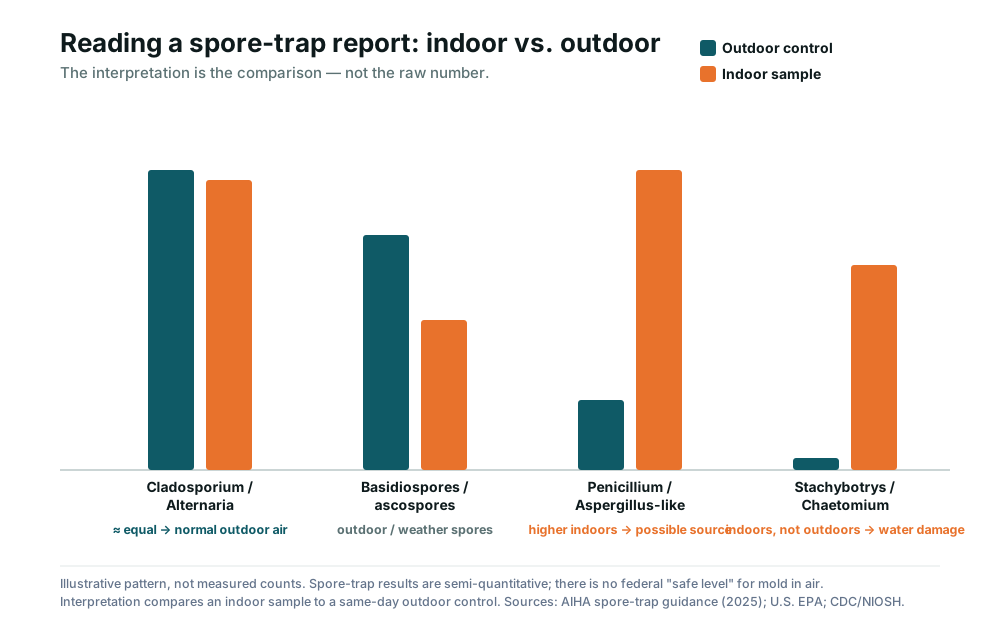
When indoor counts, or specific water-damage mold types, are clearly higher than outdoors, that suggests spores are coming from an indoor source rather than drifting in from outside. One caution: you’ll see a popular rule online that indoor should be “no more than about twice outdoor.” That specific multiplier isn’t in the EPA, CDC, or AIHA guidance — it’s a convention from inspection blogs. Trust the direction (indoor higher or different than outdoor), not a magic number.
What the mold names mean
You don’t need to memorize the whole list. The genera on a report fall into three buckets:
- Usually just outdoor air. Cladosporium and Alternaria are the most common outdoor airborne molds, and basidiospores and ascospores are rain-and-weather (“moist air”) spores. Seeing these indoors at levels similar to outdoors is normal — that’s outdoor air getting inside.
- Possible indoor growth. Penicillium and Aspergillus are among the molds most likely to be actively growing indoors. On a spore trap they’re usually reported together as “Penicillium/Aspergillus-like,” because the two can’t be told apart under the microscope. Clearly higher indoors than outdoors can indicate an indoor source.
- Water-damage markers. Stachybotrys (the “black mold” of headlines) and Chaetomium need surfaces that stay very wet — sustained high humidity on cellulose materials like drywall paper. Stachybotrys also disperses poorly into the air, so when it shows up on a test, it’s a strong hint of a chronic moisture problem nearby. That’s a reason to find the water, not a health verdict — see is black mold dangerous? and our black mold guide for what it does and doesn’t mean.
The Phoenix and desert angle
Homeowners here are often surprised that a Phoenix outdoor sample comes back high. It should. Outdoor air always carries spores, and the arid Southwest is no exception: a peer-reviewed six-year airborne spore calendar for the Sonoran Desert found Cladosporium and Alternaria dominate outdoor air, peaking during the summer monsoon. So a July or August outdoor control in the Valley will read high in exactly those common molds — which is precisely why the indoor-vs-outdoor comparison, not the raw count, is what tells you something. (Don’t confuse any of this with Valley Fever; that comes from a soil fungus, a completely different organism from household mold.)
ERMI and other dust tests
Some companies push an ERMI (Environmental Relative Moldiness Index) — a DNA analysis of settled house dust that compares 36 mold species against an index. It’s worth knowing what it is: the EPA developed ERMI as a research tool, and says it “is a research tool and is not recommended for use except as a research tool” — it has “not been validated for non-research purposes.” Because there are no health-based standards for indoor mold at all, an ERMI score can’t clear a home or diagnose an illness — for most homeowners it adds cost without changing the next step.
Red flags in a “mold test”
- A single indoor air sample with no outdoor control. For air testing, the outdoor baseline is the whole point; without it, one indoor number is hard to read. (A surface/tape sample of visible mold is the exception — it identifies the mold directly.)
- The same company tests and remediates. If one business profits from finding a bigger problem, an independent inspection reduces that bias.
- A scary number sold as a verdict. There is no “safe level” to be above, so a big spore count presented as a pass/fail grade is a marketing move, not science.
What to do with your results
The number was never the goal — the moisture source is. Wherever the report points, the fix is the same: find the water and stop it, then clean up what grew. If your results are confusing, or they suggest an indoor source you can’t locate, that’s what an inspection is for. We handle mold across the Phoenix metro, and a mold inspection is built to trace the moisture behind a puzzling report. You can get a free, no-obligation quote using the form below, or browse the full library of Phoenix mold guides for the specific growth type or room you’re dealing with.
Sources
- U.S. EPA — A Brief Guide to Mold, Moisture and Your Home / Mold Testing or Sampling — no federal mold standard; visible mold usually needs no sampling; use AIHA/ACGIH methods. epa.gov/mold/mold-testing-or-sampling
- CDC / NIOSH — Mold, Testing, and Remediation — there are no health-based standards for mold in indoor air, and short-term spore counts can’t be interpreted for health risk. cdc.gov/niosh/mold
- AIHA — FAQs About Spore Trap Air Sampling for Mold (Guidance Document, 2025) — report structure, the indoor-vs-outdoor comparison, and the semi-quantitative (30–200% error) caveat. AIHA guidance (PDF)
- U.S. EPA — Environmental Relative Moldiness Index (ERMI) — a research tool, “not recommended for use except as a research tool” and “not been validated for non-research purposes.” epa.gov/mold ERMI · epa.gov/air-research ERMI
- Ortega-Rosas et al., “A Six-Year Airborne Fungal Spore Calendar for a City in the Sonoran Desert,” Journal of Fungi, 2025 — Cladosporium and Alternaria dominate desert outdoor air, peaking in the summer monsoon. PMC11943160