Types of Mold Testing Explained
There are four common ways to test a home for mold: air (spore-trap) sampling, surface sampling (tape-lift, swab, or bulk), culture (viable) sampling, and ERMI dust analysis. They answer different questions, and the biggest practical split is simple: an air test only means something next to a same-day outdoor sample, while a surface swab of visible growth stands on its own. And if you can already see or smell mold, the EPA says you usually don’t need a test at all.
This guide is about which method does what. Whether you even need a test — and what a DIY kit can and can’t do — is a separate question we cover in how to test for mold. Reading a finished lab report is covered in how to read a mold test report. Here we stay on how each sample is collected and which one fits a given Phoenix situation.
Start here: if you can see or smell it, you may not need a test
The honest baseline comes straight from the EPA’s Brief Guide to Mold, Moisture and Your Home: “In most cases, if visible mold growth is present, sampling is unnecessary.” Mold spores are in every home’s air and dust — you can’t get rid of all of them — so the goal isn’t a spotless test result. It’s finding the moisture and removing the growth.
There’s also no score to chase. The EPA has set no federal limit for mold or mold spores, and CDC/NIOSH states plainly that “there are no health-based standards for mold or other biological agents in indoor air.” So no test certifies a home as “safe.” Testing earns its cost in specific cases: a musty smell with no visible source, confirming whether a spot is mold, or documenting a real-estate or post-cleanup situation. When it is worth it, EPA notes sampling “should be conducted by professionals” using methods recommended by groups like the American Industrial Hygiene Association (AIHA).
Air sampling (spore trap): it counts spores, and it needs an outdoor control
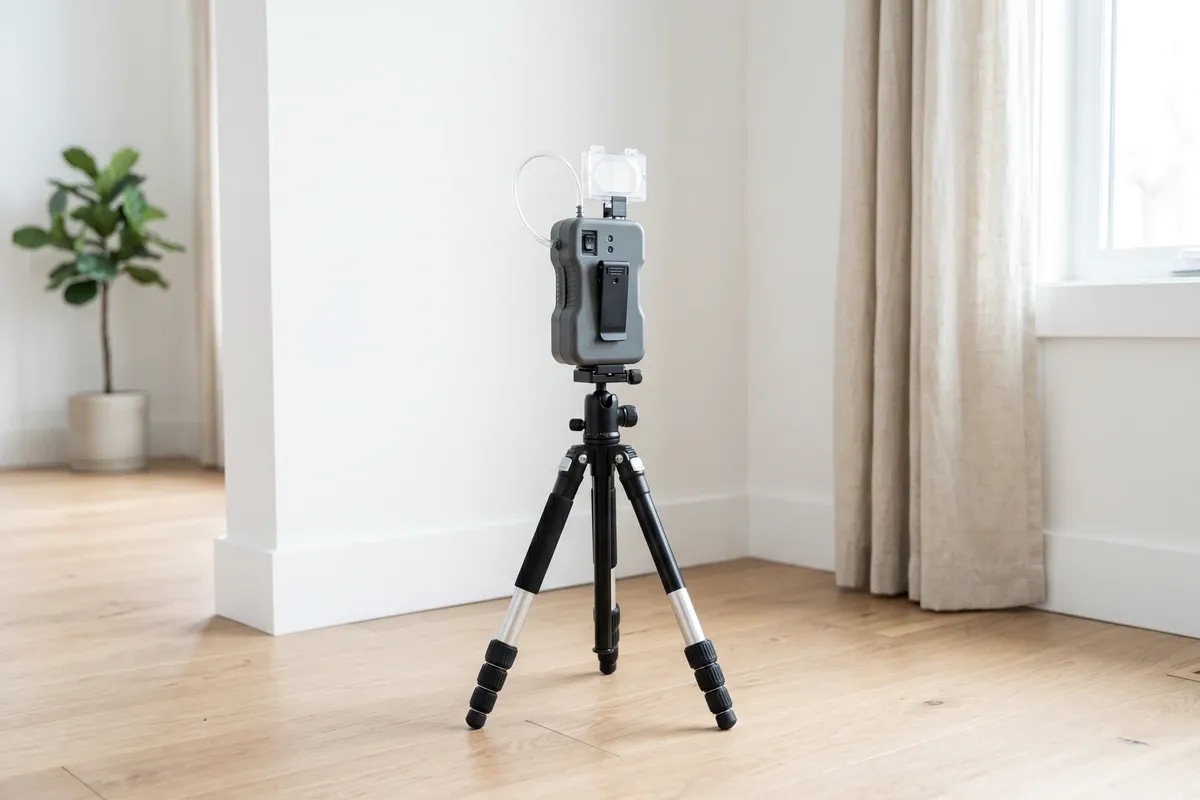
A spore trap is the most common air test. As AIHA describes it, “air is drawn through a narrow slit and spores and other particles in the air impact and stick onto a small, stationary glass slide” — cassettes you’ll see named on a report include Air-O-Cell, Allergenco-D, and Cyclex-D. A lab counts what stuck and reports it in spores per cubic meter.
Two things about that number matter. First, it’s an estimate, not a precise count — AIHA calls spore-trap results “semi-quantitative” and “notional at best.” Second, and this is the whole game: an indoor air number is nearly meaningless by itself, because outdoor air always carries spores. The accepted method is to take a same-day outdoor control and compare. As InterNACHI’s air-sampling guidance puts it, “it is best to take the outdoor samples as close together in time as possible to the indoor samples that they will be compared with.” The investigator is checking whether the mold types indoors are “materially different from those outdoors.”
One more limit worth stating plainly, because it’s easy to assume otherwise: air sampling “does not, and cannot, evaluate potential health risks for building occupants” (AIHA). It maps where spores are, not whether anyone will get sick.
Surface sampling (tape-lift, swab, bulk): confirms whether a spot IS mold
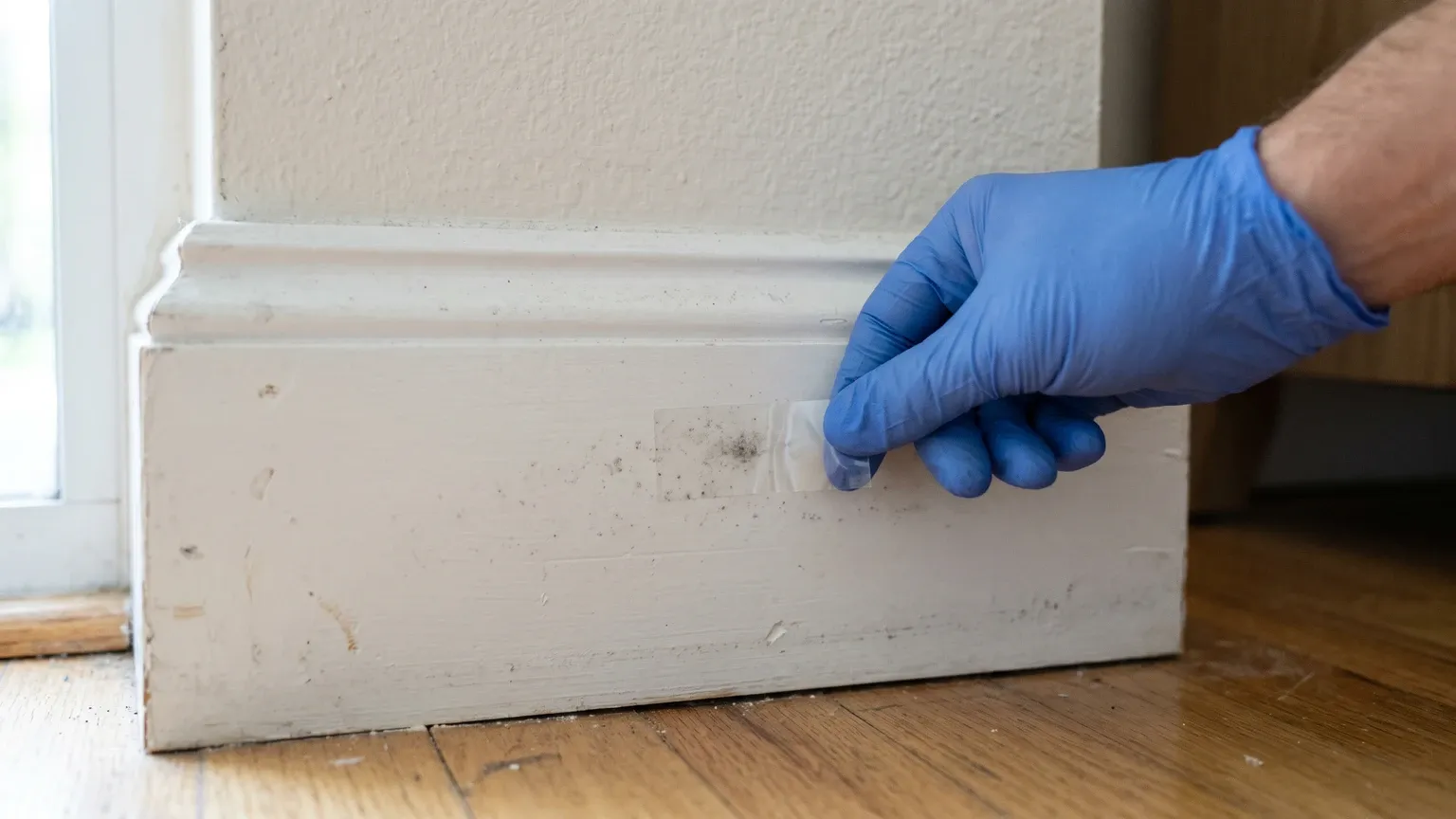
Surface sampling answers a narrower, more direct question: is this spot mold, and what is it? The EPA lists the forms — a “clear plastic tape” lift, a swab, or a bulk piece (“chunks of carpet, insulation, wall board”). It’s the tool for “determining if an area has been adequately cleaned or remediated,” and for confirming a suspicious stain.
Here’s the key difference from air sampling, and it’s a point a lot of write-ups get wrong: a targeted surface sample of visible growth does not need an outdoor control. The outdoor-comparison rule exists because indoor air has to be judged against the background of outdoor air. A tape-lift or swab tests the material itself — it’s a direct yes-or-no on that spot, usually with the genus attached. The trade-off is scope: a surface sample tells you about the spot you sampled, nothing about the room’s air.
Culture (viable) sampling: grows it to name the species — slower, and it misses dead spores
Culture, or “viable,” sampling collects living organisms and grows them on a medium so the lab can often reach the species level, not just the genus. AIHA notes it’s “usually identified to the genus level, and sometimes to the species level,” reported in colony-forming units, with a turnaround of “seven to 14 days.”
Its usefulness is specific: “culturable samples with species identification may help direct the investigator to a potential source of hidden contamination.” Its limitation is just as specific — culture only reports what actually grows. As AIHA puts it, “the choice of culture medium has a major effect on which fungal species will be able to grow,” and some species inhibit others. So a viable sample can undercount what a spore trap would have caught, and there is “no reliable correlation” between culture results and spore-trap results. The two methods aren’t interchangeable.
ERMI dust testing: an EPA research tool, not a home clearance test
ERMI — the Environmental Relative Moldiness Index — gets marketed to homeowners as a definitive “mold score.” It isn’t one. EPA scientists built it by analyzing the DNA of 36 indicator molds in settled house dust (a method called MSQPCR) across “over 1,000 homes” in a national HUD survey, then ranking the results on a scale that “ranges from a low of approximately -10 to a high of about 30.”
The important part is EPA’s own position on using it at home. In its ERMI fact sheet, EPA states the index “has been peer reviewed for research purposes but has not been validated for non-research purposes. For this reason, EPA does not recommend the routine public use of ERMI in homes, schools, or other buildings.” And it points back to the basics: “inspection for water damage and mold remain the key to current EPA mold-assessment guidance.”
For a Phoenix homeowner, that’s the whole story. A national research index built on dust from homes across the country can’t speak to your specific desert house, and it won’t change your next step — find the water and fix it. It adds cost without adding a decision.
Side by side: which method answers which question
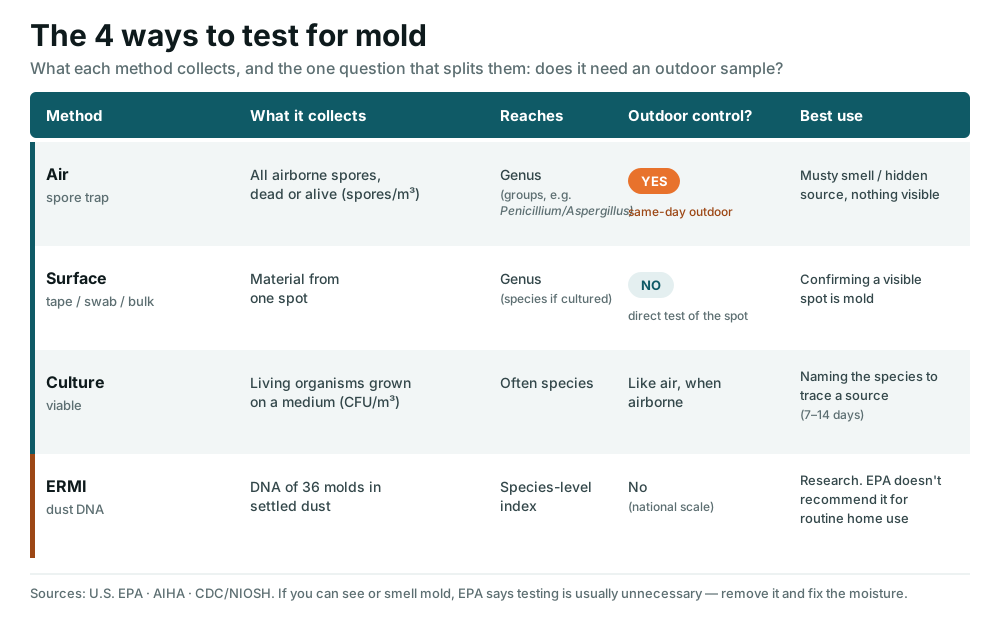
| Method | What it collects | Genus or species? | Needs an outdoor control? | Best use |
|---|---|---|---|---|
| Air — spore trap | All spores in the air, dead or alive (spores/m³) | Genus (groups like Penicillium/Aspergillus) | Yes — same-day outdoor sample | A musty smell or suspected hidden source with nothing visible to swab |
| Surface — tape/swab/bulk | Material from one spot | Genus (species if cultured) | No — it’s a direct test of that spot | Confirming whether a visible spot is mold, or that an area was cleaned |
| Culture — viable | Living organisms grown on a medium (CFU/m³) | Often species | Compared like air when airborne | Naming the species to trace a hidden source (7–14 days) |
| ERMI — dust DNA | DNA of 36 molds in settled dust | Species-level index | No (national scale) | Research; EPA doesn’t recommend it for routine home use |
Which one a Phoenix home actually needs
Method choice follows the situation, and Phoenix situations tend to fall into a few buckets — the same local moisture drivers we see everywhere in the Valley: AC condensate overflow, monsoon roof and attic intrusion, and slab leaks.
- Musty smell when the AC runs, but nothing visible. This is the classic case for air sampling with a same-day outdoor control, run by a professional. There’s nothing to swab, so the indoor-versus-outdoor air comparison is the tool — often around the air handler and the rooms fed by it.
- A stain or growth you can see after a monsoon roof leak. You may not need a test at all (EPA: visible growth usually doesn’t). If you want it confirmed, a targeted surface sample of the spot answers it directly — no outdoor control needed.
- Not sure if a mark on the drywall near a slab leak is mold or just efflorescence. A surface tape-lift or swab gives a direct yes-or-no on that spot.
- A real-estate transaction or post-remediation clearance. This is air sampling against an outdoor control, and the “pass” isn’t a magic number — see our guide on the mold clearance test for how that’s judged.
- “Should I just buy an ERMI kit for my desert home?” Generally no, for the reasons above — put the money toward finding and fixing the moisture.
Make sure the lab and inspector are legit
Because Arizona requires no state mold license, the credential that matters here is accreditation, not a state card. Two honest signals to look for:
- The lab. Mold samples should go to a lab accredited under AIHA-LAP’s Environmental Microbiology Laboratory Accreditation Program (EMLAP), which covers air, surface, and bulk analysis and requires proficiency testing and ISO/IEC 17025 compliance.
- The inspector. Independent inspectors and consultants may hold certifications such as the American Council for Accredited Certification’s Council-certified Microbial Investigator (CMI) or Consultant (CMC) — ACAC’s certifications are third-party accredited by the CESB.
Neither is legally required in Arizona, which is exactly why they’re worth asking about.
What to do with any result
Every method above points to the same next step, and it’s the one EPA keeps returning to: find the water source and fix it, then remove the growth. A test can confirm a suspicion, document a transaction, or check a cleanup — it doesn’t replace the repair. If you want the results interpreted, our guide on reading a mold test report walks through what the numbers and mold names actually mean.
If you’re weighing whether to test at all, or you want a professional to scope it, a mold inspection sizes the problem and points to the moisture source — and you can get a fast, free, no-obligation quote below.
Sources
- U.S. EPA — A Brief Guide to Mold, Moisture and Your Home and Mold Testing or Sampling: visible mold usually needs no sampling; no federal mold limits; sampling should be done by professionals using AIHA methods.
- U.S. EPA — The Environmental Relative Moldiness Index (ERMI) Fact Sheet: ERMI is a research tool “not validated for non-research purposes”; EPA “does not recommend the routine public use of ERMI”; 36 indicator molds, over 1,000 homes, scale ≈ −10 to 30.
- AIHA — FAQs About Spore Trap Air Sampling for Mold (Guidance Document, Oct 2025): spore-trap mechanics; “semi-quantitative” / “notional at best”; genus-level ID; air sampling “does not, and cannot, evaluate potential health risks”; culture 7–14 days and medium-dependent.
- CDC / NIOSH — Mold: Testing and Remediation: “there are no health-based standards for mold”; routine air sampling not recommended for building evaluations.
- InterNACHI — Air Sampling for Mold Inspections: take outdoor control samples as close in time as possible to the indoor samples.
- AIHA-LAP — Environmental Microbiology Laboratory Accreditation Program (EMLAP) and ACAC — microbial certifications: lab and inspector accreditation.