Mold and Hair Loss: What Doctors Actually See
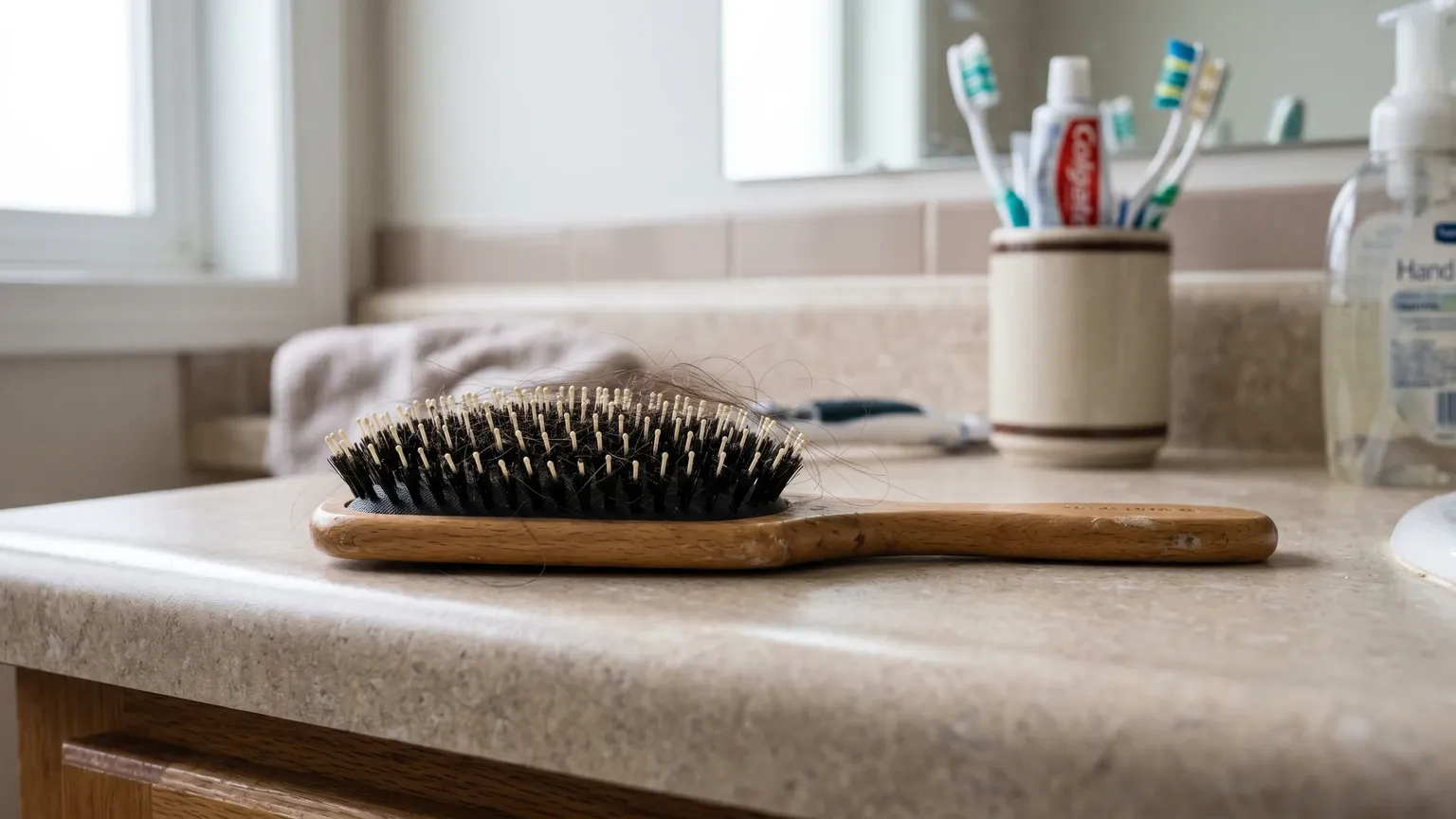
Mold does not directly attack hair follicles. But when mold exposure triggers a severe systemic illness — sustained immune activation, prolonged fever, or the kind of whole-body physiological stress documented in conditions like hypersensitivity pneumonitis or severe allergic asthma — the body can respond with telogen effluvium: a delayed, diffuse hair shed that mainstream dermatology already accepts as a real illness response. The pattern matches what some patients with known mold exposure have publicly described. The mechanism is established; a large cohort study in mold-exposed populations has not been done.
What telogen effluvium is
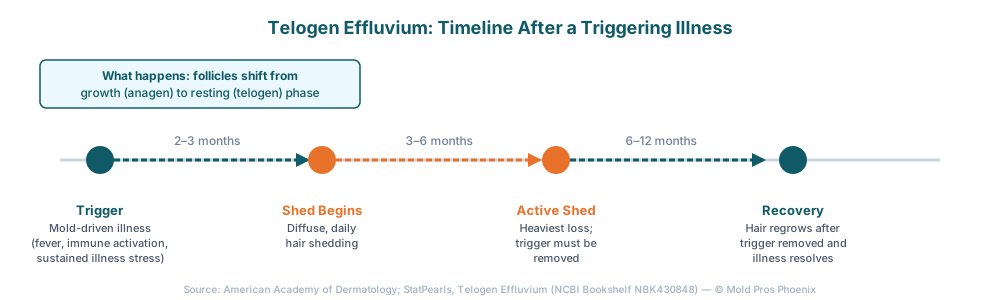
Telogen effluvium is not a disease on its own. It is a reactive pattern: the hair follicle cycle gets disrupted by a systemic stressor, and a batch of follicles that should be in the growth phase (anagen) shifts prematurely into the resting phase (telogen). About 2 to 4 months later, those follicles release their hairs roughly simultaneously, producing the characteristic diffuse shed.
The StatPearls review of telogen effluvium lists the established triggers: febrile illness, major surgery, childbirth, hemorrhage, severe psychological stress, crash dieting, thyroid dysfunction, and certain medications. The Cleveland Clinic’s patient guidance describes it as one of the most common causes of temporary hair loss in adults.
COVID-19 produced a well-documented wave of post-illness telogen effluvium, confirmed in peer-reviewed clinical series. Patients recovering from moderate to severe COVID noticed substantial hair shedding two to four months after their acute illness — tracking the telogen effluvium timeline precisely. A published clinical series documented the pattern in recovering patients. This is the same biological machinery that would apply to any sufficiently severe illness.
The key characteristic of telogen effluvium is its timing: the stressor and the hair loss are separated by months, so patients rarely connect them without guidance. By the time the hair is falling out, the triggering event may feel long past.
How severe mold illness can trigger it
The research base on indoor mold and human health — most comprehensively reviewed by the Institute of Medicine’s 2004 report, Damp Indoor Spaces and Health — documents sufficient evidence of an association between damp buildings and upper respiratory symptoms, cough, wheeze, asthma exacerbations, and hypersensitivity pneumonitis. Those last two are the entries most relevant to the hair-loss question.
Hypersensitivity pneumonitis (HP) is a well-documented severe lung condition triggered by immune reaction to inhaled organic particles, including mold. The NHLBI describes HP as capable of producing significant systemic illness and, without treatment, permanent lung damage. A person experiencing an HP flare — or the kind of immune-activation event that accompanies severe allergic bronchopulmonary aspergillosis, another mold-linked condition — is going through exactly the category of systemic stressor that the telogen effluvium literature identifies as a reliable trigger.
The chain of logic is this: mold-driven severe illness → severe immune activation and systemic physiological stress → hair follicles shift to telogen phase → diffuse hair shed 2 to 4 months later. Each link in that chain is documented. What the peer-reviewed literature has not done is study hair outcomes specifically in mold-exposed populations at scale. That is a research gap — an absence of investigation, not a refutation.
What patients actually report
Candace Owens described her mold illness experience on the Shawn Ryan Show (Episode 318). In her account, she said: “I had head-to-toe overnight eczema. I had never had eczema. Athlete’s foot. My eyes were red and just kept pussing.” She attributed hair loss and facial skin changes to her mold illness, which she traced to an HVAC leak in her Stamford, Connecticut apartment. She sued her landlord in 2017 over the mold; the case did not succeed, with reporting on the outcome centered on the admissibility of medical-expert testimony. Her symptom cluster — skin reactions, eye inflammation, respiratory episodes, cognitive fog, hair changes — is consistent with a severe multisystem immune response.
Lauren Lowenstein, profiled by Newsweek in 2024, described hair loss among her symptoms after moving into a Houston home where ERMI dust testing showed elevated mold and inspection found colonies under the master shower and in walls from HVAC condensation. Her full reported symptom list included hair loss, insomnia, migraines, heart palpitations, body hives, and brain fog.
These are patient-attributed accounts from named individuals with documented exposure, covered by mainstream news outlets. They are not clinical trials. The connection they describe — severe mold-driven illness followed by hair loss among other symptoms — is plausible through the telogen effluvium mechanism, though no physician has formally documented the link in their specific cases.
Across mold-illness patient communities, hair loss recurs as a reported symptom alongside the broader cluster of fatigue, brain fog, skin reactions, and respiratory changes. The pattern is consistent enough to take seriously as a signal, without overstating what the evidence proves.
The honest position on the evidence
The IOM 2004 review of indoor mold and human health did not specifically evaluate hair loss as an outcome — its tiered evidence framework focused on respiratory and immune outcomes. That means no formal IOM adjudication either way. The gap is one of investigation: no large cohort study has measured hair loss specifically in mold-exposed populations, so the population-level question remains open. The individual-level mechanism (severe systemic illness driving telogen effluvium) is dermatologically well established for other triggers.
What this means in practice: at the population level, there is no large randomized cohort study documenting hair loss specifically in people exposed to indoor mold. The absence of that study is real. But the individual mechanism — a person whose mold-driven illness was severe enough to produce the kinds of systemic physiological stress that dermatology already accepts as reliable telogen effluvium triggers — is not refuted by the absence of that population-level data.
One framing that holds up: the CIRS (Chronic Inflammatory Response Syndrome) practitioner community documents hair loss as part of a broader symptom cluster in patients with water-damaged building exposure. Mainstream medicine has not accepted CIRS as a defined clinical entity — UCLA Health notes explicitly that it is “not considered an established medical diagnosis.” Presenting CIRS claims as established science would overstate what the evidence supports.
The honest position sits between those poles: mold does not make hair fall out the way a fungal infection directly attacks a follicle. But when mold causes a severe enough systemic illness, the same biological machinery that produces post-COVID hair loss, post-surgical hair loss, and post-hospitalization hair loss can plausibly operate. The trigger changes; the follicle response does not.
When to see a doctor and what to ask
Hair loss with a known mold exposure history warrants a two-track evaluation.
Track one — rule out the more common causes. Thyroid disease (both hypothyroidism and hyperthyroidism), iron deficiency anemia, and hormonal shifts are among the most frequent drivers of diffuse hair loss and must be excluded before attributing shedding to any systemic illness. Ask your primary care doctor for a thyroid panel (TSH, free T4), a complete blood count, and ferritin. These are standard, inexpensive tests. A dermatologist can perform a pull test and scalp examination to differentiate telogen effluvium from alopecia areata (which produces discrete patches rather than overall thinning) and from androgenic hair loss (which follows a predictable pattern).
Track two — address the exposure itself. If you have confirmed or suspected mold in your home, get a professional inspection. The mold inspection is the step that determines whether an active exposure source is still present. Removing the trigger is the single most important thing you can do for any systemic illness that may be driving hair loss. Hair does not stabilize while the triggering condition remains active.
When speaking with your dermatologist, be specific: describe the timeline of your mold exposure, when the hair loss started relative to any illness or symptom onset, and whether the shedding is diffuse or patchy. This information lets a dermatologist place your presentation on the right diagnostic track.
What actually helps
The hair loss question is downstream of a more fundamental one: is there still an active mold source in the home, and is there an underlying illness that has not been addressed?
Remove the trigger first. For telogen effluvium from any cause, hair recovery depends on resolving the underlying stressor. If mold exposure is driving a chronic systemic immune response, remediation is not optional — it is the prerequisite. Most patients in documented mold-illness cases who describe recovery attribute it partly to environmental remediation. Candace Owens described recovery taking roughly a year, which she linked in part to diet changes and leaving the environment.
Address the underlying illness. If a mold-exposed person has developed hypersensitivity pneumonitis, ABPA, or another diagnosable condition, treating that condition with a physician is necessary. Hair recovery follows resolution of the illness, not the other way around.
Timeline expectations are realistic. Most dermatologists describe a 6-to-12-month recovery window after the underlying trigger is removed. Telogen effluvium is generally reversible — the follicles are not permanently damaged, they are temporarily shifted. The caveat is that recovery requires the trigger to be genuinely removed, not just reduced.
Nutritional support (iron, protein, zinc where deficient) and stress reduction are standard adjunct recommendations. They do not substitute for fixing the exposure and treating any illness it caused.
The Phoenix connection
This guide covers a question with genuinely national relevance — mold exposure happens everywhere. But the mechanisms that produce severe mold illness are worth naming in the Phoenix context.
Phoenix HVAC systems run continuously from May through October, producing significant condensate. A clogged AC drain line overflows into ceiling cavities and wall interiors where mold can establish on wood framing and drywall within 24 to 48 hours, per EPA guidance. Slab leaks — common in older Valley homes with aging copper and galvanized supply lines — feed mold below flooring and inside wall bases where it is rarely seen before a musty smell develops. Monsoon season roof intrusions create another exposure vector that can run undetected through an empty attic for months.
A Valley homeowner who suspects mold-driven illness and hair loss should start with an environmental inspection, not a supplement stack. The guides on who is most at risk from mold and what mold sickness feels like cover the broader health picture. For the full evidence landscape — mainstream conditions, contested CIRS frameworks, primary sources — see our reporting on whether mold illness is real. The mold inspection page covers the environmental side.
Get a free inspection quote
If you suspect mold in your Phoenix-area home and have been experiencing unexplained symptoms — including hair changes — the right starting point is finding out what is actually in the home. We handle mold inspections and removal across the Phoenix metro, from Scottsdale to Chandler, Gilbert to Laveen. Fill out the form below for a free, no-obligation quote.