Section 8 and HUD Housing Mold Rights in Arizona
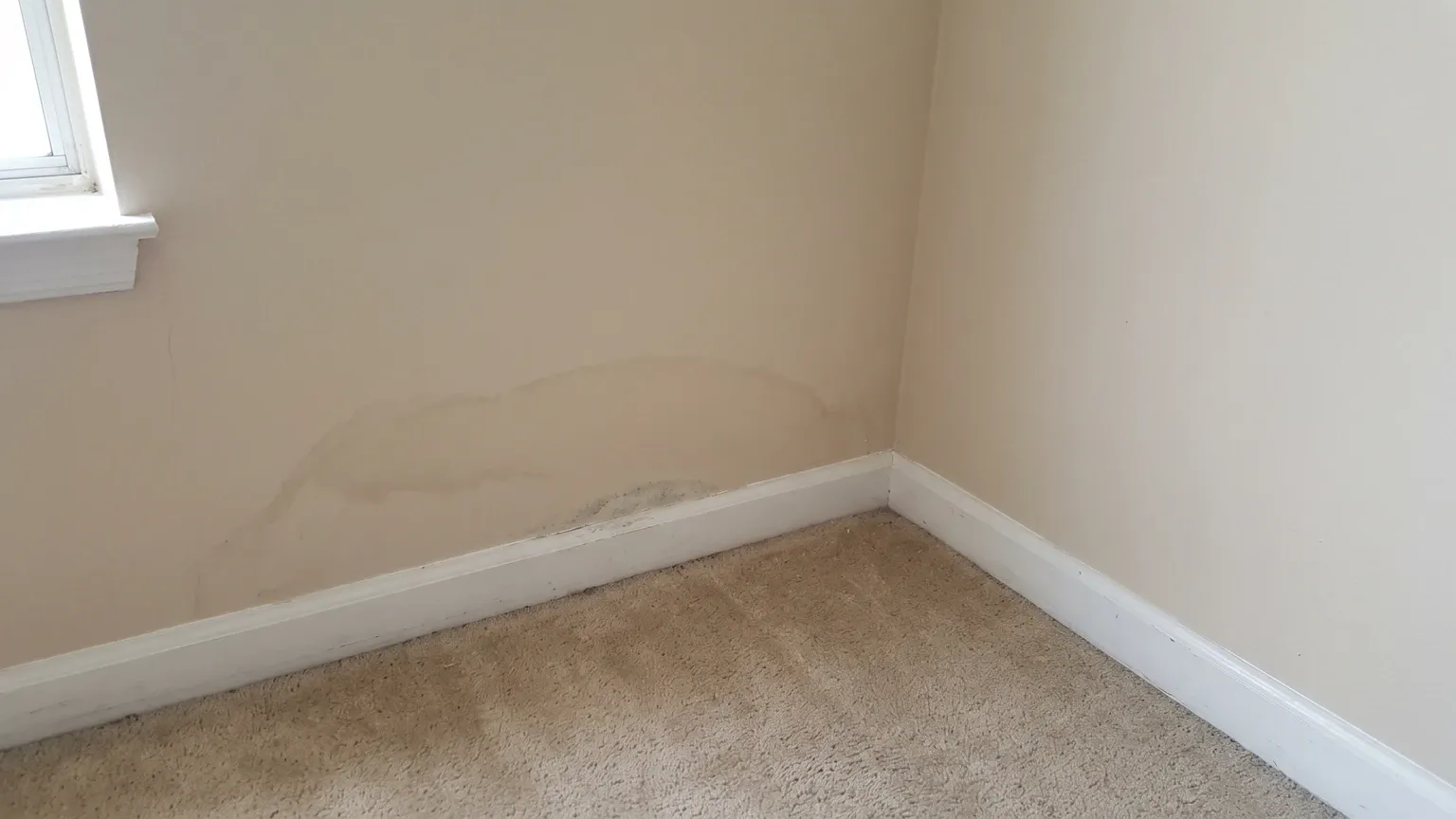
If you rent with a Section 8 Housing Choice Voucher, reporting mold to your housing authority triggers a free inspection: 24 hours if it is life-threatening, 15 days otherwise. If the inspector confirms it, your landlord gets 24 hours or 30 days to repair. Miss that and the authority must stop paying the subsidy, and your landlord may not end your tenancy over that abatement.
That last part is the piece almost nobody explains to a voucher tenant. Here is the order of operations, plus the one way this can go wrong for you instead of for your landlord.
Which standard is your unit actually inspected against right now?
Search this topic and you will be told that NSPIRE replaced Housing Quality Standards. For the Housing Choice Voucher and Project-Based Voucher programs, that is not yet true in the way that affects you. NSPIRE did become effective for voucher programs on October 1, 2023 and, in HUD’s words, “redefined HQS for these programs” — but the date by which a PHA must actually inspect to it has moved three times. As of October 2026 the compliance date is February 1, 2027. Unless HUD extends it a fourth time, the HQS half of this section stops applying on that date.
HUD published the NSPIRE final rule on May 11, 2023 (88 FR 30442) and the standards on June 22, 2023 (88 FR 40832). Notice PIH 2026-18, issued July 15, 2026, records the slippage plainly: “On September 28, 2023, HUD announced the first extension of the compliance date to October 1, 2024. On July 5, 2024, HUD extended the compliance date to October 1, 2025. On September 30, 2025, HUD further extended the compliance date to February 1, 2027.”
The same notice says “PHAs may continue using HQS as previously defined or other HUD-approved inspection methods as their inspection standards until February 1, 2027.”
For mold, that gap is bigger than for almost any other item. The words mold, mildew, fungus, moisture and damp appear zero times in 24 CFR 982.401 as that section read before May 7, 2024 — the text that is still “HQS as previously defined” for inspection purposes. Look the section up today and you will not find those thirteen performance requirements at all: it was rewritten in 2024 into a one-line cross-reference pointing at the NSPIRE standards in 24 CFR 5.703. Mold failed an HQS inspection only through an inspector’s judgment under general language, such as the requirement that a unit be free of pollutants in the air at levels that threaten the health of the occupants. NSPIRE swaps that for a measured square-footage threshold, removing, in HUD’s words in Notice PIH 2026-18, “subjective opinions about general health and safety, housekeeping, and cosmetics/aesthetics.”
HUD also “encourages PHAs to implement NSPIRE standards at their earliest convenience,” so your agency may already be using it. Ask which one it runs on. Either way a voucher inspection is pass/fail rather than scored: one failed item fails the unit. Not every recorded deficiency is a failure, though — as the table below shows, some are logged and the unit still passes.
How much mold fails a Section 8 inspection?
Under the NSPIRE Mold-like Substance standard (V3.0, published 06/20/23) the answer is a measurement, not an opinion: the inspector adds up the patch area in one room and reads off a severity. The standard carries a general correction timeframe and a separate HCV correction timeframe, and for a voucher tenant only the HCV column governs.
| NSPIRE Mold-like Substance deficiency | Inside your unit | In a common or interior area |
|---|---|---|
| 4 sq in or less | No deficiency recorded | No deficiency recorded |
| More than 4 sq in, less than 1 sq ft | Moderate — fail, 30 days | Low — pass |
| More than 1 sq ft, less than 9 sq ft | Severe — fail, 30 days | Moderate — fail, 30 days |
| More than 9 sq ft | Life-threatening — fail, 24 hours | Severe — fail, 30 days |
| Elevated moisture, no visible mold | Moderate — fail, 30 days | Low — pass |
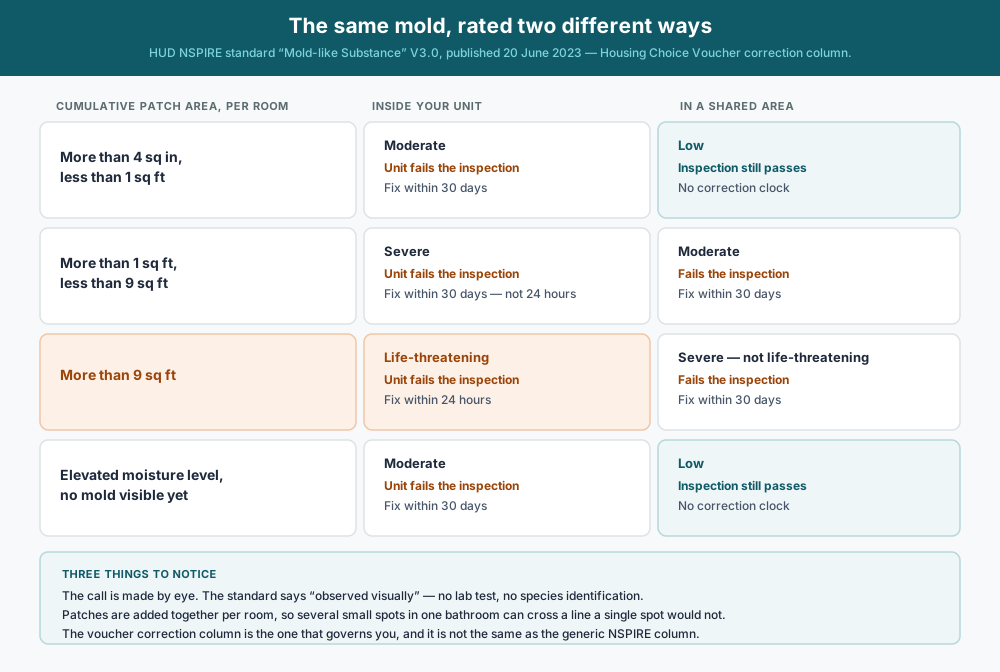
Three things in that table are easy to get wrong, and all three matter to a voucher tenant.
Only a patch over 9 square feet inside your own unit carries the 24-hour clock. Between 1 and 9 square feet your unit is rated Severe, which sounds like an emergency. But that row carries a 24-hour general correction timeframe and a 30-day HCV correction timeframe, and the voucher column is the one that governs you. Reading the general column and expecting a fix in a day sets you up to think the agency broke a rule it did not break.
Location changes the rating. That same 9-plus square foot patch in a shared hallway or laundry room is Severe with 30 days, not life-threatening, because the standard separates your unit from the interior areas around it.
The area is added up per room, not across the whole unit. Each of the three size bands is written as a cumulative area “in a room,” so a patch in the bathroom and a patch in a bedroom are measured separately rather than totalled together.
The finding is also observed visually and measured cumulatively per room: no lab test, no species identification, no air sample. The standard covers patches or spots that “may be colored differently than the surface (coloration may be white, green, yellow, gray, brown, or black),” that “can appear ‘fuzzy’ or ‘cottony’ and a musty or earthy odor can be associated with it,” and that “would also include what is often identified as ‘mildew’.” It rules out one common false alarm: “algae are not mold-like substances (algae are grass-green).”
Keep one number separate. HUD’s life-threatening trigger inside a unit is 9 square feet; the 10-square-foot figure you have probably seen is EPA’s do-it-yourself-versus-hire-a-pro guideline, a different number for a different purpose.
A stain with no mold on it is still a failed item
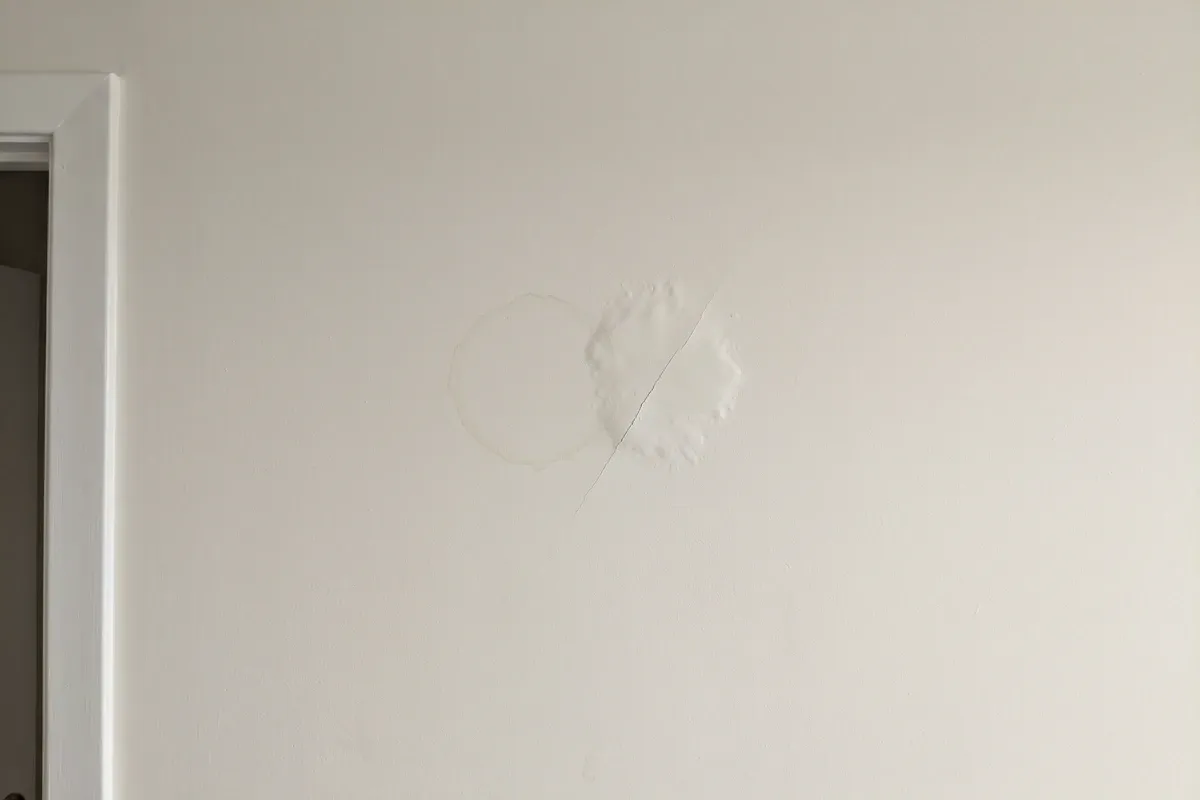
Elevated moisture is its own deficiency under the same standard, no visible mold required. The inspector looks for “peeling paint or wallpaper, a wall that is warped or stained, or a buckled, cracked, or water-stained ceiling, carpet, or wooden floor,” then must confirm it with a pinless moisture meter. The standard adds that “infrared cameras are optional and will not be used on their own to evaluate this a deficiency.”
In Phoenix that item is the slab-leak and AC-condensate signature: stained drywall low on a wall, buckled flooring near a bathroom, a ceiling ring under an air handler. The water shows up long before anything grows.
How to report mold to Section 8 (and start the clock)
Nothing starts by itself. Routine inspections are infrequent by design, and 24 CFR 5.707 exempts HCV, PBV and Moderate Rehabilitation owners from the self-inspection requirements that apply to other HUD programs. Between inspections, you are the reporting mechanism.
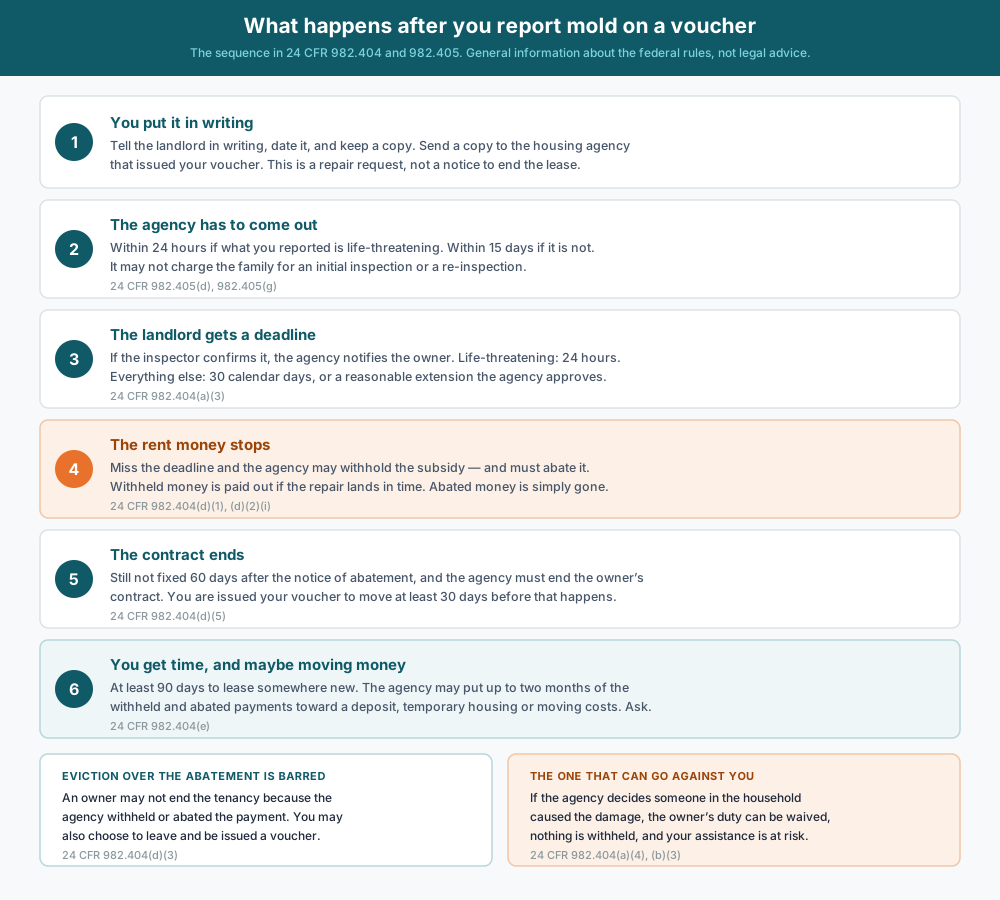
- Photograph it and measure it. Add up the patch area in each room, because that is how the standard is scored. Date the photos.
- Put it in writing to the landlord. Dated, specific about the room and the suspected water source, and keep a copy.
- Give the housing authority a copy. This is the step that converts a maintenance complaint into a regulatory clock.
- The agency inspects. Under 24 CFR 982.405(d), when a participant family notifies the PHA of a potential deficiency, for a life-threatening one “the PHA must, within 24 hours of notification, both inspect the housing unit and notify the owner if the life-threatening deficiency is confirmed.” For anything else it is 15 days, with the same duty to notify the owner. HUD can approve an exception for extraordinary circumstances, such as a presidentially declared disaster area.
- It should not cost you anything. Section 982.405(g): “The PHA may not charge the family for an initial inspection or reinspection of the unit.” If the PHA charges the owner a reinspection fee under (h), that paragraph is explicit that “The owner may not pass this fee along to the family.” Section 982.405(e) adds that in scheduling inspections the PHA must consider complaints and other information brought to its attention.
Do not wait for the routine visit. Section 982.405(b) requires a periodic inspection only “at least biennially,” and a small rural PHA only “once every three years.”
One honest caveat about that 24-hour label: Notice PIH 2026-18 acknowledges that lead-based paint, “mold and moisture,” and pest infestation “may take a significant amount of time to permanently control,” and lets PHAs apply the flexibilities in Notice PIH 2023-16 / H 2023-07 on what counts as an appropriate correction for a 24-hour repair. Something has to be done in 24 hours. The mold being gone in 24 hours is not what it means.
What if the landlord won’t fix the mold?
This is where a voucher gives you leverage a market-rate renter does not have, and the operative word in the regulation is must.
24 CFR 982.404(a)(1) puts the duty on the owner: “The owner must maintain the unit in accordance with HQS.” Then (a)(2): “If the owner fails to maintain the dwelling unit in accordance with HQS, the PHA must take enforcement action in accordance with this section.” The cure periods in (a)(3) are 24 hours from notification for a life-threatening deficiency and 30 calendar days otherwise, or a reasonable PHA-approved extension.
The money then moves in two stages, and the difference between them is the part landlords understand:
- Withholding is permissive. Under (d)(1) the PHA may hold back the housing assistance payment once it has notified the owner in writing. If the unit complies inside the cure period, the PHA resumes payments and pays the withheld amount.
- Abatement is mandatory, and that money is gone. Section 982.404(d)(2)(i): “The PHA must abate the HAP, including amounts that had been withheld, if the owner fails to make the repairs within the applicable cure period.”
Abatement also starts a countdown on the tenancy. Under (d)(2)(ii), when it abates the PHA must tell you and the owner that if the unit does not meet standards within 60 days — measured from the determination of noncompliance, or a reasonable longer period the PHA sets — it will terminate the HAP contract and you will have to move to keep your assistance. The PHA “must issue the family its voucher to move at least 30 days prior to the termination.” Paragraph (d)(5) sets the matching deadline for the owner: fail to repair “within 60 days (or a reasonable longer period established by the PHA) of the notice of abatement,” and the PHA must terminate the contract. Then (e)(1) gives you “at least 90 days,” or longer if reasonably necessary, to lease somewhere else.
Relocation money is worth asking about rather than assuming. Under (e)(3) a PHA may put up to two months of the withheld and abated payments toward relocation costs such as security deposits, temporary housing and reasonable moving costs. That is discretionary and sits in each PHA’s administrative plan, so ask whether yours does it.
A limit on all of the above: this version of § 982.404 applies to HAP contracts executed on or after, or renewed after, June 6, 2024, and older contracts fall under the prior version.
Can my landlord evict me for reporting mold to the housing authority?
Not for the withholding or the abatement. Section 982.404(d)(3) is direct: “An owner may not terminate the tenancy of any family due to the withholding or abatement of assistance under paragraph (a) of this section.”
The same paragraph gives you an exit. During an abatement you may end the tenancy yourself by notifying the owner and the PHA, and “the PHA must promptly issue the family its voucher to move.”
That covers the subsidy mechanics specifically. Retaliation generally, and anything that involves actually ending a lease, is a legal question with real consequences if you get it wrong, so take that part to the free help listed below before you act.
The trap: when the agency decides you caused it
This is the part of the deal that can run against you, and leaving it out would not be doing you a favor.
Under 24 CFR 982.404(a)(4), where the PHA determines that a household member or guest caused the deficiency, “other than any damage resulting from ordinary use,” it may waive the owner’s responsibility. Then, in the regulation’s own words, “The HAP to the owner may not be withheld or abated if the owner responsibility has been waived” — and the PHA “may terminate assistance to a family.” Section 982.404(b)(3) adds that if the family has caused a breach of the standards, “the PHA must take prompt and vigorous action to enforce the family obligations,” and under (b)(2) the duty to chase the repair shifts to you — you “must take all steps permissible under the lease and State and local law to ensure” it is corrected, within 24 hours for a life-threatening deficiency and 30 days otherwise. That is an obligation to pursue the fix, not necessarily to pay for it.
In practice the argument against you is some version of you ran the shower without the fan. The counter is a water source that belongs to the building: a clogged AC condensate line, a monsoon roof leak, a slab leak, a dripping supply line under a sink. Ordinary household living is not tenant damage, and a failed building component is the owner’s problem under § 33-1324 and under the HAP contract both.
What settles that argument is a written record of the cause, made early. The cheapest one is already coming: the housing authority’s inspection report names the deficiency and costs you nothing, and Community Legal Services can tell you what it means for your case. If you want a second, independent record of where the water is coming from, a mold inspection documents the building rather than your housekeeping. Our guide to a clogged AC drain line covers the most common Phoenix version of that water source.
How this stacks with Arizona law
Arizona has no mold statute: no state exposure limit, no remediation standard, and no mold license. Mold here is handled by general law, which we lay out in full in our guide to Arizona mold laws.
For a renter, two sections carry the weight. A.R.S. § 33-1324 requires the landlord to keep the unit fit and habitable and to maintain the plumbing, heating, ventilating and air-conditioning systems they supply. Under § 33-1361(A) a tenant can end the lease in 5 days over a § 33-1324 failure materially affecting health and safety — but only with a notice that both specifies the breach and states the termination date, which is not what an ordinary complaint letter does. The Phoenix section below spells out the difference. The statute’s 10-day notice is a separate branch, for a material breach of the rental agreement itself. Neither branch sets a size threshold for mold, and neither is a repair order: the 5-day branch turns on whether the § 33-1324 failure materially affects health and safety, which is a judgment call rather than a square-footage test. Both are tenant lease-termination remedies, and no agency enforces that clock.
That is what makes the voucher path different. The state remedy puts the burden on you to end a tenancy; the federal one obligates an agency to inspect on a deadline and to stop paying your landlord. For the private-market remedies and the free tenant-help list that goes with them, see our guide to mold in an Arizona apartment — keeping in mind that a § 33-1361 notice is a tenant’s lease-termination remedy rather than a landlord repair deadline.
Phoenix: the letter that gets an inspector to your door
The City of Phoenix Housing Department’s Section 8 inspections page still describes HQS and lists four inspection types: Initial, Biennial, Special and Quality. On the routine one: “A biennial inspection determines that the unit continues to meet HQS and must be conducted within 24 months of the last full inspection.” Repairs run 30 calendar days, or “24 hours if the defect is life-threatening or required for livability.”
The procedural detail is the useful part. For the complaint-driven inspection the department says: “In most cases to conduct a special inspection, tenant must provide notice of deficiencies to the landlord and provide the Housing Department with a copy.”
So the letter that gets an inspector to your door is an ordinary, dated description of the problem: which room, what you can see, roughly how big it is, and what you think the water source is. Write it to the landlord, keep a copy, and send a copy to the housing department.
Keep that separate from a notice under A.R.S. § 33-1361(A), which is a different letter doing a different job. The statute requires a tenant’s notice to specify “the acts and omissions constituting the breach” and to state “that the rental agreement will terminate upon a date not less than” five or ten days after receipt if the breach is not remedied. A repair request does not contain that second part, so it does not start the statutory clock — and a letter that does contain it is a step toward ending your tenancy, with your voucher attached to the outcome. That one is worth a call to Community Legal Services before you send it.
That procedure is the City of Phoenix’s. Other Valley housing authorities run their own administrative plans, so confirm the steps with whichever agency issued your voucher.
Where to get free help
The agency to call is the one that issued your voucher, not HUD. If you are not sure which that is, HUD publishes a public housing agency contact directory you can search by state.
For the legal side, Community Legal Services is a non-profit law firm whose offices cover Maricopa and four other Arizona counties. Intake is (602) 258-3434 or toll-free 1-800-852-9075, Monday to Friday 9am to 2pm, with an online application at apply.azlawhelp.org. They can tell you whether you qualify.
This page is information, not legal advice. Anything that touches ending your lease or keeping your voucher is worth a call to Community Legal Services or an Arizona attorney before you act. If mold cleanup does end up in your hands for a small patch, wear the gear EPA names as the minimum first: an N-95 respirator, gloves and eye protection. For the rest of the Phoenix mold picture, browse our mold guides.
Sources
- HUD, Notice PIH 2026-18 (July 15, 2026) — PIH-2026-18: the three compliance-date extensions, February 1, 2027, HQS as previously defined, pass/fail inspections, and the mold-and-moisture correction flexibility.
- HUD, NSPIRE Standard — Mold-like Substance, V3.0 (06/20/23) — standard PDF. HUD also serves a later printing of the same V3.0 standard dated 08/11/23; the thresholds, severities and HCV timeframes are identical; the definition swaps two instances of “may” for “can”. Quotations here follow the 06/20/23 printing: the size bands, severities, HCV correction timeframes, unit-versus-inside split, visual cumulative measurement, the definition and algae exclusion, and the elevated-moisture item.
- NSPIRE rulemaking — final rule at 88 FR 30442 (May 11, 2023); standards at 88 FR 40832 (June 22, 2023).
- 24 CFR 982.401 (2022 CFR edition — the pre-May-2024 text that is “HQS as previously defined”): the check showing no mention of mold, mildew, fungus, moisture or damp. The current text of the section, at 89 FR 38296 (May 7, 2024), is a one-line cross-reference to 24 CFR 5.703.
- 24 CFR 982.404 (2025 CFR edition): owner duty, mandatory enforcement, cure periods, withholding, mandatory abatement, the 60-day and 30-day notices, the eviction ban, relocation, the tenant-caused waiver, and the June 6, 2024 applicability date.
- 24 CFR 982.405 (2025 CFR edition): periodic inspections, the 24-hour and 15-day interim clocks, the disaster-area exception, and no inspection charge to the family.
- 24 CFR 5.707: the self-inspection exemption for HCV, PBV and Moderate Rehabilitation owners.
- A.R.S. § 33-1324 and § 33-1361 — § 33-1324 (the habitability duty) and § 33-1361 (the two notice branches and the required contents of a tenant’s notice).
- City of Phoenix Housing Department — Section 8 Inspections: HQS, the four inspection types, the biennial window, repair timeframes, and the special-inspection procedure.
- Community Legal Services — clsaz.org.
- U.S. EPA — A Brief Guide to Mold, Moisture and Your Home (the 10-square-foot guideline) and Mold Remediation in Schools and Commercial Buildings (“The minimum PPE is an N-95 respirator, gloves, and eye protection”).