Arizona Mold Laws: There Is No Mold Statute
Arizona has no mold statute: no state exposure limit, no remediation standard, and no mold license. Mold is handled by general law instead: habitability for renters (A.R.S. § 33-1324 and § 33-1361), the condo and planned-community acts for HOAs, seller disclosure in a home sale, and trade licensing for contractors. The two rules in the main state compilation that do name mold cover foster homes and hotel rooms, not a private house.
This is general information, not legal advice. It explains how Arizona law generally treats mold, with citations. Your lease, your declaration (CC&Rs), your contract, and the specific facts control your situation. For advice on your case, talk to a licensed Arizona attorney or one of the resources named in the sections below.
Does Arizona have a mold law?
No. There is no Arizona statute that sets a safe mold level, tells a landlord or seller to test for mold, spells out a cleanup standard, or creates a mold assessor or remediator license. If you were hoping to look up “the Arizona mold law” and read your rights, that page does not exist.
That is the start of the answer, not the end. Mold does not need its own statute to have legal consequences, because it runs through four bodies of general law. Which one applies depends on who you are in relation to the building. There is also a fifth situation that none of them reaches, and it is the one a lot of Phoenix homeowners are in. The matrix below sorts them out.
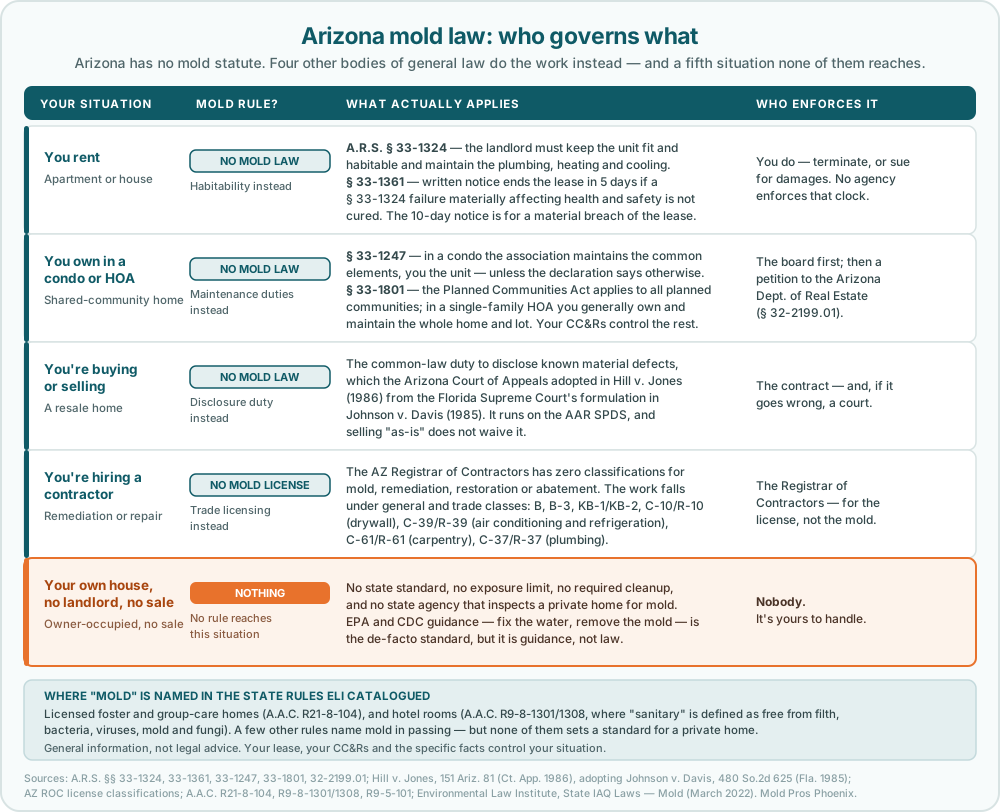
| Your situation | Mold rule? | What actually applies | Who enforces it |
|---|---|---|---|
| You rent | No mold law — habitability instead | A.R.S. § 33-1324: the landlord must keep the unit fit and habitable and maintain the plumbing, heating and cooling they supply. § 33-1361: written notice ends the lease in 5 days if a § 33-1324 failure materially affecting health and safety is not cured. The statute’s 10-day notice is for a material breach of the rental agreement itself. | You do — terminate, or sue for damages. No agency enforces that clock. |
| You own in a condo or HOA | No mold law — maintenance duties instead | § 33-1247: in a condo the association maintains the common elements and you maintain your unit, except as the declaration provides. § 33-1801: the Planned Communities Act applies to all planned communities; in a single-family HOA you generally own and maintain the whole home and lot. Your CC&Rs control the rest. | The board first; then a petition to the Arizona Department of Real Estate (§ 32-2199.01). |
| You’re buying or selling | No mold law — disclosure duty instead | The common-law duty to disclose known material defects, which the Arizona Court of Appeals adopted in Hill v. Jones (1986) from the Florida Supreme Court’s formulation in Johnson v. Davis (1985). It runs on the AAR seller disclosure statement, and selling “as-is” does not waive it. | The contract — and, if it goes wrong, a court. |
| You’re hiring a contractor | No mold license — trade licensing instead | The Arizona Registrar of Contractors has zero classifications for mold, remediation, restoration or abatement. The work falls under general and trade classes: B, B-3, KB-1/KB-2, C-10/R-10 (drywall), C-39/R-39 (air conditioning and refrigeration), C-61/R-61 (carpentry), C-37/R-37 (plumbing). | The Registrar of Contractors — for the license, not the mold. |
| Your own house, no landlord, no sale | Nothing | No state standard, no exposure limit, no required cleanup, and no state agency that inspects a private home for mold. EPA and CDC guidance — fix the water, remove the mold — is the de-facto standard, but it is guidance, not law. | Nobody. It’s yours to handle. |
Look at the last row. If you own your house, are not selling it, and have no landlord or HOA above you, no state law sets a mold standard for you at all. The guidance you follow is the EPA’s and the CDC’s, and nobody enforces it. That is the gap this guide is about.
Where does “mold” show up in the Arizona rules we could find?
Almost nowhere, and not where you live. The most complete public compilation we could find is the Environmental Law Institute’s Database of State Indoor Air Quality Laws, Mold Laws excerpt (March 2022, covering laws enacted through December 2021). It lists exactly two Arizona entries, and neither reaches a private home:
- Foster homes and residential group care. A.R.S. § 8-453(A)(5) leads to Department of Child Safety rules. Ariz. Admin. Code R21-8-104, “General Condition and Cleanliness of the Premises,” requires that “the premises are clean to the degree that the condition does not constitute a hazard,” and names “an accumulation of mold” as one of the conditions that constitutes a hazard.
- Hotels and other lodging. A.R.S. § 36-136(I)(8) leads to Department of Health Services lodging rules (Ariz. Admin. Code R9-8-1301 and R9-8-1308). A lodging unit must be sanitary, and R9-8-1301 defines “sanitary” as “free from filth, bacteria, viruses, mold, and fungi.”
Put plainly: an Arizona hotel room carries a legal requirement to be free of mold that your own house does not. It is a requirement, not a measurable standard — the rule names mold but sets no level, no method and no threshold.
Three honest limits. The ELI says its chart does not include every state law that addresses mold, and it stops at December 2021, so read this as “the best public compilation we found” rather than an exhaustive legal search of every rule on the books. And a few Arizona rules outside that chart do name mold in passing: the child care facility licensing rules define “sanitize” as reducing pathogens “including bacteria, viruses, mold, and fungi” (Ariz. Admin. Code R9-5-101). What none of them does is set a standard for a private home.
Does Arizona license mold remediators?
In 2011, House Bill 2388, “Certified Mold Assessors and Remediators,” was introduced in the 50th Legislature. It would have added mold professionals to the Board of Technical Registration. It defined a mold assessor as “a person who, for a fee, performs the service of examining residential or commercial buildings to confirm or refute the presence of a proliferative source of mold in a residential or commercial building” and a mold remediator as one who performs projects “for the purpose of removing mold in excess of ten square feet.”
Those definitions never reached the statute books. The current text of A.R.S. § 32-101, which defines the professions that board regulates, lists architects, engineers, geologists, home inspectors, landscape architects, land surveyors, and alarm agents. There is no mold profession in it.
The practical result: there is no mold credential to look for. The Registrar of Contractors has zero license classes for mold, remediation, restoration, or abatement. Mold work is licensed by trade (general residential, drywall, HVAC, carpentry, plumbing), so the question to ask a contractor is which license class covers the work they propose. Our guide to Arizona mold contractor licensing walks through the classes and how to look one up.
Arizona mold laws for renters: the habitability duty
Renters have the strongest mold protection in Arizona, and it comes from the habitability rules. Under A.R.S. § 33-1324, a landlord must make repairs and do whatever is necessary to keep the premises in a fit and habitable condition, and must keep the plumbing, heating, ventilating, and air-conditioning systems they supply in good working order. A roof leak or a failed AC condensate line that feeds mold is that kind of failure.
The remedies depend on proper written notice, and the detail most summaries get wrong is worth stating precisely. Under § 33-1361(A), a tenant can deliver written notice that the lease terminates in 5 days if a § 33-1324 failure materially affecting health and safety is not cured in that time. The statute’s 10-day notice is a different branch, covering a material breach of the rental agreement itself. Both are tenant termination remedies rather than an order to repair, and no agency enforces the clock — § 33-1361(B) separately lets a tenant sue for money damages or ask a court to order the fix. A phone call or a text to maintenance does not reliably start any of it.
Repair-and-deduct under § 33-1363 is a separate procedure with its own notice. The remedies, the repair-and-deduct guardrails, and free tenant help are in our guide to mold in your Arizona apartment. If you need a written notice to start from, use the mold notice letter tool.
Arizona mold laws for condo and HOA owners
Which statute applies depends on what kind of community you live in. A condominium falls under the Arizona Condominium Act. A.R.S. § 33-1247 says the association is responsible for maintenance, repair and replacement of the common elements and each unit owner for the unit, except to the extent the declaration provides otherwise. So mold fed by a failed roof or shared plumbing riser tends to land on the association, while mold from a fixture inside your unit tends to land on you.
A single-family HOA is a planned community under the Planned Communities Act, and A.R.S. § 33-1801 says that chapter applies to all planned communities. There you generally own and maintain the whole home, so interior mold from your own roof, plumbing, or AC condensate line is yours.
Two things hold in both. The CC&Rs can shift the default lines, so read them. And courts generally analyze this as negligence rather than strict liability: an association is on the hook when it fails to maintain a common element after it had notice. Mold showing up is not by itself enough. If a board will not act, an owner can petition the Arizona Department of Real Estate under A.R.S. § 32-2199.01. The details are in who is responsible for mold in an Arizona condo or HOA.
Arizona mold disclosure for home sellers and buyers
Arizona has no mold disclosure statute either. Sellers still have to speak up, and the duty comes from the courts. In Hill v. Jones (Ariz. Ct. App. 1986), the court looked at how other states had framed a seller’s duty to speak up and picked Florida’s wording. That sentence comes from the Florida Supreme Court in Johnson v. Davis (1985): “where the seller of a home knows of facts materially affecting the value of the property which are not readily observable and are not known to the buyer, the seller is under a duty to disclose them to the buyer.” The Arizona court adopted that formulation for a home sale. The case involved termites. Known mold and water-damage history would generally fit the same description, which is why the Arizona disclosure form asks about both.
In a typical agent-represented sale, that duty is carried out on the Arizona Association of REALTORS seller disclosure statement (the SPDS), which asks about past and present mold, water damage, roof leaks, and plumbing leaks. Buyers get an inspection period, usually negotiated, to check what the form says.
The myth to drop is “I’m selling as-is, so I don’t have to say anything.” As-is covers who pays for repairs. It does not remove the duty to disclose what you know. The full picture is in mold disclosure when selling an Arizona home.
Is there a legal limit for mold in an Arizona house?
No. What you get instead is guidance, from the EPA and the CDC. The EPA has set no federal standard for acceptable airborne mold levels, and it says sampling is generally unnecessary when mold is visible. Its practical rule of thumb in A Brief Guide to Mold, Moisture and Your Home is 10 square feet: “If the moldy area is less than about 10 square feet (less than roughly a 3 ft. by 3 ft. patch), in most cases, you can handle the job yourself…” Above that, the EPA points you to its larger remediation guide for schools and commercial buildings rather than ordering you to hire anyone. The CDC’s instruction is shorter and blunter: “If mold is growing in your home, you need to clean up the mold and fix the moisture problem.” The CDC also states flatly that “CDC does not recommend mold testing,” because whatever the type, you remove it either way. In Arizona all of that is guidance, not law. Nobody enforces it, and nothing requires you to follow it.
The Arizona Department of Health Services says much the same in its mold fact sheet, an undated Indoor Air Quality info sheet from its environmental health program whose PDF was created in 2010. It states that it “does not recommend testing as the first step to determine if you have a mold problem,” that “there are few available standards for judging what an acceptable quantity of mold is,” and that “mold cleanup is usually considered one of the housekeeping tasks of the private citizen, along with roof and plumbing repairs, sweeping and house cleaning.”
That last line is the honest summary of Arizona mold law for an owner-occupant. If it is your house, it is your job, and the state has not written a rulebook for it. Two related guides cover what sits next to the law: how mold testing works and when it helps and what Arizona homeowners insurance does and does not cover for mold. For the building rules that do exist, see Phoenix building code and mold.
What this means for you, practically
If you rent, your protection is the habitability duty, and it only works with written, dated notice. Send it first, and keep proof.
If you own, the question that matters is who owns the water source: you, the association, or nobody but you. Trace the water before you argue about who pays. If you are in a condo, the answer often sits on the line between a common element and your unit.
If you are buying, the seller’s form tells you what they say they know. It does not tell you what is behind the drywall.
In every one of these paths, with no state standard and no mold license to point to, the record is what decides the outcome: what the mold is, where it is, and what moisture source feeds it. A mold inspection you arrange yourself, which documents the growth and traces the moisture, is the kind of record a notice letter, a board petition, or a purchase negotiation can actually stand on. It documents the mold; it is not legal action, and it does not replace an attorney.
Sources
All accessed 2026-10-02 unless noted.
- Environmental Law Institute, Database of State Indoor Air Quality Laws, Mold Laws (March 2022): eli.org mold laws excerpt
- Ariz. Admin. Code R9-8-1301 (lodging establishments, definitions): Cornell LII
- Ariz. Admin. Code R21-8-104 (foster homes and child welfare agencies, general condition and cleanliness of the premises): Cornell LII
- A.R.S. § 32-101 (Board of Technical Registration definitions): azleg.gov
- HB 2388, 50th Legislature, 1st Regular Session (2011): azleg.gov bill text
- A.R.S. § 33-1324, § 33-1361, § 33-1363 (landlord and tenant): A.R.S. § 33-1324
- A.R.S. § 33-1247 and § 33-1801: § 33-1247, § 33-1801; A.R.S. § 32-2199.01 (ADRE petitions)
- Hill v. Jones, 151 Ariz. 81, 725 P.2d 1115 (Ct. App. 1986), adopting Johnson v. Davis, 480 So.2d 625, 629 (Fla. 1985); Arizona Association of REALTORS seller disclosure statement (SPDS)
- Arizona Registrar of Contractors license classifications (term search accessed 2026-06-28)
- Ariz. Admin. Code R9-5-101 (child care facility licensing, definition of “sanitize”): Cornell LII
- Arizona Department of Health Services, Mold in My Home: What Do I Do? (undated info sheet)
- U.S. CDC, About mold
- U.S. EPA, Mold testing or sampling; EPA, A Brief Guide to Mold, Moisture and Your Home
For the rest of the library, see the full set of Phoenix mold guides.