Black Mold in Shower Grout and Caulk: Clean It or Replace It?
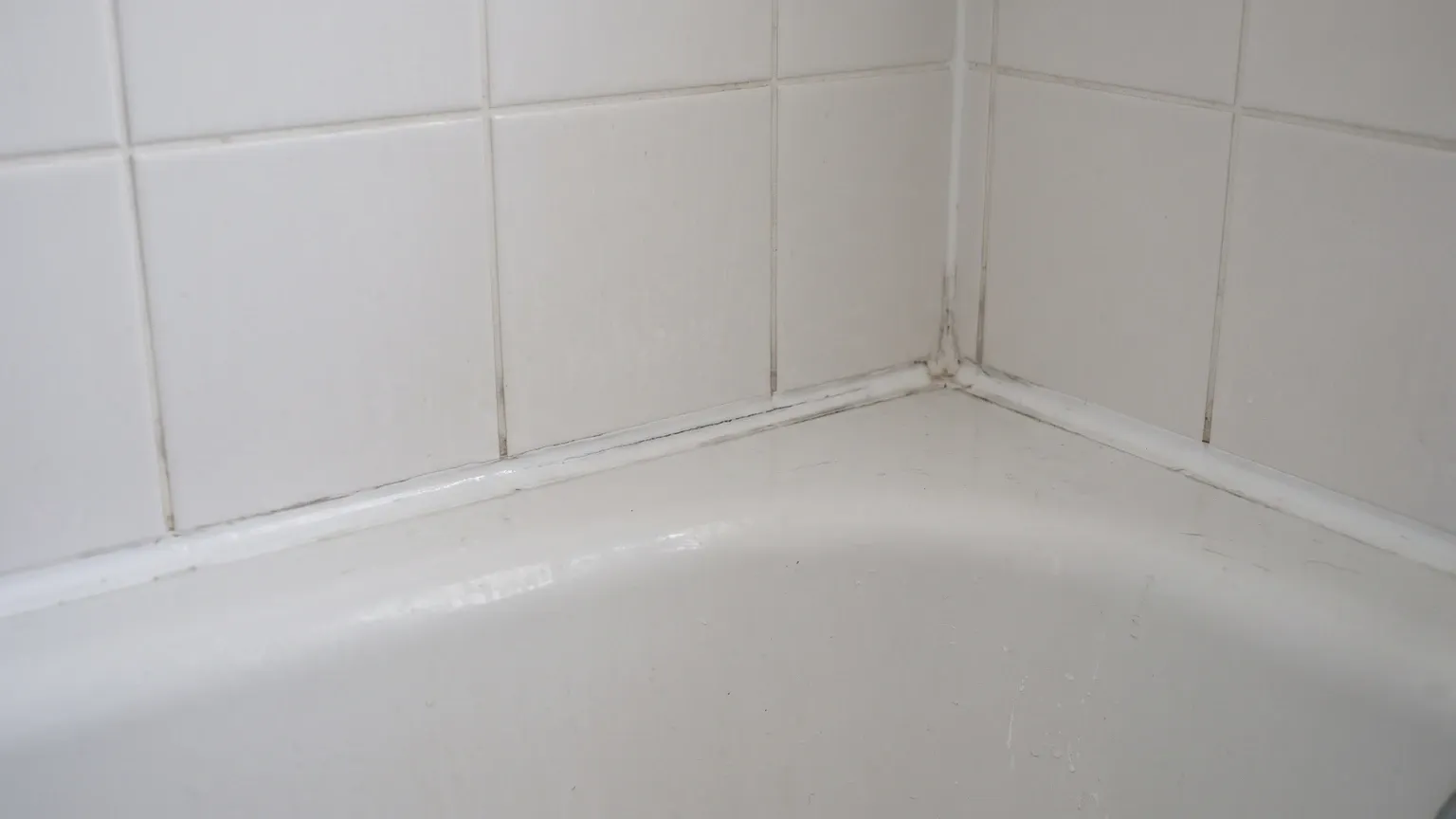
You cannot tell the species of black mold in shower grout or caulk by looking, and CDC says you do not need to. Research on fungi isolated from bathrooms and washing machines points at a mechanism: in culture they can feed on soap residue. We found no published survey of shower grout or caulk. Scrub with detergent, wearing gloves, goggles and an N-95, then dry the joint and ask whether it is still sealing.
Is the black in shower grout and caulk actually “black mold”?
“Black mold” is usually shorthand for one organism. CDC describes it this way: “Stachybotrys chartarum is a greenish-black mold. It can grow on material with a high cellulose content, such as fiberboard, gypsum board, and paper.” CDC adds that “Constant moisture is required for its growth.”
Cement grout is not cellulose. A cured silicone bead is not cellulose. Neither is wet around the clock in a bathroom that gets used and then dries. That does not prove what is growing on your joint, and we are not claiming it never happens. It means a caulk line is a poor match for CDC’s description of that organism.
The more useful point is what CDC does with the question. CDC says: “It is not necessary to determine what type of mold you may have growing in your home or other building.” And in its general guidance: “You do not need to know the type of mold.” The floor is the same for every species: “No matter what type of mold is present, you need to remove it.”
If you want the general version of why color tells you nothing, our guide to black mold covers it. For the health question, go to is black mold dangerous. CDC’s position is that “All molds should be treated the same with respect to potential health risks and removal.” For the rest of the room, see our bathroom and shower mold guide.
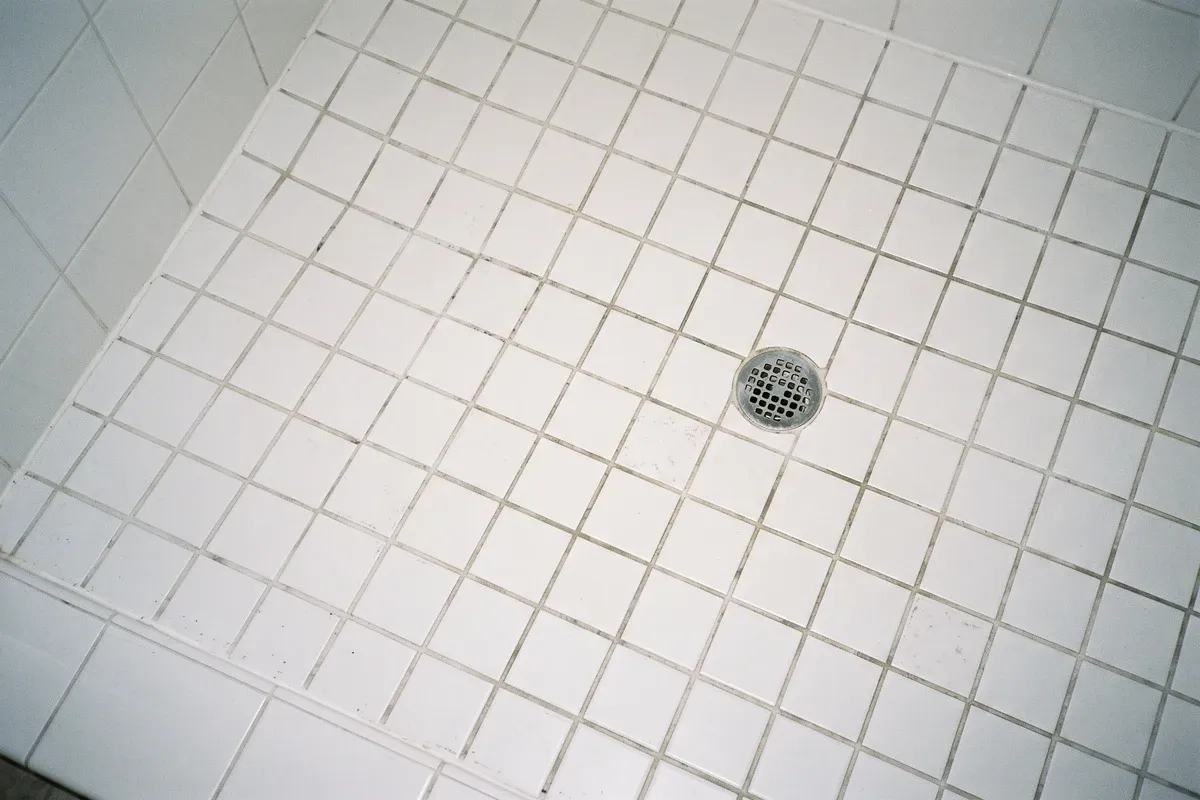
What the surface growth is probably eating: the soap film, not the tile
If the tile and the joint are not food, what is? A run of papers by two Osaka researchers (Hamada and Abe, 2010 to 2018, at the city’s public-health institute for most of it) points at the film that builds up on every shower surface.
The research has two limits. These studies sampled bathroom drains, bathroom and washing-machine isolates, and detergent-rich indoor environments in Japan. We did not find a published survey of shower grout or caulk specifically, in Phoenix or anywhere else. So what this research supports is a mechanism, not a species name for your bathroom.
The mechanism is consistent across the papers. In a 2010 study of fungi from bathroom and kitchen sink drains, Hamada and Abe reported that “In both bathrooms and sinks, Exophiala dermatitidis was predominant in culture at 37 degrees C.” That is predominance within a thermotolerant subset: the same paper puts the fungal count at 37 degrees at about one six-hundredth of the count at 25 degrees. They also found that “E. dermatitidis grew at 40 degrees C and used surfactant as a nutrient.” In a second 2010 paper on four fungal isolates from bathrooms, the same authors reported: “These fungi were found several times in bathrooms and washing machines, but not in other indoor environments such as house dust or windows.” Those isolates “were able to consume surfactants, soap and shampoo, but were unable to grow well in high-temperature or dry conditions.”
The pattern shows up elsewhere. In a 2011 paper on isolates from detergent-rich indoor environments, Abe and Hamada found that “S. humicola and S. constricta could utilize both surfactants generally included in soaps or synthetic detergents as nutrients.” A 2018 paper states that “In Japan, Ochroconis species are often found in indoor detergent-rich environments, such as bathrooms and washing machines.” The authors’ own summary of the bathroom work: “Soap and shampoo seem to affect fungal flora in the bathroom.”
On that evidence, the black in a shower joint is plausibly growing on the soap film rather than on the tile. That is the case for scrubbing with detergent, which is what EPA tells you to do, and for rinsing the residue away afterwards, which is our own addition. It is not a claim that cleaning starves the organism out: our pink mold in the shower guide covers a different organism on the same tile and says plainly that the starve-it explanation is the folk version and not something we can source. On detergent versus bleach, see does bleach kill mold.
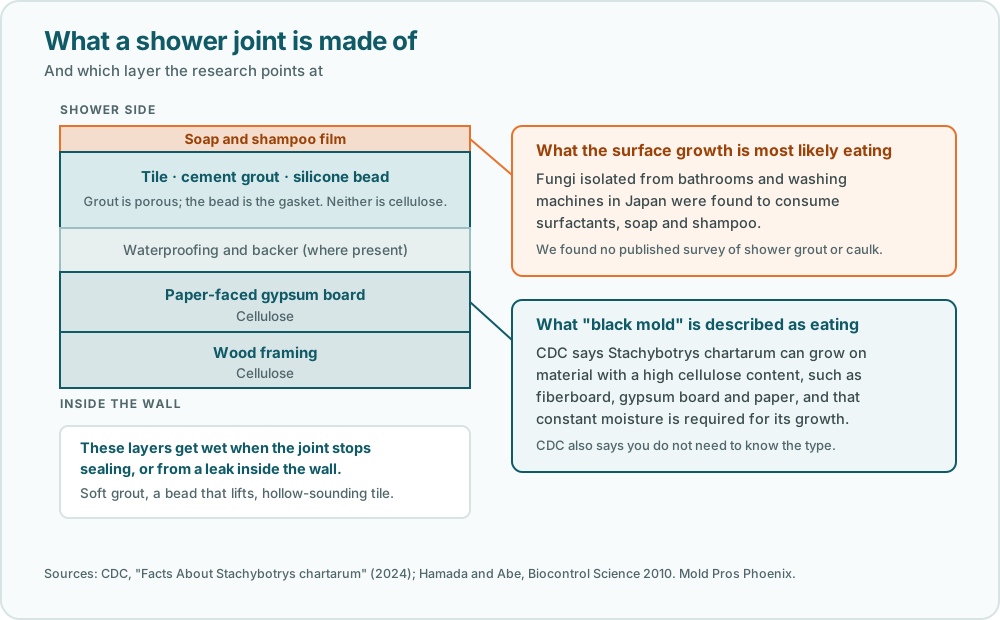
Why grout and caulk are two different repairs
Grout and caulk fail differently, so the fix differs.
Grout is porous. EPA’s point about porous materials is that the mold itself can persist in them: “Mold can grow on or fill in the empty spaces and crevices of porous materials, so the mold may be difficult or impossible to remove completely.” That is one reason growth returns in a grout line that looked clean, and it is why the dry-it step matters as much as the scrub. Grout can be cleaned and re-sealed. Grout that is soft, crumbling or missing is a different case, because it is no longer keeping water out.
Caulk is a gasket. A cured silicone bead exists to keep water out of the joint. A bead that is dark only on the surface can often be scrubbed clean. A bead where the black runs through the thickness, or one that is cracked, peeling or lifting at the edge, is no longer doing its job. That bead gets cut out and replaced, not scrubbed.
So for grout, ask whether it is solid. For caulk, ask whether the black is on the bead or in it, and whether the bead still grips both surfaces. This page carries no re-caulking or re-grouting prices; for cost ranges see black mold removal cost.
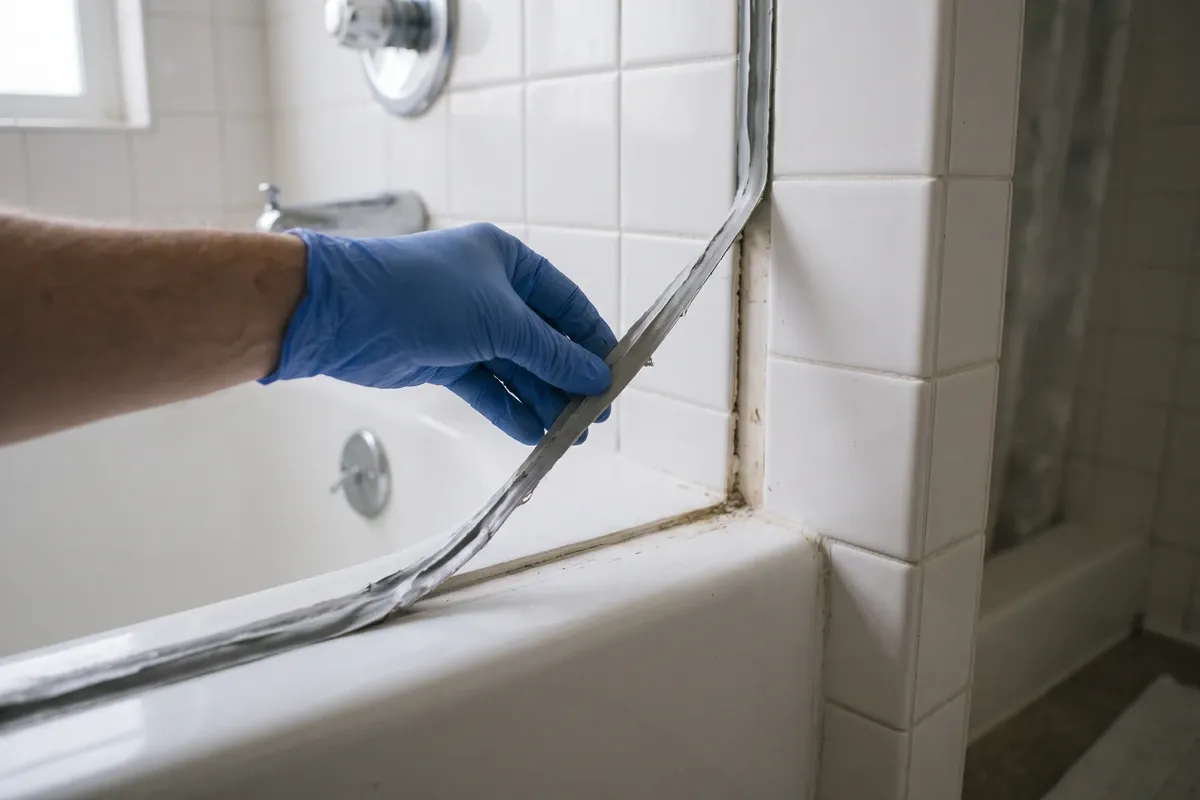
How to clean black mold off shower grout and caulk
Steps 1, 2, 4 and 5 follow EPA’s guidance, from its home mold cleanup page and its guide to mold, moisture and your home. Step 3, and the note on who should check with a doctor first, are ours.
- Put on the gear first. EPA says to “Avoid breathing in mold or mold spores” and suggests an N-95 respirator for airborne mold. It also says “Wear gloves” (for water and a mild detergent, “ordinary household rubber gloves may be used”) and “Wear goggles,” the kind without ventilation holes. Open a window or run the fan. And before any of it, EPA’s own line: “If you have health concerns, consult a health professional before starting cleanup.” If someone in the house has asthma, a mold allergy or a weakened immune system, that call comes before the brush, and our guide to whether black mold is dangerous covers what the evidence does and does not show.
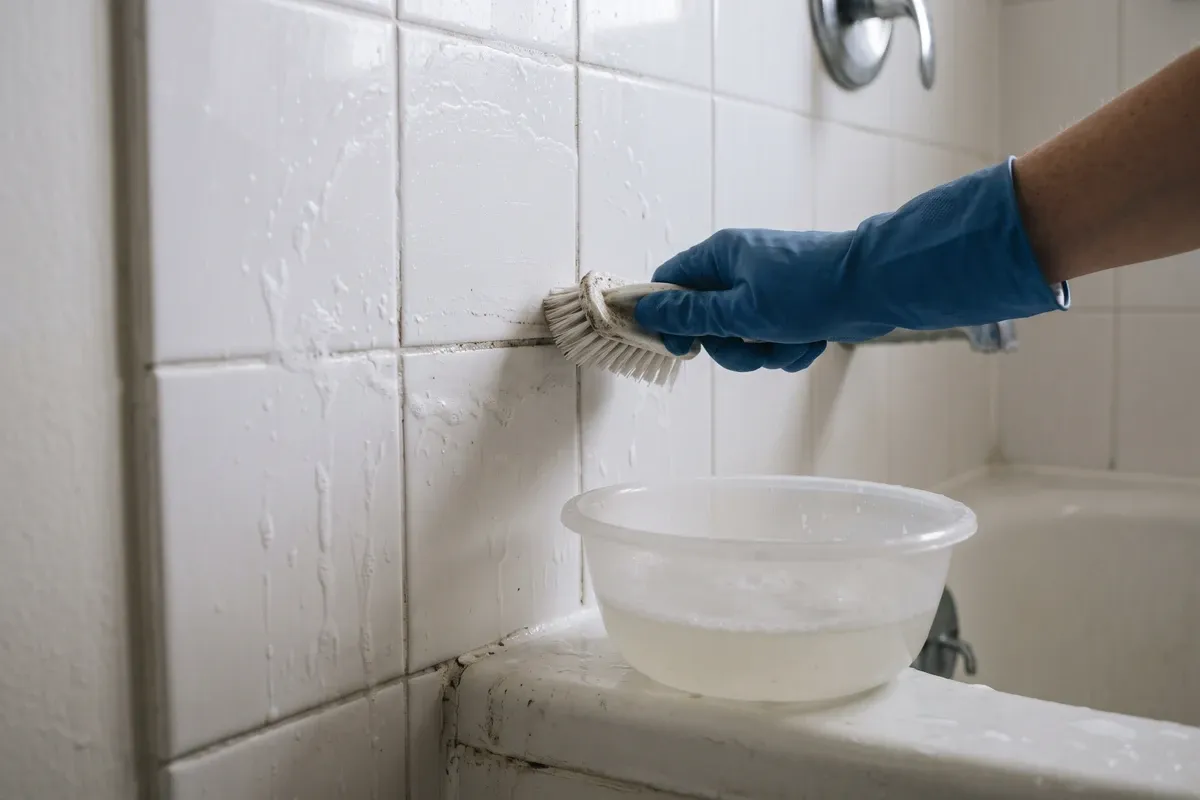
- Scrub with detergent and water. EPA: “Scrub mold off hard surfaces with detergent and water, and dry completely.” A stiff brush along the grout line does more than a spray does, because the film is what you are removing.
- Rinse the residue off. Soap film is the best-supported food source we found, so leaving a detergent film behind plausibly works against the step before it. No study we found has tested that on a joint, and EPA gives no rinse step. This one is our reading of the mechanism.
- Dry the joint completely. EPA says it twice in its cleanup tips: “Fix plumbing leaks and other water problems as soon as possible. Dry all items completely.” and “Scrub mold off hard surfaces with detergent and water, and dry completely.”
- Do not seal over what is left. EPA: “Do not paint or caulk moldy surfaces. Clean up the mold and dry the surfaces before painting.” A fresh bead laid over a black one buries the problem. That is a rule against sealing over mold, not a rule against re-caulking: cut the failed bead out, clean and dry the joint, then lay the new one.
CDC’s version of the same instruction is shorter: “If mold is growing in your home, you need to clean up the mold and fix the moisture problem.”
How to tell if water is behind the tile
CDC names one requirement for the organism it describes — constant moisture — and describes the materials it grows on as high-cellulose. A tile joint is a poor match for both. The space behind a failed joint is not, because that is where paper-faced gypsum board and framing live. So the useful question is not what species is on the surface. It is whether water is getting behind it.
Signs that point to water behind the tile:
- Grout that is soft, crumbling or missing.
- Tile that sounds hollow when tapped, or flexes under light pressure.
- Staining along the bottom row of tile or at the tub flange.
- A musty smell that outlasts the cleaning.
- Swelling at the adjacent baseboard or door jamb.
Any one of these is a reason to look closer. Several together mean the joint has stopped working as a seal. At that point you are scoping a moisture problem, not a cleaning job, and our bathroom mold removal page explains how that work is assessed. EPA’s advice on contaminated water is specific: if damage was caused by sewage or other contaminated water, “call in a professional who has experience cleaning and fixing buildings damaged by contaminated water.”
The Phoenix part: a joint that never dries in a climate that dries everything
Low relative humidity does suppress mold on exposed surfaces, which is the honest half of the desert story in our Phoenix dry-air mold myth guide: the air dries what it can reach, and hides what it cannot. A shower that is wiped, ventilated and left open should lose its surface moisture. One culture result points the same way: the four bathroom isolates in Hamada and Abe’s second 2010 paper were “unable to grow well in high-temperature or dry conditions.” Two limits on that, though. A culture result is not a statement about the humidity in your bathroom, and their other 2010 paper found a drain organism that grew at 40 degrees C, so “bathroom fungi do not like heat” is not a rule. Either way, if one joint stays black while the rest of the room dries, ask why that joint stays wet. It may be holding water.
Ventilation is the usual first suspect. An exhaust fan that dumps into the attic or runs too briefly leaves the room damp, and our guide to checking bathroom fan venting in the attic shows how to look.
Phoenix hard water is a second, smaller complication. The City of Phoenix 2024 Water Quality Report lists total hardness in the distribution system from 158 to 344 ppm, or 9.2 to 20.1 grains per gallon. The city notes that “Hard water can cause some types of scaling in pipes and water heaters, and on plumbing fixtures such as faucets and showerheads.” We found no source linking water hardness to how fast mold grows, and we do not claim one. The practical point is narrower, and it is our reading rather than the city’s: a scaled joint can be harder to scrub clean and harder to get dry.
Clean it yourself, or get it looked at
EPA’s size rule is the starting point: “If the moldy area is less than about 10 square feet (less than roughly a 3 ft. by 3 ft. patch), in most cases, you can handle the job yourself”. A black line along a tub or a few grout lines is well inside that.
Recurrence on its own is not a reason to escalate either, and EPA addresses that case directly in its bathroom advice: “Places that are often or always damp can be hard to maintain completely free of mold. If there’s some mold in the shower or elsewhere in the bathroom that seems to reappear, increasing ventilation (running a fan or opening a window) and cleaning more frequently will usually prevent mold from recurring, or at least keep the mold to a minimum.”
What does belong in the get-it-looked-at column is recurrence together with one of the structural signs above (soft grout, hollow-sounding tile, staining at the flange), or EPA’s own larger-job line: “If there has been a lot of water damage, and/or mold growth covers more than 10 square feet, consult EPA guide Mold Remediation in Schools and Commercial Buildings”.
If you want a second set of eyes on a shower you suspect is leaking, you can request a free quote. For what remediation typically costs, see black mold removal cost. More guides are in the guide hub.
Sources
All accessed 2026-10-13.
- CDC — “Facts About Stachybotrys chartarum,” cdc.gov/mold-health/data-research/facts-stats/ (page dated May 29, 2024), and “About Mold,” cdc.gov/mold-health/about/index.html.
- U.S. EPA — “Mold Cleanup in Your Home,” epa.gov/mold/mold-cleanup-your-home (cleanup tips, the 10-square-foot threshold, contaminated water, Bathroom Tips), and “A Brief Guide to Mold, Moisture and Your Home,” epa.gov/mold/brief-guide-mold-moisture-and-your-home (What to Wear When Cleaning Moldy Areas).
- Hamada N, Abe N. “Comparison of fungi found in bathrooms and sinks.” Biocontrol Science 2010;15(2):51-56. doi:10.4265/bio.15.51. Fungi collected from drains of bathrooms and kitchen sinks, Japan; authors at the Osaka City Institute of Public Health and Environmental Sciences.
- Hamada N, Abe N. “Growth characteristics of four fungal species in bathrooms.” Biocontrol Science 2010;15(3):111-115. doi:10.4265/bio.15.111. Four isolates from bathrooms.
- Abe N, Hamada N. “Molecular characterization and surfactant utilization of Scolecobasidium isolates from detergent-rich indoor environments.” Biocontrol Science 2011;16(4):139-147. doi:10.4265/bio.16.139.
- Hamada N, Abe N. “Molecular and Biological Differences Among Ochroconis Strains Collected from Indoor and Outdoor Environments.” Biocontrol Science 2018;23(4):187-198. doi:10.4265/bio.23.187.
- City of Phoenix Water Services — 2024 Water Quality Report, table “2024 Aesthetic Water Quality Analysis from Distribution System.”