How much does black mold removal cost in Phoenix?
Black mold removal costs the same as any mold removal of the same size: a bathroom or shower job runs $500–$1,500, attic mold $1,500–$5,000, and an extensive whole-home job $6,000–$30,000. Here's what the fear-marketing won't tell you: there is no "black mold premium." The CDC and EPA say the cleanup doesn't depend on color or species — so the price tracks area, moisture, and access, never the color.
Get my free black mold quote
The color doesn't change the price
Type "black mold removal cost" into a search bar and you'll get pages built to scare you into thinking a darker mold means a bigger bill. It doesn't. "Black mold" almost always means the species Stachybotrys chartarum, and it is priced exactly like any other mold — by the affected area, the location, the moisture feeding it, and how hard it is to access. Not by the color. The CDC and EPA are explicit on this point: the cleanup process and the health precautions don't depend on mold color or species, and you generally don't need to identify the species before cleanup, because the removal is the same regardless of type. Our guide on whether black mold is dangerous walks through the science behind that in detail.
So black mold in a bathroom costs the same as any mold in a bathroom. Black mold on a single wall costs the same as any mold on that wall. The number on your quote comes from the job, not the species.
What black mold removal actually costs in Phoenix
These are typical Phoenix-area ranges for 2026 — the same bands we use for mold removal cost generally, because the color doesn't move them. They're estimates to set expectations; the exact figure depends on the size of the area, where it is, and what's behind it.
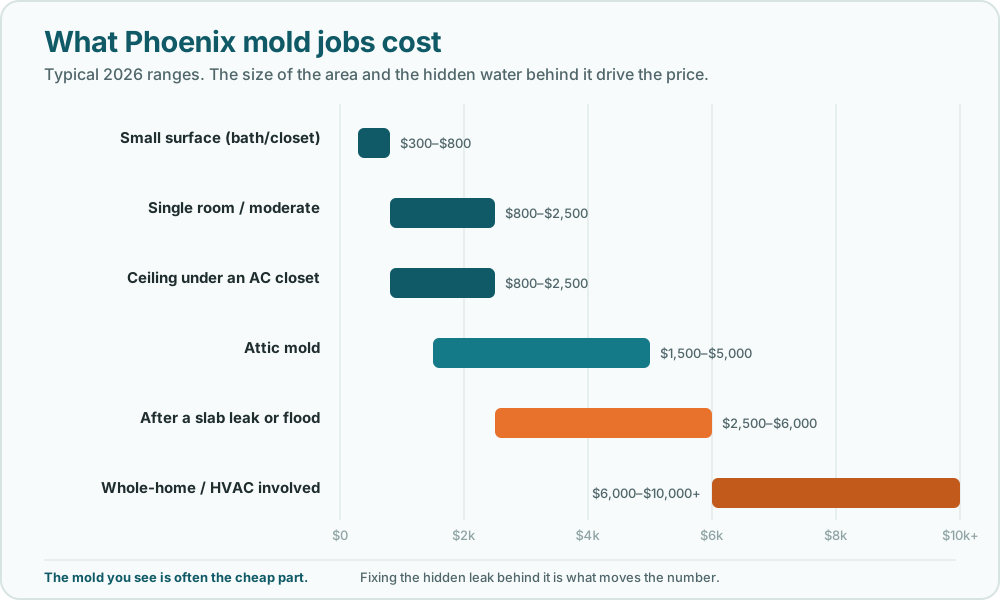
| Job | Typical Phoenix range | What it usually involves |
|---|---|---|
| Small surface spot (bathroom/closet, under ~10 sq ft) | $500–$800 | A small, contained spot on a hard surface. Under ~10 sq ft with the moisture already fixed, EPA says many homeowners can DIY — a floor, not a green light. |
| Bathroom / shower | $500–$1,500 | Typical contained bathroom job. Can reach ~$8,000 if mold is hidden behind the tub, sink, or inside the wall (cut-out + rebuild). |
| Single room / surface drywall | $800–$2,500 | One affected room — containment, surface drywall removal, drying. Mold only on the visible face. |
| Drywall — mold behind / inside the wall | $2,500–$20,000 | Once mold is through the back of the drywall it is cut-and-trash, not cleanable; demolition to reach it raises the rate and the band scales with area. National source range is $1,000–$20,000 for walls; behind-the-wall work sits in its upper half, so we floor it where surface work ends. |
| Ceiling (often under an AC closet) | $800–$2,500 | Fix the condensate line or roof leak + ceiling repair. Phoenix-common under second-floor AC closets. (National publishers fold ceilings into drywall; we use our own Phoenix-specific band.) |
| Attic | $1,500–$5,000 | Insulation removal + treatment; a large or long-undetected roof leak can push it to roughly $7,000, with the roof repair billed separately (often the bigger line). Monsoon roof intrusion is the Phoenix trigger. |
| HVAC — air ducts only | $600–$2,000 | Cleaning/sealing the duct runs alone. Spores distribute through the whole network, so this is its own line, never folded into a room price. |
| HVAC — full system (air handler, coils + ducts) | $3,000–$10,000 | Whole distribution system: air handler, coils, and ducts. Phoenix-disproportionate because of AC-condensate-driven mold. |
| After a slab leak or flood (multi-room) | $2,500–$6,000 | Multi-room extraction, drying, removal, and rebuild. Slab leaks under post-tension slabs are a real Phoenix driver — see 'fix_water_source', billed separately. |
| Extensive / whole-home | $6,000–$30,000 | Typical extensive jobs run $6,000–$10,000+; severe, structural, whole-house infestation reaches $10,000–$30,000 (unanimous national consensus, the most reliable figure in the dataset). |
To put your own situation on this scale, the mold cost calculator walks you through area, location, and access and returns a personalized range — again, no field for color, because there isn't one.
When a "black mold" job does cost more — and why
Here's the honest nuance most pages skip. A black-mold job sometimes does land at the higher end of these ranges. But that's a severity surcharge, not a species one. Heavy Stachybotrys growth almost always means a long-running, hidden water leak — that's the condition it needs to take hold and spread. By the time it's visibly widespread, the cost climbs for reasons that have nothing to do with the color:
- More saturated material to remove. A chronic leak soaks more drywall, insulation, and framing. Porous material that's grown mold all the way through is cut out and trashed, not cleaned — and the bigger the wet area, the more there is to demo and rebuild.
- Bigger containment and more PPE. A larger, heavier job needs more sealed poly containment, HEPA negative-air, and protective gear for the crew. That's labor and materials, and it scales with the size of the affected area.
- Often a clearance test at the end. Larger remediation jobs frequently finish with a post-remediation clearance test ($250–$500) to confirm the work passed before the walls go back up.
- A separate water-source repair. The leak that fed the mold — a slab leak, a roof intrusion, an AC condensate overflow — has to be fixed by a plumber, roofer, or HVAC tech, or the mold comes back. That's a separate trade bill on top of the mold work, and on a long-neglected leak it can be the biggest line of all.
Every one of those costs tracks the water damage and the area, not the color. A small spot of black mold in a bathroom still costs the same $500–$1,500 as any bathroom mold. If a company adds a flat "black mold premium" for the color alone, that's a sales framing — push back on it. For the moisture side of the bill, our mold remediation page covers what a full containment-and-removal job includes.
Can you remove black mold yourself to save money?
The line is the same one the EPA draws for any mold: if the moldy area is less than about 10 square feet (roughly a 3-foot-by-3-foot patch) on a hard, non-porous surface, most homeowners can handle it themselves once the moisture is fixed. Color doesn't change that threshold. But treat the 10-square-foot figure as a floor, not a green light. Heavy black-mold growth is usually already past it — by the time Stachybotrys covers a large area, it has typically saturated porous drywall or insulation that has to be cut out and replaced, not wiped down. And reaching for bleach is a common, costly mistake: see whether bleach actually kills mold before you try. When the area is large, inside walls, in the HVAC, or fed by a leak you can't find, professional removal is the cheaper call once you count the regrowth.
Do you need to pay to confirm it's "black mold" first?
Almost never. Because the removal is the same regardless of species, paying a lab to tell you "yes, it's Stachybotrys" rarely changes a single thing you'd do next — you'd still remove the visible mold and fix the water. A paid test earns its cost in narrow cases: when you smell mold but can't find it, or when a home sale, lender, landlord, or legal dispute needs documentation. Our mold inspection cost breakdown covers when a test is and isn't worth it. The Phoenix takeaway holds either way: find the hidden water — a clogged AC condensate line, a slab leak, monsoon roof intrusion — fix it, then remove the mold, and the color never enters the math.
Get a real price for your home — no color surcharge
Ranges are useful, but your home is specific. Tell us what you're seeing and we'll get you a free, no-obligation quote with a real number — priced by the job, not by the color of the mold.
Black mold removal cost questions
How much does black mold removal cost in Phoenix?
Black mold removal costs the same as any mold removal of the same size and location: a bathroom or shower job runs $500–$1,500, surface mold on one room's drywall $800–$2,500, attic mold $1,500–$5,000, and an extensive whole-home job $6,000–$30,000. There is no surcharge for the color. Price tracks the affected area, the moisture behind it, and how hard it is to reach — not whether the mold is black.
Is black mold more expensive to remove than other mold?
Not because it is black. The CDC and EPA are explicit that the cleanup process and the health precautions do not depend on mold color or species, and you generally do not need to identify the species before cleanup. When a "black mold" job does cost more, it is because heavy Stachybotrys usually means a long-running water leak — so there is more saturated material to remove, bigger containment, and often clearance testing. The cost tracks the water damage and the area, not the color.
Do I need a test to confirm it is black mold before removal?
Usually no. The EPA states that in most cases, if visible mold growth is present, sampling is unnecessary, and the CDC does not recommend routine mold testing — you do not need to identify the species, because the removal process is the same regardless of what type it is. Paying to confirm "is it black mold?" rarely changes a single thing you would do next. A test earns its cost only when you smell mold but cannot find it, or when a sale, lender, landlord, or legal dispute requires documentation.
Can I remove black mold myself to save money?
The EPA says that if the moldy area is less than about 10 square feet (roughly a 3-foot-by-3-foot patch) on a hard, non-porous surface, most homeowners can handle it themselves after fixing the moisture — color does not change that line. But that 10-square-foot figure is a floor, not a green light: heavy black-mold growth is usually past it, because by the time Stachybotrys covers a large area it has typically saturated porous drywall or insulation that has to be cut out and replaced, not wiped down.
Why does my "black mold" quote cost more than a basic mold quote?
It is almost always a severity difference, not a species one. Visible Stachybotrys usually signals a chronic, hidden water source, which means more saturated material to demo, a bigger sealed containment, more protective equipment, and frequently a post-remediation clearance test (about $250–$500). All of that scales the price — but a bathroom spot of "black" mold costs the same $500–$1,500 as a bathroom spot of any other mold. If a company quotes a flat "black mold premium" for the color alone, that is a sales framing, not a real cost.