Can Mold Grow on Concrete? (Phoenix Slab, Garage & Foundation)
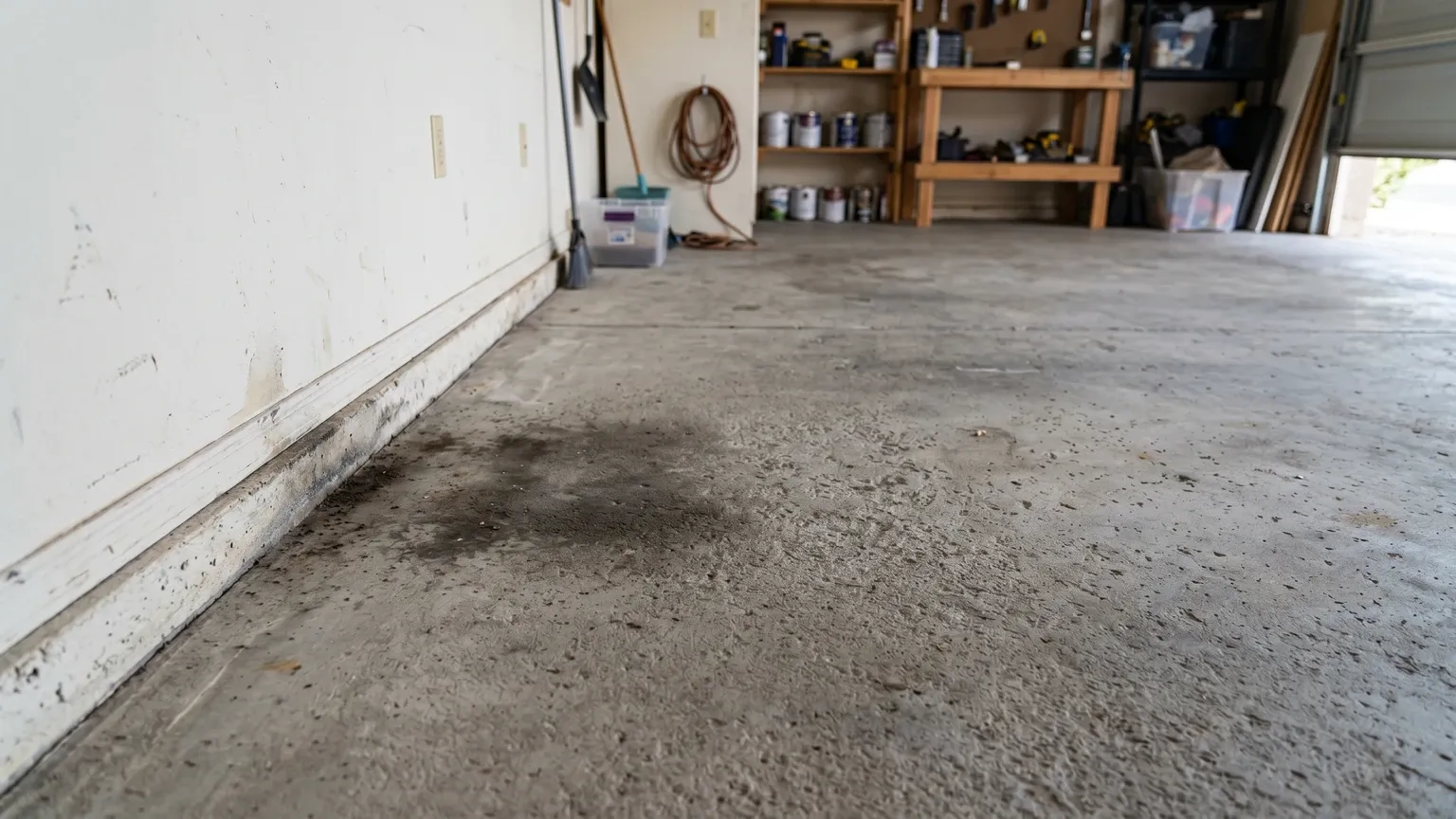
Yes, mold can grow on concrete — but it isn’t feeding on the concrete itself. Mold grows on the organic film of household dust, dirt, drywall paper, and residue that accumulates on the surface. Concrete is the platform; the film is the food. That distinction matters for cleaning and for understanding why some concrete stains are mold and most are something else entirely — efflorescence, oil, or tire marks.
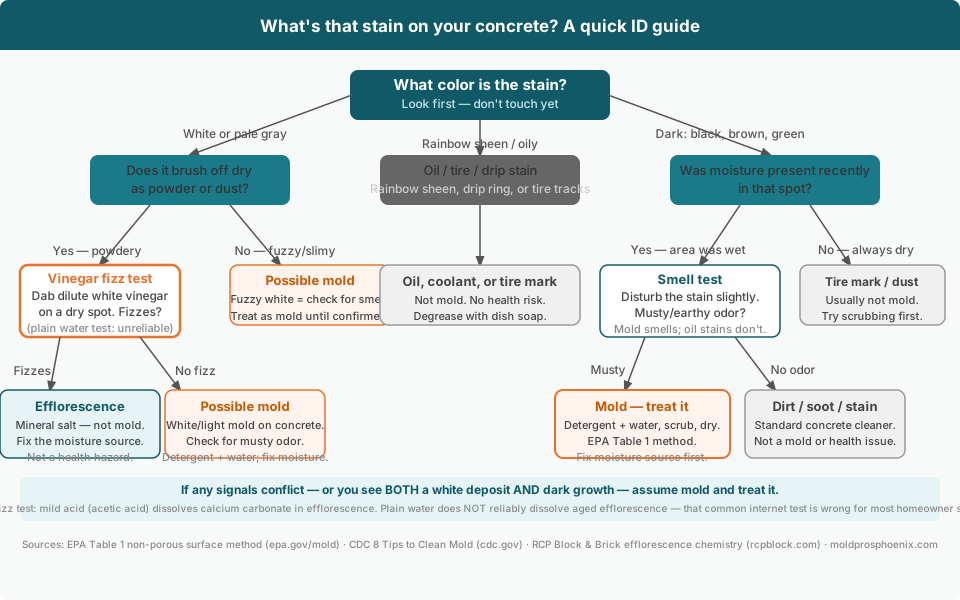
Is it mold? A quick identification framework
The most useful thing you can do before worrying about cleanup is figure out what you are actually looking at. In Phoenix, the majority of white staining on block walls and concrete is efflorescence — a harmless mineral deposit — and a large share of dark garage-floor staining is oil or tire marks, not mold. Treating the wrong thing wastes effort and can lead you to skip the moisture investigation that actually matters.
Use the pattern below. No single test is lab-certain. If three or more signals point one direction, you have a working identification. If signals conflict, or if you see both white mineral deposits and dark organic-looking growth in the same spot, treat it as mold until confirmed otherwise.
Signal-by-signal comparison
| Signal | Efflorescence | Mold | Oil / tire |
|---|---|---|---|
| Color | White, pale gray, sometimes yellowish | Black, dark green, brown, dark gray; occasionally white/pink | Dark brown, gray, or shows a rainbow sheen |
| Texture | Powdery, crystalline, dry-brushes off easily | Slimy when wet, fuzzy or velvety when dry; smears rather than brushes off | Shiny or tacky; circular drip rings or smeared tire tracks |
| Location | Where water exits concrete: expansion joints, wall bases, mortar joints, slab edges | Where water sits on organic film: under cardboard, behind furniture, in corners, near a water heater | Under a vehicle, near a drain line, in drip patterns |
| Odor | None | Often musty or earthy when disturbed | Chemical, gasoline, or faintly sweet |
| Vinegar fizz test | Fizzes and begins dissolving (calcium carbonate + acetic acid reaction) | No reaction | No reaction |
| Plain water test | Unreliable — fresh deposits dissolve, but aged efflorescence does NOT dissolve in plain water | No reaction | No reaction |
| Grows back | Re-deposits if moisture continues migrating through the wall | Regrows if moisture source and organic film are not addressed | Does not spread; stays where it was deposited |
A note on the plain-water test. You will see this recommended across most internet guides: “spray it with water; if it dissolves, it’s efflorescence.” That test only works on fresh efflorescence — the calcium hydroxide stage before it reacts with atmospheric CO₂. Once efflorescence ages and converts to calcium carbonate, it is water-insoluble and does not dissolve when sprayed. The plain-water test will give you a false “must be mold” reading on most mature deposits. The vinegar test (mild acid dissolves calcium carbonate) is the better check for aged deposits. One limit worth knowing: it confirms a carbonate, and efflorescence can also be a sulfate, which dissolves without fizzing. So a fizz rules out mold; no fizz on its own does not rule it in.
The efflorescence chemistry — why it matters
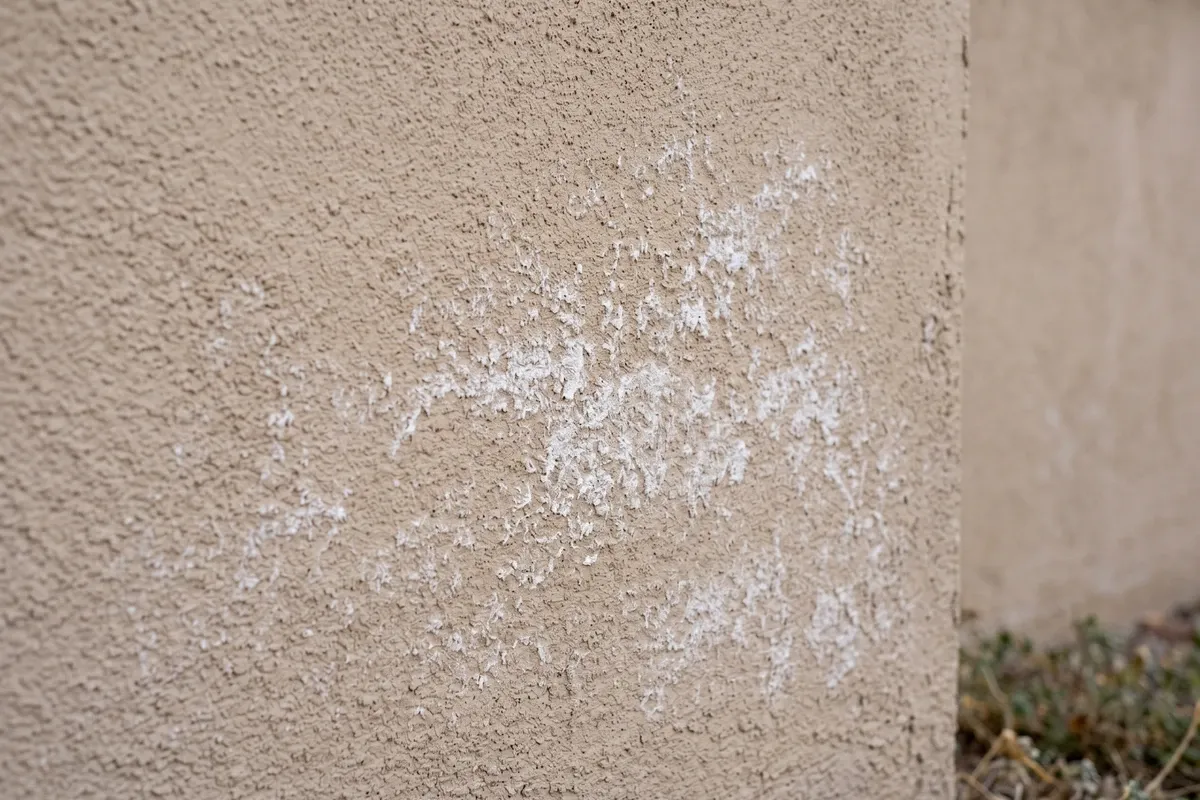
Efflorescence on concrete and block is commonly calcium carbonate — a white mineral bloom that forms when water seeps into concrete or block, dissolves calcium salts, carries them to the surface, and evaporates. The calcium hydroxide in the water reacts with atmospheric CO₂ to form calcium carbonate, which deposits as the visible white film (RCP Block & Brick — Basics of Efflorescence in Masonry Products). It is not alive, it does not produce spores, and it is not a direct health hazard. It is, however, a reliable moisture signal — water is moving through that wall — and the moisture that creates efflorescence can also create conditions for mold on nearby organic material like drywall or wood.
When mold does grow on concrete
Mold can establish on concrete under the right conditions, but it requires both a moisture source and an organic substrate to feed on.
The film-on-surface mechanism. Concrete itself is not a great food source for mold — its mineral composition offers little nutritional value for fungal growth. But concrete surfaces in real homes are not bare mineral. They accumulate household dust, dead organic matter, pollen, drywall paper that blew in from construction, stored cardboard that sat against the wall, and the residue from cleaning products and spills. That organic film is what mold colonizes. The concrete is simply the platform.
pH does not protect you the way you think. Fresh Portland cement concrete has a pH around 12 to 13, and that high alkalinity does inhibit direct colonization of the concrete matrix. But there are two important limits to that protection. First, concrete’s pH drops as it cures and ages through a process called carbonation — atmospheric CO₂ reacts with the surface and the pH falls toward neutral over time. Second, mold growing on the organic film sitting on top of the concrete does not need to colonize the mineral matrix at all. The alkalinity of the substrate provides limited protection once there is a dust film and an active moisture source.
Conditions for concrete mold. Three things have to be present simultaneously: (1) persistent moisture — a surface that stays damp, not just a brief wetting that dries quickly; (2) an organic film on the surface giving mold something to feed on; (3) spores, which are present everywhere in ambient air. Remove any one of these and mold cannot establish. The EPA states the general principle directly: “If you clean up the mold, but don’t fix the water problem, then, most likely, the mold problem will come back.”
On surface penetration. Most mold on concrete is growing on the surface film, not deep inside the porous structure. That is why detergent-and-water scrubbing often clears it. Concrete is porous, though, and if you have had a chronic moisture source — a slab leak wicking upward for weeks, for example — mold can establish in the surface pores and be harder to remove than a one-time clean suggests. If light scrubbing brings it back within days, the moisture source is still active or the growth has established beyond the surface film.
How to clean mold off concrete
The EPA’s framework for non-porous hard surfaces like concrete slabs, block walls, and garage floors is Table 1 of its mold remediation guidance: “Vacuum or damp wipe with water and mild detergent and allow to dry; scrub if necessary.” The homeowner-facing companion guidance from the same agency phrases it this way: “Scrub mold off hard surfaces with detergent and water, and dry completely.”
A few practical additions from the CDC’s 8 Tips to Clean Mold:
- Scrub surfaces. Clean with water and a detergent. Remove all mold you can see. Dry right away. (Tip #6)
- Don’t cover it, remove it. “Painting or caulking over mold will not prevent mold from growing. Fix the water problem completely and clean up all the mold before you paint or caulk.” (Tip #7)
- Dry it up. “Dry your home and everything in it as quickly as possible — within 24 to 48 hours if you can.” (Tip #8)
- Don’t mix cleaners. “Do not mix cleaning products together. DO NOT mix bleach and ammonia because it can create toxic vapors.” (Tip #5)
Fix the moisture source first. The EPA is explicit: “Fix plumbing leaks and other water problems as soon as possible. Dry all items completely.” Cleaning the concrete surface without addressing what kept it wet means the mold returns to the same spot. On a Phoenix garage floor or slab, that moisture source could be a water heater drip, a laundry-room leak through the shared wall, over-irrigated planting beds against the exterior, or — most seriously — a slab leak coming up from below.
For a mold inspection to locate a hidden moisture source, or for remediation of larger areas, get a professional assessment before committing to a DIY approach.
Phoenix-specific concrete mold realities
Phoenix residential construction creates concrete mold risks that differ from most of the country, and understanding them helps you diagnose the actual source.
Slab-on-grade: the concrete IS your floor
Phoenix homes use slab-on-grade construction almost universally — no basement, no crawl space in the overwhelming majority of Valley builds. This means the concrete slab is the ground floor directly under your carpet, tile, or engineered flooring. When moisture shows up at that slab level, it often came up through the concrete from below — slab leak, vapor drive from soil, drainage failure at the foundation — not down from a roof or plumbing leak above.
This is different from how mold-on-concrete reads in basement-country climates (the Midwest, the Northeast) where the slab sits below grade and the moisture story is groundwater intrusion. In Phoenix, a wet slab means the moisture went straight up into the bottom plates of your walls, your flooring adhesive, and whatever porous material was in contact with it.
Slab leaks: the hidden concrete-wetting event
Pressurized copper or PEX water lines run through or under Phoenix slabs. When a line develops a pinhole leak, water saturates the slab from below and wicks upward through capillary action. The first signs are often staining at the base of an interior wall, warm spots on the floor, or an unexplained jump in the water bill — not a visible puddle.
A slab leak creates continuous moisture that defeats any surface cleaning. If mold keeps returning to the same spot on a slab or at the base of the same wall — especially when you cannot find a visible leak above — get a slab-leak scan before you clean again. Cleaning and repainting a mold stain over an active slab leak is exactly the scenario CDC Tip #7 was written for.
Post-tension slab caution. Newer Phoenix homes commonly use post-tension slabs — high-tension steel cables embedded in the concrete. If you are considering drilling into a stained slab spot to investigate, or if a contractor proposes to core the slab to find a leak, confirm the slab type first. Cutting a post-tension cable without detecting it first is a serious structural risk. A professional with ground-penetrating radar or cable-detection equipment needs to locate the cables before any drilling. If your home is roughly post-2000 construction, assume a post-tensioned slab until confirmed otherwise.
CMU block walls and stucco: efflorescence capital
Phoenix uses concrete masonry unit (CMU) block construction extensively — perimeter walls, party walls, many exterior wall systems. Water migrating through CMU carries dissolved salts to the surface, where they crystallize as efflorescence.
The white bloom on a Phoenix block wall or stucco exterior is almost certainly efflorescence, not mold. It means water is moving through the wall (which is worth fixing — persistent moisture eventually reaches the framing and drywall inside), but the white deposit itself is not a remediation problem. On a CMU or stucco wall, efflorescence is far more common than mold. The vinegar test confirms it.
Evaporative cooler runoff
Roof-mounted evaporative (“swamp”) coolers, still common in older Phoenix homes, have bleed-off lines that dump water somewhere. When the bleed-off line is poorly positioned, it can route water against a stucco wall or onto a concrete patio slab, creating a chronic wet zone. If mold keeps returning on a specific outdoor slab or exterior wall base, trace the cooler’s drain line before assuming the problem is the concrete. Our guide to swamp cooler mold covers the drainage and maintenance issues that create these recurring spots.
Monsoon flashing failures at slab edges
Post-monsoon, check where your patio meets the house wall. If the patio cover or roof flashing failed during a storm, water can pool at the base of that wall junction and drive moisture into both the concrete slab edge and the wall bottom plate. Staining appearing at that seam a few weeks after a heavy storm is almost always a flashing failure that soaked the slab edge — not a soil or drainage problem. Our mold-after-flooding guide covers the response sequence after monsoon water events.
Garage floors: the ID problem in practice
Phoenix garage floors are unfinished concrete and generate the most “is this mold?” questions from Valley homeowners. The four common stains on a garage floor, from most to least likely:
- Oil or coolant drips. Dark, often circular or elongated drip patterns under where a vehicle parks. May show a faint rainbow sheen. No musty odor. Usually not mold.
- Tire marks. Dark streaks where tires track during entry and exit. No odor, hard texture, does not smear when dry.
- Efflorescence at expansion joints. White or pale gray deposits running along the crack lines. A vinegar fizz confirms a mineral deposit rather than mold; no fizz means keep checking.
- Mold. Real but less common than the above. Most likely near a garage-adjacent water heater that drips, a wall shared with a laundry room or bathroom, or in a corner where water pools during a monsoon. Has a musty odor. Dark, may smear when wet.
When to call a professional
Self-cleaning with detergent and water is appropriate for small areas of confirmed mold on hard concrete surfaces. Several situations call for professional assessment:
- Mold inside a wall cavity. Concrete-block or stucco walls can have mold growing on the interior wythe or on framing inside — not on the visible exterior surface. If there is a musty odor from an exterior wall but the outside surface looks clean, the problem may be inside the wall.
- Coverage larger than a small patch. The EPA’s general rule of thumb for DIY mold cleanup is areas around 10 square feet or less on hard non-porous surfaces. Larger coverage on concrete, particularly on interior slabs, typically warrants a professional assessment.
- Slab-leak-caused mold. A slab leak wets the concrete slowly and continuously. The mold at the surface is a symptom; the water source is inaccessible without leak detection and remediation expertise. Fixing the surface without the leak means the mold returns.
- Mold after a sewage backup or floodwater. Both introduce contaminants beyond mold. Phoenix mold remediation after sewage contact requires containment and handling that goes beyond standard detergent-and-water cleaning.
For any of these situations — or when you have confirmed mold but cannot locate the moisture source — a free professional assessment is the right next step before committing to a cleanup approach.