Is a Mold Endorsement Worth It in Phoenix? Buy or Skip

Often yes, if the premium difference is small, though not for the reason we found most pages giving. On the forms we read a mold endorsement is a trade rather than an addition: it removes the narrow mold coverage already sitting in the base policy and gives back a wider one, capped at $5,000 to $10,000. General information, not insurance advice.
What you are actually buying: a trade, not an addition
Read the base policy and the endorsement together and the picture turns around. A mold endorsement, sometimes sold as a mold rider, does three things at once in AAA’s HO 04 27 09 05: it deletes the mold paragraph already in the base form, adds a broad fungi exclusion, and gives back a capped Additional Coverage.
That matters because the base form was not silent on mold. AAA’s HO 00 03 10 00 says that for the dwelling it does not insure loss “Or consisting of mold ‘Fungi’ or wet rot,” and then carves back: “However, we do insure for loss caused by mold, fungus or wet rot that is hidden within the walls or ceilings or beneath the floors or above the ceilings of a structure” where it follows an accidental discharge or overflow from “a plumbing, heating, air conditioning or automatic fire protective sprinkler system, or a household appliance, on the ‘residence premises’” — or from an off-premises storm drain or water, steam or sewer pipe. Personal property gets a parallel line. Neither carries a mold cap.
The endorsement deletes both of those paragraphs, putting a seepage test in their place (gate 2 below). Separately, it adds Section I Exclusion A.10, barring loss from “the presence, growth, proliferation, spread or any activity of” fungi, wet or dry rot or bacteria. That exclusion does not apply at all where the mold “results from fire or lightning,” which on our reading leaves fire-driven mold outside the capped coverage entirely, and it gives way for every other covered peril “to the extent coverage is provided for in” the new Additional Coverage.
So the trade reads: a narrow grant with no mold cap, swapped for a wider grant with one — plus a condition the base form never imposed. Narrow becomes wide because the capped coverage is not limited to a water discharge; it attaches to any covered peril. Uncapped becomes capped at the form’s limit. And the base form’s mold paragraph asked only where the mold was and what caused the water, never what you knew; the seepage test that replaces it does ask, which matters for a slow leak.
The capped pot pays for four things at once:
- the loss itself, when it is caused by or consists of fungi or rot
- the cost to remove it
- the cost to tear out and replace part of the building “as needed to gain access to” it
- the cost of testing air or property, “whether performed prior to, during or after removal, repair, restoration or replacement”
Testing has a condition: it is paid only where “there is a reason to believe that there is the presence of” the fungi. Tear-out and testing draw from the same pot as the cleanup, so a job that needs a wall opened and a clearance test spends the cap on all three.
Where these forms come from: four documents are public. AAA’s homeowners endorsement HO 04 27 09 05 and its base form HO 00 03 10 00, both posted by the Nevada Division of Insurance; the West Virginia FAIR Plan’s policyholder notice describing its dwelling-property endorsement DP-300 FP (ed. 2/2003); and Sugar Creek Mutual’s HO 2089 09 08. The two AAA forms carry the Insurance Services Office copyright line and the Sugar Creek form is an American Association of Insurance Services form, so the same structure turns up in two different advisory organizations’ wording. None of them is an Arizona policy, and your own forms control.
| Filed document | Property aggregate | Fungi liability provision |
|---|---|---|
| AAA HO 04 27 09 05 (homeowners) | $5,000 | not addressed in this endorsement |
| WV FAIR Plan DP-300 FP (dwelling property) | $5,000 | not addressed in this notice |
| Sugar Creek Mutual HO 2089 09 08 (homeowners) | $10,000 | $50,000 annual aggregate sub-limit — a cap, not added coverage |
Where the limit lives differs: AAA and the WV FAIR Plan print theirs in the text, while Sugar Creek’s are schedule entries, which is how a carrier can file more than one tier. Ask yours whether a higher tier exists. The number for your home is on your declarations page.
The three-gate test
The cap is the last stop. The money has to clear two gates first.
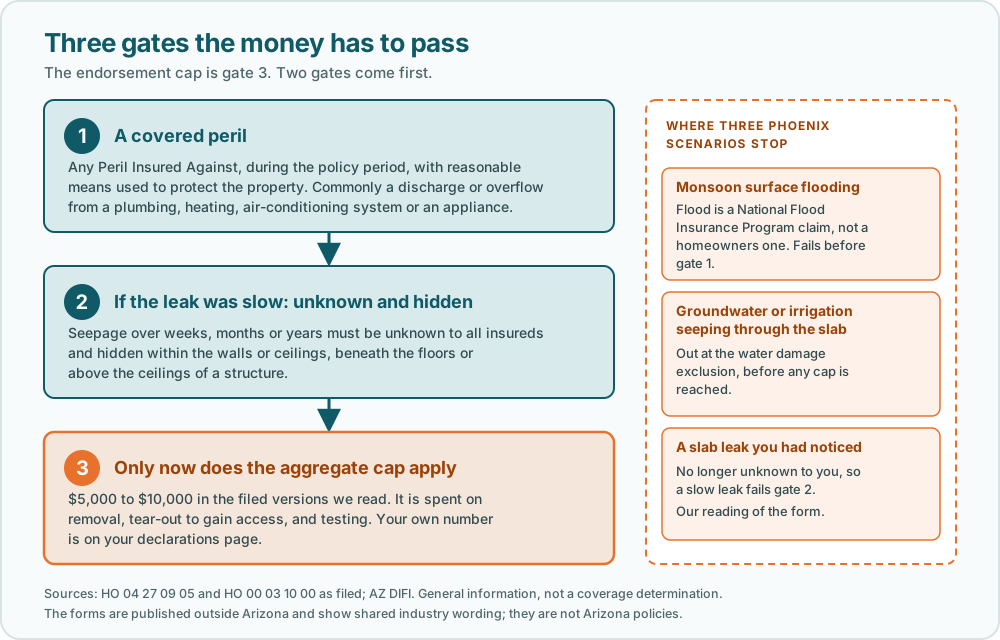
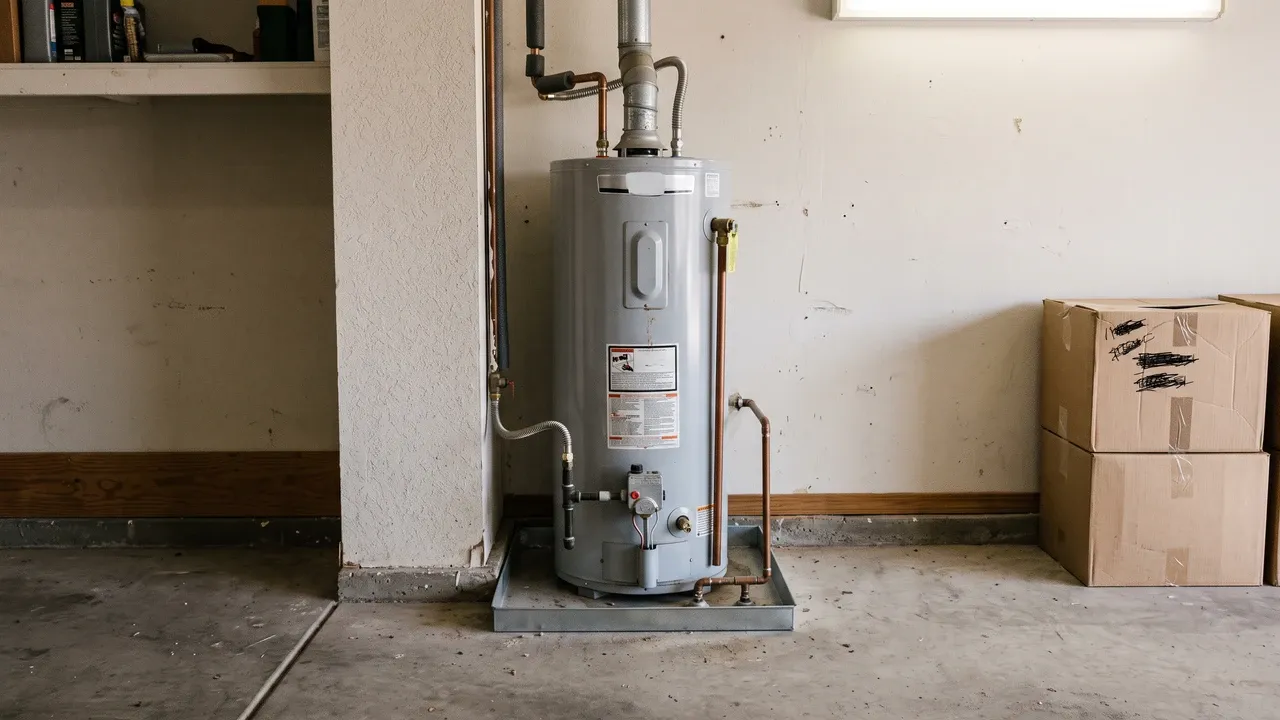
Gate 1, a covered peril. The endorsement’s coverage “only applies when such loss or costs are a result of a Peril Insured Against that occurs during the policy period,” and only where “all reasonable means were used to save and preserve the property from further damage.” The new exclusion gives way for any covered peril other than fire or lightning “to the extent coverage is provided for in” that Additional Coverage — and mold from fire or lightning falls outside that exclusion altogether. On an HO-3 the dwelling is written on an open-perils basis, so that is a wide gate, not a water-only one. A burst supply line, a failed water heater and an overflowing condensate pan are the common Valley examples, and so is rain entering through a roof a storm has opened. A sudden water event also needs fast drying, and our water damage restoration page covers what that work involves.
Gate 2, the slow-leak test. Where the endorsement deletes the base form’s mold paragraph, it puts a seepage paragraph in its place, barring loss “Caused by constant or repeated seepage or leakage of ‘water’ or the presence or condensation of humidity, moisture or vapor, over a period of weeks, months or years unless such seepage or leakage … and the resulting damage is unknown to all ‘insureds’ and is hidden within the walls or ceilings or beneath the floors or above the ceilings of a structure.” Note “all insureds” — a spouse’s knowledge counts. The sudden-versus-gradual rule is covered in full in our does insurance cover mold in Arizona guide.
Gate 3, the cap. Only mold that passes gates 1 and 2 reaches the aggregate.
Three Valley scenarios stop before the cap:
- Monsoon surface flooding. Arizona DIFI’s June 2021 consumer guide says “Damage caused by flooding is not covered by homeowners insurance,” and points to the National Flood Insurance Program. A roof opened by a storm is a different case, and falls on the covered side of gate 1.
- Groundwater or irrigation water through the slab. The base form’s water damage exclusion reaches water “below the surface of the ground,” including water that “seeps or leaks through a building, sidewalk, driveway, foundation, swimming pool or other structure.” That excludes it at the exclusion level, before any cap.
- A slab leak you had already noticed. That is our reading of the form, not the form’s own example: a slow leak you knew about is no longer “unknown to all ‘insureds’.” The claim scenarios guide walks through the full matrix.
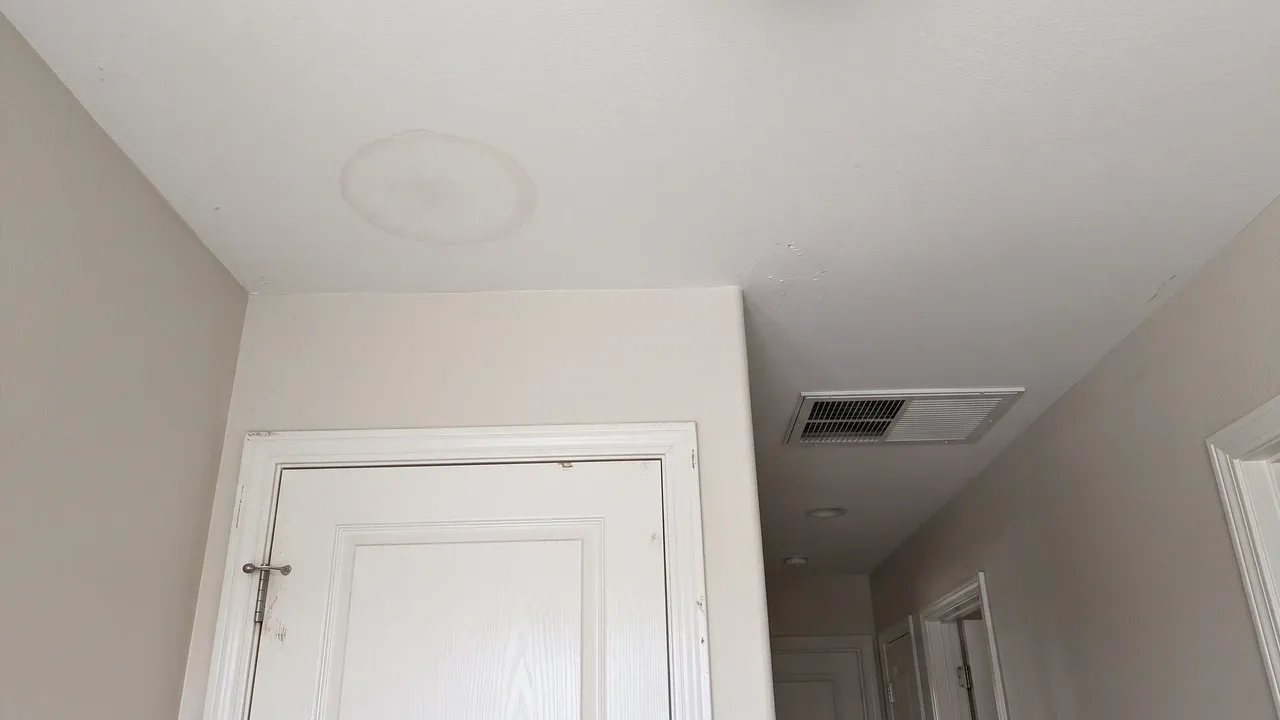
If the slow leak is a clogged AC condensate line, the gradual case is spelled out in our clogged AC drain line guide.
Why the cap is rarely what decides it in Phoenix
The pages we found on this topic argue the limit is too low. That framing fits humid-climate, whole-house jobs. Our published Phoenix cost ranges put most local jobs at $500 to $4,000 and a single affected room at $800 to $2,500, with larger jobs after a slab leak or flood at $4,000 to $6,000 or more — see our Phoenix mold removal cost page. Against a $5,000 aggregate an ordinary single-room job fits, and against $10,000 more so.
Two things eat into that.
The first is scope: the same cost page lists attic jobs to $5,000 and extensive whole-home jobs at $6,000 to $30,000, and the aggregate also has to cover tear-out and testing.
The second is your deductible. The base form’s deductible provision reads: “Subject to the policy limits that apply, we will pay only that part of the total of all loss payable under Section I that exceeds the deductible amount shown in the Declarations,” and the endorsement sets no special deductible for this coverage. The capped pot is a Section I property coverage, so the deductible comes off it. On a $1,500 single-room job, a typical deductible can leave very little to collect — which is a far better argument for skipping than the cap ever was.
The cap governs the mold, not the water loss. In the AAA form, where there is covered loss not consisting of fungi, “loss payment will not be limited by the terms of this Additional Coverage, except to the extent that” fungi “causes an increase in the loss.” The drywall a burst pipe ruined is paid under the ordinary limits; the cap governs the increase from mold growth. The form also says the coverage “does not increase the limit of liability applying to the damaged covered property.” That is what the form says; a carrier can read a mold-driven repair differently, so ask for the mold scope itemized separately from the water scope on the estimate.
What the endorsement does to the rest of your policy
The capped dollars and the new exclusion arrive in one document, so the endorsement is best read whole rather than by its limit. Beyond Exclusion A.10 and the seepage swap above, it also strikes “dry rot” from a separate wear-and-tear line in the base form, and it applies to loss during the policy period.
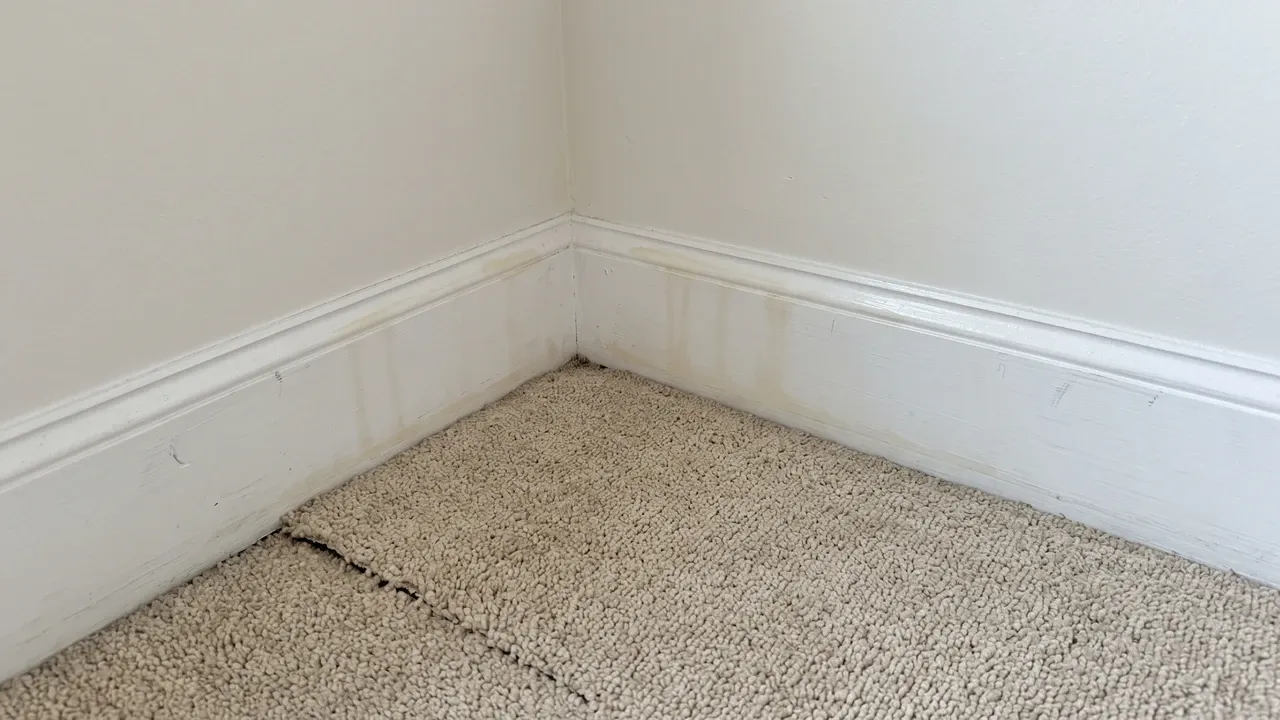
For a Phoenix homeowner the seepage wording is where the money sits. An attic air handler leaking over a ceiling you cannot see, or a supply line inside a wall, falls in the window the form leaves open. A stain you watched spread for a year does not. An empty house nobody checks raises separate problems, covered in our vacant home mold insurance guide. For what an adjuster tests in a claim, see what an adjuster looks for.
Does the endorsement cover liability claims?
A liability figure printed on one of these forms is easy to read as extra protection. In the one filed version here that prints one, it is a ceiling.
On the AAA base form, Section II excludes “bodily injury” or “property damage” arising out of “actual, alleged, or threatened inhalation of, ingestion of, contact with, exposure to, existence of, or presence of any ‘fungi’, wet or dry rot, or bacteria.” The AAA property endorsement does not touch Section II, so on that pair fungi liability stays excluded.
Sugar Creek Mutual’s form takes the other route. Rather than leaving fungi liability excluded, it rewrites Coverage L for fungi claims, capping all of them at the “Coverage L Annual Aggregate Sub-limit” shown in its schedule — $50,000 — which applies regardless of the number of occurrences, insureds, claims, suits or locations. The form states plainly that the sub-limit “does not increase the Coverage L ‘limit’.” It is a cap on liability coverage, not added liability coverage.
So the question to ask is not “how much liability does it add” but “does my form exclude fungi liability outright, or cap it?” That answer matters if you rent out a home, host often, or sit on an HOA board. Our HOA and condo mold guide covers that lane, and a landlord policy may be a different form entirely.
Lean buy or lean skip
On balance, if the premium difference is small and your likely losses are not the ones the base form already reaches uncapped, buying is the better call: the capped pot is the only thing on these forms that pays for air or property testing, and it widens the trigger to any covered peril. General information, not insurance advice. We have read published forms, not your policy. Published sources do not show what this endorsement costs; your agent has that number.
Lean toward buying if:
- The premium difference, once you ask for it, is small next to a $500 to $4,000 job.
- Your realistic losses are the ones the deleted paragraph never reached: a roof opened by a storm, a fire, or hidden moisture from something that is not a plumbing, HVAC or appliance line, such as a failed shower pan or bad wall flashing. (If your worry is a leak from a supply line, a condensate line or a water heater above a finished ceiling, the base form already reached that one uncapped and without asking what you knew — for that case the endorsement adds a cap and a knowledge test, not coverage.)
- Your realistic risks are storm and sudden-failure losses, where the wider trigger earns its keep.
- Your carrier’s version caps fungi liability rather than excluding it, and you rent out or host.
Lean toward skipping if:
- Your deductible is close to what a single-room job costs, which can leave little to collect.
- The premium difference, multiplied by the years you expect to hold the policy, approaches the cost of a single-room job.
- Your likely scenarios are the ones that stop at the gates: slab seepage, irrigation, monsoon surface flooding.
- You would repair a small job out of pocket anyway. DIFI notes that claims can affect rates or renewal.
DIFI’s June 2021 consumer guide says water damage that results in mold and rot “is typically excluded in homeowners policies, although some insurance companies offer extra coverage you can buy to cover this kind of damage.” It is an optional purchase, not a given.
Five questions for your agent
- What is the exact annual premium difference with and without the mold endorsement?
- What is my aggregate, is it separate from my dwelling limit, and can I buy a higher tier?
- Does the limit also pay for tear-out to gain access and for testing, and does my deductible come off it?
- Does my form exclude fungi liability, or cap it with an annual aggregate sub-limit?
- Does the endorsement delete any mold wording my base policy already has, and what replaces it?
If an answer is unclear, ask for the endorsement form number and edition and read it yourself.
Where to go next
If you are weighing a claim, start with does insurance cover mold in Arizona. To compare against what a job costs, see mold removal cost in Phoenix. If water has already gotten into a home, water damage restoration is the work that stops mold before it starts, and you can request a free quote. More guides are in the guide hub.
Sources
All accessed 2026-10-14. These are forms filed or published outside Arizona; they show shared industry wording, not any Arizona policy.
- AAA/CSAA — HO 04 27 09 05, “Limited ‘Fungi’, Wet or Dry Rot, or Bacteria Coverage,” posted by the Nevada Division of Insurance: docs.nv.gov HO 04 27 09 05. Includes copyrighted material of Insurance Services Office, Inc.
- AAA/CSAA — HO 00 03 10 00 (base homeowners form), same source: docs.nv.gov HO 00 03 10 00. Includes copyrighted material of Insurance Services Office, Inc.
- West Virginia FAIR Plan — “Limited Fungi, Wet or Dry Rot, or Bacteria Coverage / Revised Appraisal Condition — Advisory Notice to Policyholders,” describing dwelling-property endorsement DP-300 FP (ed. 2/2003). A dwelling-policy notice, not a homeowners form: wvfairplan.com advisory notice
- Sugar Creek Mutual — AAIS form HO 2089 09 08, “Limited Bacteria, Fungi, Wet Rot, Or Dry Rot Coverage” (© American Association of Insurance Services, 2008): sugarcreekmutual.com HO 2089 09 08
- Arizona DIFI — “Insurance & Storms or Disasters” consumer guide, June 2021 edition, read from an Internet Archive copy.
- Mold Pros Phoenix — Phoenix mold removal cost ranges.