Mold and Brain Fog: What the Evidence Actually Shows

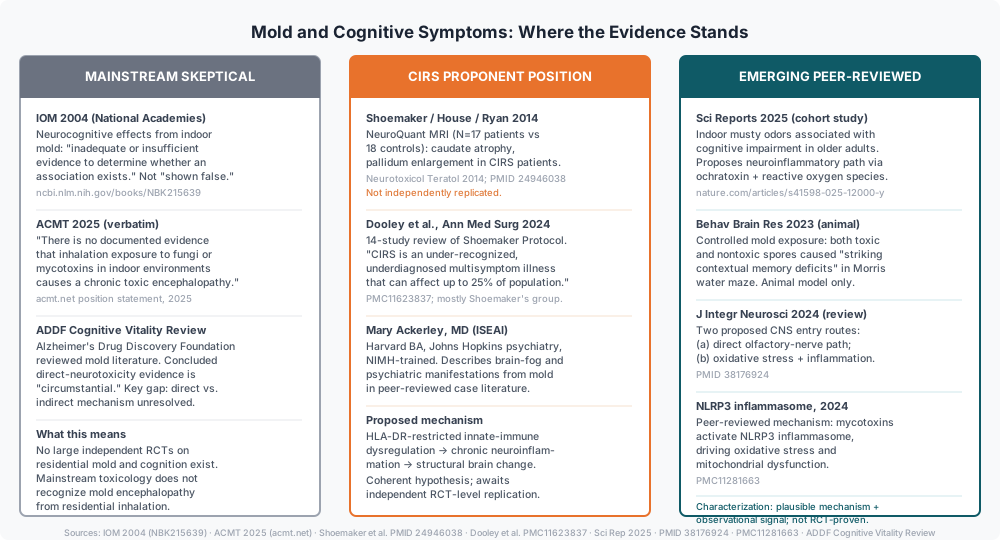
Brain fog from mold exposure sits in an uncomfortable place in the medical literature: consistent patient reports, a biologically plausible mechanism, and an evidence base that has not reached the threshold mainstream medicine requires to endorse it. The IOM 2004 review categorized neurocognitive symptoms from indoor mold as “inadequate evidence”—meaning insufficient studies exist to confirm or rule out the link, not that it has been shown false. The ACMT’s 2025 position statement goes further, stating there is “no documented evidence” that indoor mold inhalation causes a chronic toxic encephalopathy. At the same time, peer-reviewed 2020+ research has documented real biological mechanisms by which mold and mycotoxins could plausibly impair cognition. That is where the honest answer lives.
What “brain fog” actually is
Brain fog is not a clinical diagnosis. It is a patient-reported symptom cluster that includes difficulty concentrating, short-term memory gaps, word-finding problems, slowed thinking, and mental fatigue that does not improve with rest. Physicians recognize it as a genuine experience even when they disagree about its cause—it shows up in post-COVID illness, fibromyalgia, lupus, hypothyroidism, sleep apnea, and many other conditions.
The lack of a precise clinical definition makes it harder to study in relation to any single environmental exposure. You cannot run a controlled trial where you reliably induce and then measure brain fog the way you can measure lung function or antibody levels. That research gap is part of why the evidence tier is where it is.
What the IOM evidence tiers actually mean
The 2004 Institute of Medicine report Damp Indoor Spaces and Health is the most authoritative U.S. review of indoor mold and health. It organized its findings into tiers based on the strength of available evidence.
The sufficient evidence tier covered conditions where the research base was strong: upper respiratory tract symptoms, cough, wheeze, asthma exacerbations in sensitized people, and hypersensitivity pneumonitis. These are the conditions mainstream medicine accepts with confidence.
The limited or suggestive tier covered new-onset asthma and lower respiratory illness in otherwise-healthy children.
The inadequate or insufficient tier—which is where neurocognitive symptoms fall—does not mean “shown to be false.” The IOM was explicit about this: “inadequate or insufficient evidence to determine whether an association exists.” That is a statement about research volume, not a statement that the association has been ruled out. No large, controlled, prospective study of brain fog in mold-exposed populations existed in 2004. Not much more exists now.
The mainstream skeptical position
The American College of Medical Toxicology issued a position statement in 2025 that represents the current mainstream toxicology view. Its key finding on cognition is direct: “There is no documented evidence that inhalation exposure to fungi or mycotoxins in indoor environments causes a chronic toxic encephalopathy.”
The ACMT also states it is inappropriate to attribute mycotoxins found in urine to remote inhalation exposure, and that unapproved diagnostic tests used to identify “mold illness” are “medically inappropriate and costly.”
The IOM 2004 and ACMT 2025 are not the same thing. The IOM said “we don’t have enough studies to know.” The ACMT 2025 is saying “the documented evidence does not support this specific syndrome.” Both positions are worth representing accurately, and they are not identical.
The Alzheimer’s Drug Discovery Foundation reviewed the mold and mycotoxin literature and characterized the direct-neurotoxicity evidence as “circumstantial,” identifying the key unresolved question as whether cognitive effects are direct or mediated through indirect mechanisms like systemic inflammation, sleep disruption, or respiratory illness.
The CIRS practitioner position
A cohort of credentialed clinicians—working under the framework called Chronic Inflammatory Response Syndrome (CIRS), developed by Ritchie Shoemaker, MD—treats what they describe as a multi-system neuroinflammatory illness driven by water-damaged buildings.
The most relevant piece of research from this group is the 2014 NeuroQuant volumetric MRI study by Shoemaker, House, and Ryan, published in Neurotoxicology and Teratology. In a sample of 17 patients with CIRS versus 18 controls, they found bilateral caudate atrophy, pallidum enlargement, and left amygdala changes. The study is peer-reviewed and published in a legitimate journal. It has not been independently replicated by a separate research group.
A 2024 review by Dooley and colleagues in Annals of Medicine and Surgery analyzed 14 studies of the Shoemaker Protocol and concluded it is the only treatment with published efficacy data for CIRS. The caveat the review itself notes: most of the underlying evidence comes from Shoemaker’s own research group, and independent replication by unaffiliated teams remains limited.
Mary Ackerley, MD—a Harvard-educated, Johns Hopkins psychiatry-trained, NIMH-affiliated psychiatrist—co-founded the International Society for Environmentally Acquired Illness and has published on neuropsychiatric manifestations of what she calls biotoxin illness. Her credentials are real; her clinical framework sits outside the mainstream evidence base.
UCLA Health has explicitly stated that CIRS “is not considered an established medical diagnosis.” That is the mainstream institutional position. Both facts belong in the same paragraph.
What 2020+ peer-reviewed research actually shows
The last five years have produced a more specific body of work on how mold and mycotoxins could plausibly affect the brain. These studies are real and worth representing honestly—with the same honesty about what they do and do not prove.
A 2020 study by Harding and colleagues in Brain, Behavior, and Immunity used controlled mold exposure in mice and found brain inflammation and behavioral changes. A 2023 Behavioural Brain Research study using the Morris water maze—a spatial memory test—found that both toxic and nontoxic mold spores caused “striking contextual memory deficits.” These are animal models. They establish a biological basis for the concern; they do not confirm human clinical disease from residential exposure.
A 2025 study in Scientific Reports linked self-reported indoor musty odors to cognitive impairment in older adults, proposing a neuroinflammatory mechanism via ochratoxin and reactive oxygen species. This is a human observational cohort study—the first kind of epidemiological signal that would, if replicated, move this topic from “mechanism” to “association.” It is observational, not causal.
A 2024 review in the Journal of Integrative Neuroscience (PMID 38176924) proposed two routes by which mycotoxins could enter the CNS: direct olfactory-nerve transport and toxicological effects via oxidative stress and neuroinflammation. A separate 2024 review documented that mycotoxins activate the NLRP3 inflammasome, a well-established inflammation pathway with downstream effects on cytokine production and mitochondrial function (PMC11281663).
How to characterize this tier honestly: documented biological mechanisms and early observational human signals exist. They are consistent with patient reports. They have not been confirmed in large, prospective, independent human clinical trials. “Emerging evidence with mechanistic support” is an accurate description. “Proven” is not.
What patients actually report
The pattern in patient accounts of mold-related brain fog is consistent across very different individuals and settings. Candace Owens described her experience on the Shawn Ryan Show (Episode 318) after what she says was mold exposure from an HVAC leak in her Stamford, Connecticut apartment: “if you ever had brain fog, imagine the most intense brain fog.”
Her full symptom cluster—overnight eczema, athlete’s foot, red discharging eyes, hair loss, asthma attacks requiring hospital visits, and prolonged brain fog—is consistent with the pattern documented in other cases: Kristina Baehr, a former DOJ attorney in Austin who spent two years dizzy and brain-fogged before a moldy HVAC system was identified; and the Finnish hospital workers cohort, where a peer-reviewed study in ScienceDirect documented neurological symptom prevalence in mold-exposed workers.
Patient experience is real. The consistent reporting across unconnected individuals in different countries and contexts is itself a signal that warrants investigation. That is not the same as confirmation that mold caused it—other explanations, including nocebo effects, symptom misattribution, and undiagnosed conditions that happen to coexist with mold exposure, remain possible. What the mainstream critique does not do is make the patient experience go away.

What can plausibly cause brain fog in mold-exposed people
Even setting aside the contested CIRS question, several mainstream-accepted pathways can produce cognitive symptoms in people exposed to mold:
Respiratory impairment. Hypersensitivity pneumonitis—which the IOM 2004 places in the “sufficient evidence” tier—is a serious lung disease from mold exposure that reduces oxygen exchange. Reduced oxygenation affects cognition. Severe ABPA flares and acute invasive fungal sinusitis do the same. These are documented, mainstream, and real.
Immune activation. Systemic inflammation is well-documented as a driver of cognitive symptoms across many conditions. The WHO 2009 review noted that damp building exposure causes “perturbation of the immunological system.” If that immune activation is sustained and systemic, cognitive effects are plausible through the same mechanisms that produce brain fog in autoimmune conditions, post-COVID, and other inflammatory states.
Sleep disruption. Mold-triggered respiratory symptoms—chronic cough, congestion, asthma—disrupt sleep. Sleep deprivation produces brain fog that is independent of any direct neurotoxic mechanism. This is one of the most likely indirect pathways and requires no contested mechanism at all.
Chronic sinusitis. Fungal sinusitis and mold-related allergic rhinitis produce chronic nasal inflammation and congestion. Persistent sinusitis is associated with reduced cognitive performance in peer-reviewed literature—a well-accepted if unglamorous connection.
Direct mycotoxin exposure (contested). Whether airborne mycotoxins at residential indoor concentrations reach the brain and impair it directly is the contested question. The dose and route matter. Aflatoxicosis from ingested moldy food is fatal at high doses—clear proof that mycotoxins can harm humans. Whether the much lower concentrations inhaled from indoor air reach neurotoxic thresholds is not established.
What to do if you have brain fog and suspect mold
The practical steps are the same regardless of where you land on the mechanism debate.
First, see a physician and ask specifically about conditions mainstream medicine accepts as mold-related: hypersensitivity pneumonitis, allergic bronchopulmonary aspergillosis, allergic fungal rhinosinusitis, and chronic sinusitis. If you have respiratory symptoms alongside brain fog, these are the diagnoses to rule in or out before assuming a contested syndrome.
Second, get a sleep evaluation. Chronic sleep disruption from mold-related respiratory symptoms is both common and treatable, and its contribution to brain fog is not contested by anyone.
Third, look at your home for moisture. You do not need a spore count to identify a water problem. A professional mold inspection with a moisture meter can find active sources—AC condensate drips, monsoon roof intrusions, slab leaks—that a visual check misses. In Phoenix specifically, the AC condensate drain line is the most common hidden moisture source and is worth checking first.
Fourth, if you find mold, get it removed and the moisture source fixed. Both camps in this debate agree on this point. Removing the exposure is the correct first step. Whether it resolves your cognitive symptoms is something only you and your doctor can track—but it eliminates a variable that neither side of the scientific debate thinks is benign.
The honest bottom line
Mold-driven brain fog is reported by a large number of patients and taken seriously by a cohort of credentialed clinicians. The mainstream evidence tier for that association is “inadequate”—which means insufficient research, not a refutation. The ACMT’s 2025 position is stronger and explicitly denies that indoor mold inhalation causes a toxic encephalopathy. Emerging 2020+ peer-reviewed work documents real mechanisms and early human signals.
The practical action is the same whichever position you hold: if mold is present, it should be removed and the moisture source fixed. That is not a contested claim. It is what every credible voice in this space—mainstream or otherwise—recommends.
If you have brain fog and a moisture problem in your Phoenix home, the first step is an honest inspection. We handle mold removal across the Valley and can start with a free, no-obligation quote. Fill out the form below and we will get you a local estimate with no pressure.
For more on what mold illness actually looks like and which health effects mainstream medicine does and does not accept, see our guide on what mold sickness feels like, or our overview of who is most at risk from mold exposure.