How Long Does Mold Remediation Take? (Phoenix Homeowner Timeline)
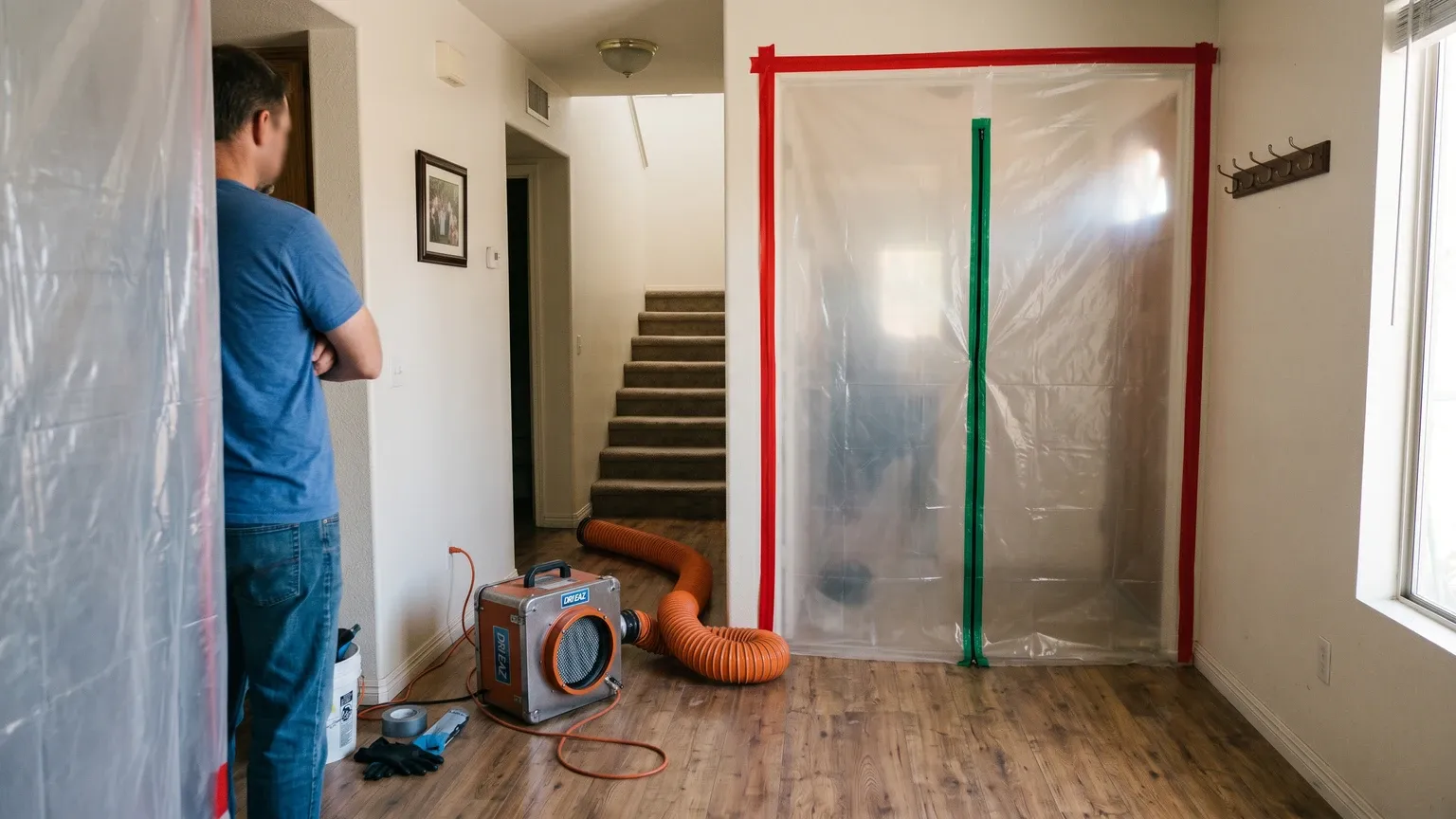
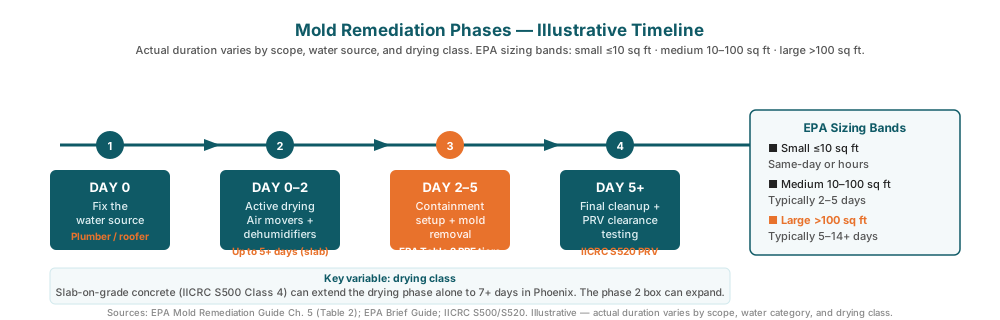
Mold remediation takes anywhere from a few hours to two weeks or more, depending on three things: how large the affected area is, how contaminated the water was, and how long the drying phase takes. Most jobs fall into one of three size tiers from the EPA’s professional remediation guidelines. Small patches under 10 square feet are often same-day. Mid-size jobs covering 10 to 100 square feet typically run 2 to 5 days. Large jobs over 100 square feet can run 5 to 14 days or longer. The drying phase is the biggest variable in all three.
Why size and drying class — not a calendar — drive the timeline
No federal agency publishes a single duration for mold remediation. The EPA, CDC, and the industry-standard IICRC S520 (the professional mold remediation standard) describe what must be done, not how many days it takes. Anyone who quotes you a firm number without seeing the job is estimating, not citing authority.
What the sources do give you are the variables that explain duration. The EPA’s professional remediation guide uses three size tiers in its Table 2 guidance (Chapter 5). Under the widely used IICRC S500 water-damage classification, water is categorized by contamination level (Category 1 through 3) and by how deeply it has soaked into materials (Class 1 through 4). Those inputs — size band, water category, drying class — are the math the timeline hangs on. The sections below show how each one adds or subtracts days.
The three EPA size tiers and what they mean for your schedule
The EPA’s Chapter 5 Table 2 defines three remediation tiers based on the area of visible mold growth. Size determines the level of containment and protective equipment required — which in turn determines how much setup time comes before any mold is actually touched.
Small: 10 square feet or less. This is the EPA’s boundary for DIY cleanup — “If the moldy area is less than about 10 square feet (less than roughly a 3 ft. by 3 ft. patch), in most cases, you can handle the job yourself.” At this scale, a professional can typically complete the work in a few hours to a single day, assuming the water source has already been stopped and materials are dry enough to treat.
Medium: 10 to 100 square feet. This tier calls for limited or full containment and professional judgment on protective equipment. Setup time for containment barriers, negative-air machines, and decontamination chambers adds hours before work begins. A mid-size job — say, a bathroom wall section or a bedroom affected by a window leak — typically runs 2 to 5 days from start to final cleanup, with the range coming down to how wet the materials are and whether the drying target is hit within the first 48 hours.
Large: more than 100 square feet. Full containment, full PPE, and professional judgment on remediator and occupant exposure. This is the tier that covers whole-room or multi-room jobs, major attic cases, and jobs where mold has reached structural components. Jobs at this scale typically run 5 to 14 days or longer when HVAC contamination, Category 3 water, or Class 4 drying is involved.
Day 0: fix the water source before anything else
The EPA states it plainly in its Brief Guide to Mold, Moisture, and Your Home: “If you clean up the mold, but don’t fix the water problem, then, most likely, the mold problem will come back.” The same guide’s completion standard drives the point further: “You must have completely fixed the water or moisture problem before the cleanup or remediation can be considered finished.”
The EPA’s Chapter 3 professional guide opens with the same principle: “The Key to Mold Control is Moisture Control,” with step one being: “Fix the water or humidity problem. Complete and carry out repair plan if appropriate.”
This matters for your schedule because the water fix often involves a separate trade — a plumber for a supply line or slab leak, a roofer for monsoon flashing failure, an HVAC tech for a condensate drain overflow. The mold contractor cannot start the clock until that repair is complete or actively in progress. In Phoenix, where the most common drivers are slab leaks and AC condensate overflows, scheduling the right trade first can add one to several days to the front of your timeline.
Day 0 to 2: the drying phase sets the pace for everything downstream
After the water source is fixed, the next phase is drying wet materials before remediation begins. The EPA and CDC are explicit about the target window.
From the EPA’s Brief Guide: “It is important to dry water-damaged areas and items within 24-48 hours to prevent mold growth.” The same source: “If wet or damp materials or areas are dried 24-48 hours after a leak or spill happens, in most cases mold will not grow.”
The CDC says the same thing in different words: “Clean up and dry out your home fully and quickly (within 24–48 hours) after a flood.”
These quotes describe a prevention window, not a remediation duration — they explain why wet materials cannot be skipped or dried slowly. Once mold is already established, the drying phase still runs first, because the remediation standard requires materials to be dry before final cleaning and treatment. A professional will meter wood and drywall daily, targeting specific moisture content before calling the drying phase complete.
For most water-caused jobs, drying runs 1 to 2 days with proper equipment. For slab leaks and monsoon intrusions into dense materials, it can run significantly longer — and that extension ripples through the entire timeline.
Days 2 to 5: containment, removal, and cleanup
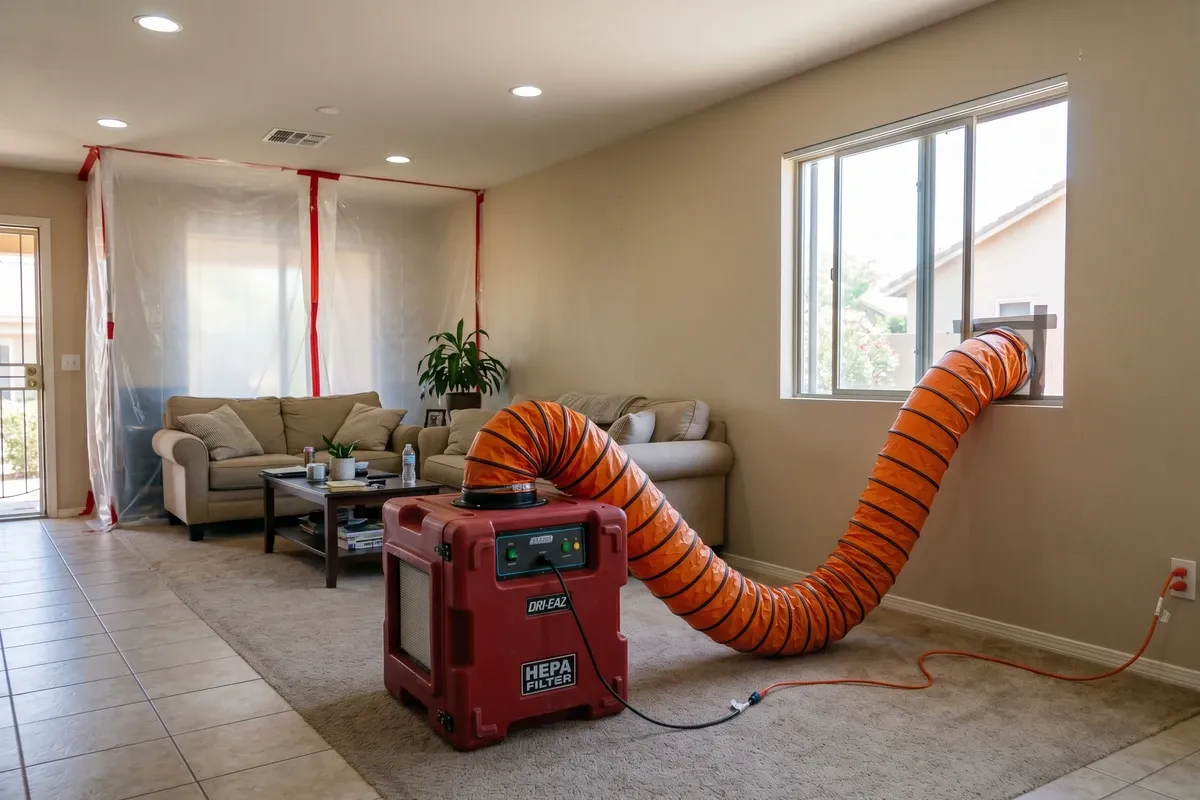
Once drying targets are met, the active mold work begins. The IICRC S520 is the professional standard that licensed Phoenix mold contractors work under — it describes itself as “a procedural standard for the remediation of mold damaged structures and contents.” In practice, remediation follows a defined sequence of inspection, isolation of the work area, contamination removal, and post-remediation verification. Phase by phase:
Containment setup. Poly barriers are sealed over doorways and HVAC openings to create an isolated work zone. Negative-air machines (HEPA air scrubbers) run throughout the job to create negative pressure inside containment, keeping spores from migrating into unaffected areas. For a mid-size job, setup takes two to four hours.
Mold removal. Affected porous materials — drywall, insulation, carpet — are removed and bagged following EPA Table 2 containment requirements for the job’s size tier. Hard surfaces (framing, concrete block, tile) are HEPA-vacuumed and treated with EPA-registered antimicrobial. Non-porous surfaces that can be cleaned are cleaned; porous materials that cannot be effectively dried are removed and replaced.
Final cleanup. All surfaces in containment are HEPA-vacuumed after treatment. Containment materials themselves are removed carefully, bagged, and disposed of. The area is left ready for any reconstruction — drywall replacement, insulation reinstallation, painting.
For a 10–100 square foot job with no structural complications, this phase runs 1 to 3 days. For jobs involving insulation removal, significant structural drying, or replacement of decking or subflooring, it runs longer.
Post-remediation verification: the job is not done until testing clears it
After the remediation work is complete, independent clearance testing confirms the job was done correctly. The IICRC S520 names “Post-Remediation Verification” (PRV) as a defined component of professional mold remediation. An inspector — separate from the contractor who did the work — samples the air, takes swabs, and checks moisture readings.
Most Phoenix pros wait 24 to 48 hours after the mold work is done before sampling, giving airborne particulates time to settle so the sample reflects the cleaned space rather than freshly disturbed dust. That window is common industry practice; there is no federal rule specifying the exact wait time.
Clearance testing is not federally required for residential jobs. Arizona does not have a blanket state requirement for it either. That said, it is the most defensible way to confirm the job is complete, and a signed clearance report is useful if you ever sell the home and need to document the mold history honestly. For a deeper look at how clearance testing works and what a passing result actually means, see our guide on mold clearance testing explained.
Phoenix realities: three scenarios that stretch the timeline
Phoenix is not a generic market for mold remediation. The water sources that drive local jobs — AC condensate overflows, monsoon roof intrusions, and slab leaks — create specific drying and removal challenges that extend timelines beyond what a generic national estimate would suggest.
Attic jobs after a monsoon roof leak
Phoenix attics get brutally hot on the roof deck and hold very low humidity on a summer afternoon — which sounds like it should dry a monsoon-soaked rafter overnight. It does not. Wet lumber holds bound moisture that releases slowly regardless of surrounding air temperature, so hitting the 15% wood-moisture-equivalent target that pros meter for still typically takes three to five days with air movers running — even in a Phoenix attic.
Monsoon roof jobs also often require insulation removal. The EPA’s Table 1 water-damage guidance lists cellulose and fiberglass insulation in the “Discard and replace” category when wet — neither can be effectively dried. If decking was wet for more than 48 hours before work began, it may need to be replaced rather than treated. These add demolition and material replacement to the schedule, pushing a mid-tier job into the 4 to 7 day range.
Slab leaks: the timeline diverges at day one
Phoenix homeowners often discover mold after a slab leak — a supply line running under the concrete floor that fails. When that happens, water rises up through the slab into wall bottom plates and drywall. The scenario diverges sharply from a roof-leak job in terms of drying time.
Under the IICRC S500 water-damage classification, concrete is the archetypal “Class 4” drying scenario: dense material with deeply held or bound moisture that releases slowly. Unlike a wet rafter exposed to airflow, a concrete slab releases moisture as a slow diffusion problem. Even with mat drying systems — specialized equipment that draws air through the slab surface — drying to acceptable moisture below wall plates typically runs a week or more.
If the water reached the slab, the drying phase alone often runs a week or more. The wall plates sitting on top cannot be considered dry until the concrete under them is. This is not a contractor stalling — it is concrete physics, and there is no legitimate shortcut.
A mid-to-large slab-leak job in Phoenix, from water source fix through final clearance, typically runs 7 to 14 days.
What makes any Phoenix job take longer
Beyond the attic and slab scenarios, several additional factors commonly extend timelines:
HVAC contamination. When mold has reached an air handler or ductwork, the remediation scope expands to include the mechanical system. Duct cleaning and coil treatment run separately from the structural work and require the HVAC system to be offline for part of the job.
Category 3 water (sewage, storm flooding, rising groundwater). Under the IICRC S500 classification, Category 3 water — grossly contaminated, including sewage backups and rising floodwater — requires all porous materials in contact to be removed: drywall, carpet pad, insulation, and paper-faced materials. There is no “dry it and treat it” option for Category 3 affected materials. This adds significant removal and reconstruction time to any job.
Post-tension slab complications. Many Phoenix slab-on-grade homes built after the 1980s use post-tension cable systems rather than conventional rebar. Cutting into these slabs for plumbing repairs requires a structural engineer to mark cable locations before any saw work. This does not directly extend the mold work, but it extends the water-source repair that must happen first.
For a broader look at the mold removal process itself, the mold remediation service page covers how licensed Phoenix contractors approach each phase. If you are evaluating whether your job needs professional help at all, the can I remove mold myself tool covers the EPA’s DIY criteria in detail.
What makes a mold job take longer: a quick checklist
If you are already into a job and wondering why it is running long, these are the most common causes:
- Drying phase extended — moisture readings have not hit target yet. More common in slab jobs, thick insulation, and post-tension concrete. A pro will show you the meter readings.
- Additional scope found during demolition — mold that was behind walls often covers a larger area than the visible patch suggested. The EPA’s completion standard requires the full affected area to be addressed.
- Water source repair delayed — if the plumber is backlogged or the roofing repair requires material lead time, the mold work cannot proceed to final stages.
- Clearance test did not pass — if the initial PRV sample shows elevated counts, the crew re-cleans and re-tests. This is the system working correctly, not a failure.
Understanding the timeline before the job starts lets you ask the right questions: ask the contractor what drying class they expect, what the target moisture content is before they close up, and when they plan to schedule independent clearance testing. Those answers tell you whether the estimate is grounded in the actual scope of your job or just a round number.
If you are at the point of hiring, our mold inspection page covers what to expect from the initial assessment that gives you that scope, and how to get a fair quote walks through what a credible proposal includes.
Get a free quote for your job
If you know there is a mold issue — or if a water event happened recently and you want to know the scope before it grows further — a free, no-obligation quote is the fastest way to get an honest answer on your specific job and timeline. We handle mold remediation across the Phoenix metro, from Ahwatukee to Desert Ridge to Peoria. Fill out the form below and we will get you a local estimate.