Does Mold Attract Bugs? Yes — Here's Which Ones (And What It Means)
Yes, mold attracts bugs. Five common household insects feed directly on mold and fungi — psocids (booklice), springtails, silverfish, mold mites, and fungus gnats. Seeing any of them indoors, especially in a persistent population, typically means both moisture and mold are present somewhere nearby. Fix the moisture source and remediate the mold, and both problems resolve together. Bug spray alone does not work, because the food supply remains.
Which bugs actually feed on mold?
The five bugs below have one thing in common: they require moisture and fungal material to survive. University extension entomologists across the country document the same biology consistently. These are not bugs that happen to wander through mold — they live and reproduce there.
Psocids (booklice)
Psocids are the most common mold-feeding bugs found in Phoenix homes. They are tiny — 1 to 2 mm — pale gray-tan, teardrop-shaped, and wingless indoors. Homeowners often mistake them for baby cockroaches, but they are entirely different insects with entirely different biology.
The University of Minnesota Extension is direct about what they eat: “Booklice usually feed on molds, fungi, grains, insect fragments, and other starchy material, including glue from bookbindings.” And about what their presence means: “Psocids in food indicate fungal or mold problems.”
Penn State Extension adds: “They feed on mold and fungi and are indicators of high humidity or moisture.”
Where do they live in a Phoenix home? UMN Extension says: “In homes, psocids typically are found in damp, warm, undisturbed places where mold and fungi are growing.” In Phoenix, that translates to baseboards over slab leaks, pantries where monsoon humidity has gotten into stored dry goods, and wall cavities behind a slow-leaking supply line.
Springtails
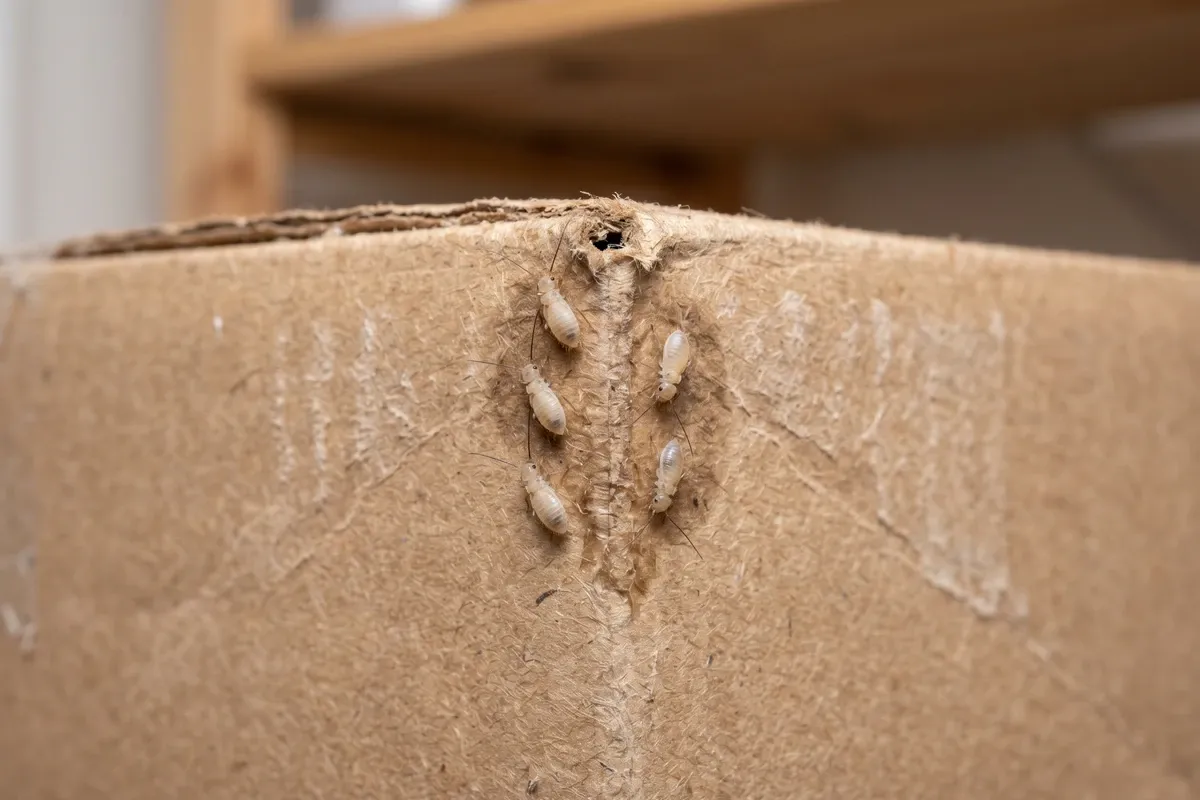
Springtails are another moisture-and-fungi indicator, 1 to 3 mm, and gray, white, or tan. The name comes from a forked organ on the abdomen that launches them into the air when disturbed — the jump is their most identifiable trait.
UC IPM (UC Statewide IPM Program) documents their diet: “They feed on decaying plant material, fungi, molds, or algae.” And their meaning: “Their continued presence indoors is an indicator of moisture.”
An important note from UC IPM: “Springtails do not bite humans or pets, nor do they spread disease or damage household furnishings.” They are a diagnostic signal, not a direct hazard.
Ohio State Extension corroborates: “Most feed on algae, fungi and decaying vegetable matter” and “They are abundant only in damp, moist or very humid locations.” Buildings with persistent high humidity, Ohio State notes, “may be overrun with springtails.”
In Phoenix homes, springtails show up at bathroom and laundry room floors near a chronic drip, along the tub-to-tile caulk line, and — less obviously — on the ceiling-drywall side under an AC condensate line leaking into attic insulation.
Silverfish
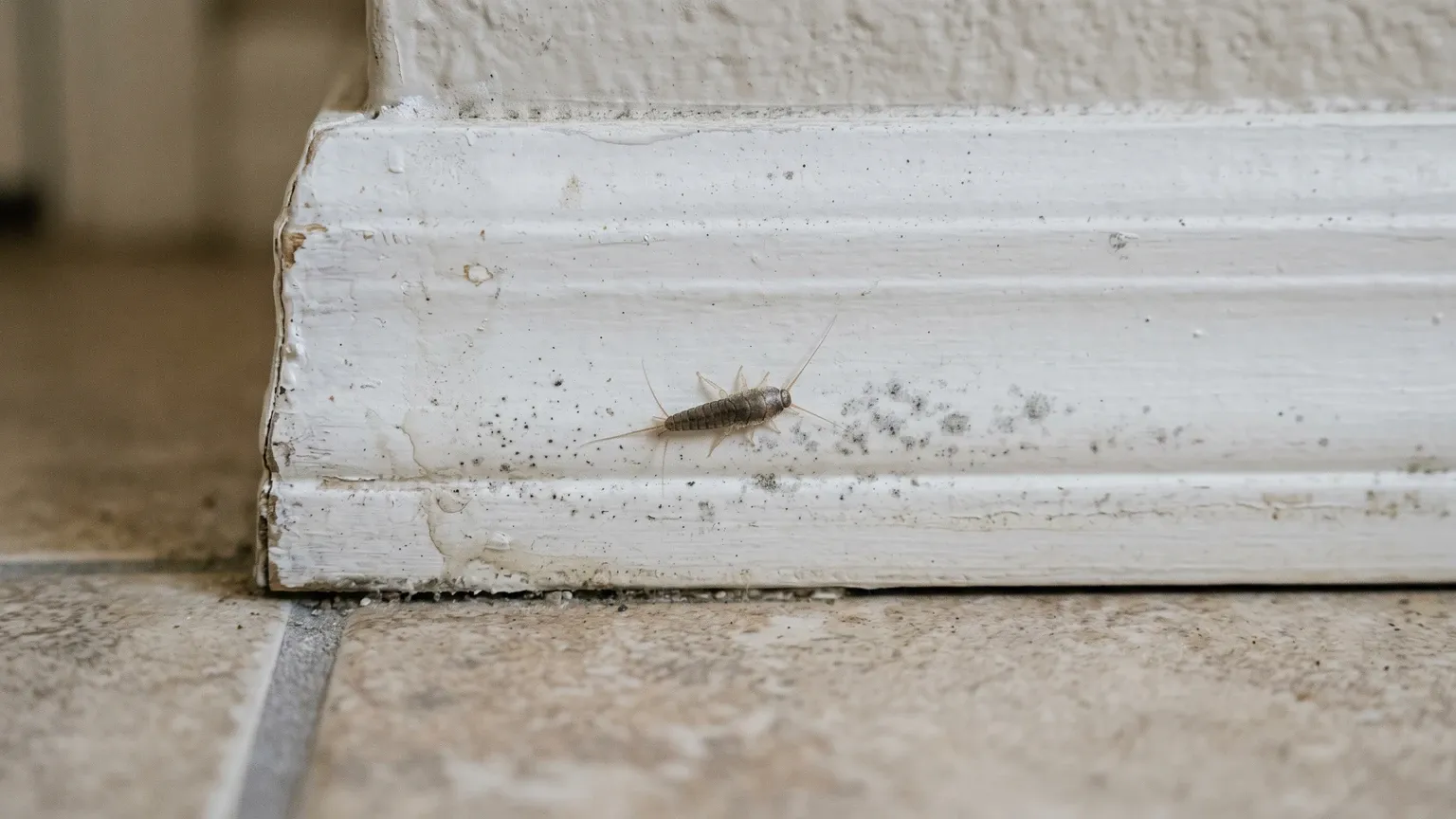
Silverfish are larger and more recognizable: silver-colored, teardrop-shaped with three long tail bristles, and they move in a distinctive wiggling pattern that earns the name. They are humidity-sensitive in a way that makes them a strong diagnostic signal in a dry-climate city like Phoenix.
Ohio State Extension on their diet: “They can tolerate the high temperatures and apparently feed on the molds and mildews that grow when the roofing gets wet.”
Ohio State also specifies their humidity requirement: silverfish prefer “75 to 95 percent relative humidity.” That range is rarely reached in Phoenix ambient air — but it is routinely reached inside wall cavities with a slow leak, in the corner of an under-sink cabinet with a dripping trap arm, and in older Phoenix attics that took monsoon water through failed roof flashing.
UF/IFAS corroborates: “Large numbers may be found in new buildings in which the newly plastered walls are still damp.”
Mold mites (Tyrophagus putrescentiae)
Mold mites are the most specific: they exist only where mold does. The University of Florida Entomology and Nematology Department documents this plainly.
On their diet: “They feed on molds and are common only where mold and fungi can flourish.”
On their moisture requirement: “Mold mites only develop where there is moisture or high humidity.”
On their size: “The mite is very small, about 0.28 to 0.41 mm long.” That is microscopic. You will not see an individual mold mite with the naked eye. What you see instead is a moving brown-tan “dust” on a moldy surface — which is a colony of mites on the mold they are eating.
In Phoenix, swamp-cooler drywall is the classic mold-mite site. The evaporative cooler adds moisture to the air continuously during operation, the wall surfaces near the duct accumulate humidity, mold grows, and mold mites move in on the mold. A homeowner seeing what looks like a faint moving dust near a swamp cooler register is looking at mold mites on mold.
Fungus gnats
Fungus gnats are the most familiar of the group. They are small dark flies, 2 to 5 mm, weak fliers that hover near soil. Colorado State University Extension documents the mechanism: “They primarily feed on fungi, algae, and decaying plant matter.” And: “Fungus gnat adults are highly attracted to moist-growing media.”
The Phoenix-specific context: during monsoon season, outdoor humidity spikes, homeowners continue watering houseplants on their dry-season schedule, growing media stays saturated, fungi bloom in the potting soil, and fungus gnats appear. This is not the same as mold inside the walls, but it is the same underlying driver — moisture creating a fungal food supply.
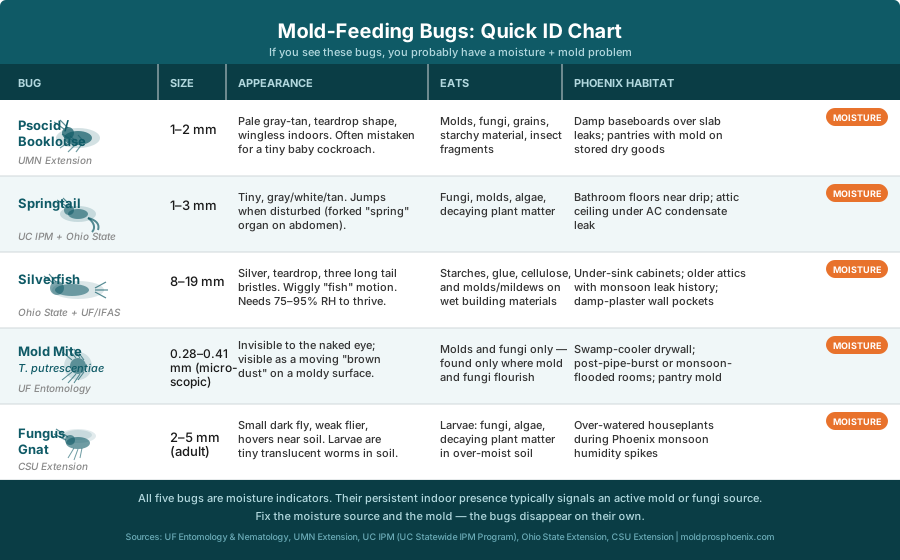
Quick ID: the 5-bug table
| Bug | Size | Look | Diet | Where in a Phoenix home |
|---|---|---|---|---|
| Psocid / booklouse | 1–2 mm | Pale gray-tan, teardrop, wingless | Molds, fungi, grains, starchy material | Damp baseboards, pantry dry goods, under wallpaper |
| Springtail | 1–3 mm | Gray/white/tan; jumps when disturbed | Fungi, molds, algae, decaying plant matter | Bathroom floors near drip, attic drywall under AC condensate leak |
| Silverfish | 8–19 mm | Silver, teardrop, three tail bristles | Starches, glue, cellulose, molds on wet materials | Under-sink cabinets, older attics with monsoon history |
| Mold mite (T. putrescentiae) | 0.28–0.41 mm | Microscopic; looks like brown dust moving on mold | Molds and fungi only | Swamp-cooler drywall, monsoon-flooded rooms |
| Fungus gnat | 2–5 mm adult | Small dark fly, hovers near soil | Larvae: fungi, algae, decaying plant matter | Over-watered houseplants during monsoon humidity |
Sources: UF Entomology & Nematology; UMN Extension; UC IPM; Ohio State Extension; CSU Extension.
What is NOT a mold bug (but often shows up nearby)
Cockroaches, ants, and cluster flies often appear in the same damp areas as mold, but they are not there because of the mold itself.
Cockroaches are strongly moisture-driven and will show up in damp basements, under leaky sinks, and in humid kitchen spaces — the same places mold grows. But they are there for water and food scraps, not the mold. They are a moisture indicator, not a mold-feeder.
Ants follow food and moisture. A trail near a wall cavity may indicate a leak without any mold-eating biology involved.
The distinction matters for diagnosis. If you see cockroaches or ants in a wet space, that confirms you have a moisture problem — it does not confirm mold-feeding biology the way a psocid or springtail population does.
What their presence means in practical terms
The underlying connection for all five bugs is the same: moisture enables mold, and mold feeds the bugs.
The CDC is clear on the moisture-mold link: “Mold will grow where there is moisture, such as around leaks in roofs, windows, or pipes, or where there has been a flood.” And: “If mold is growing in your home, you need to clean up the mold and fix the moisture problem.”
The EPA puts the strategy plainly: “The key to mold control is moisture control.” And on humidity: keep indoor relative humidity “below 60 percent (ideally between 30 and 50 percent).”
Persistent indoor populations of mold-feeding bugs typically indicate a moisture problem where mold or fungi are actively growing. A single sighting of a springtail near a window may be a wanderer from outside. A line of psocids along a baseboard, or a visible brown-dust mass on drywall near an appliance, is not a stray — it is a sign of an established population feeding on mold.
Because these species require both moisture and fungi to survive, treating the bugs without fixing the underlying moisture generally allows them to return. The food source remains, and so do the bugs.
Phoenix-specific locations to check
Phoenix has almost no basements, so the typical national guide — “check the damp basement” — does not apply here. The Valley’s moisture sources are different, and they map to specific bug locations:
Slab leaks and baseboards. A slow slab leak under a concrete-slab Phoenix home keeps the bottom of drywall and baseboard wet for weeks or months after the leak is repaired, if the remediation missed it. Psocids move in on the mold that grows on damp paper-faced drywall. If you are seeing small gray-tan bugs along a baseboard near a wall that had a slab-leak repair, the moisture is likely still there.
AC condensate lines and attic insulation. A slow drip from an attic AC condensate line dampens fiberglass insulation and then the ceiling drywall below. Springtails appear on the damp drywall surface where mold has begun to grow. This is a Phoenix-specific combination — attic air handler plus a clogged or cracked condensate drain.
Evaporative (swamp) cooler drywall. Swamp coolers add moisture to indoor air on purpose. The drywall near the duct register can accumulate surface moisture, especially during monsoon season when outdoor humidity is already elevated. Mold grows, and mold mites follow within days. A moving brown-tan film near a swamp cooler register is almost always this combination.
Older homes and monsoon roof history. Silverfish need 75 to 95% relative humidity — a condition Phoenix achieves in wall pockets that took monsoon water through failed roof flashing, in older attics where stucco was wet for a season or more, and under sinks where a dripping trap arm has run unchecked. Homeowners in older Arcadia, Coronado, or North Central Phoenix homes who find silverfish have usually found a moisture story the home carries from a past wet event.
Overwatered houseplants. Fungus gnats are the exception to the “in-wall mold” pattern. They signal fungi in potting soil, not mold in the structure. Still the same driver: moisture enabling a fungal food supply.
This Phoenix bug-and-mold connection is part of a larger picture the mold-in-the-desert guide covers in full: Phoenix’s dry outdoor air does not protect homes from indoor moisture problems. The bugs you see inside your home are one of the most reliable field indicators that indoor moisture is feeding something biological.
What to actually do
If you are seeing mold-feeding bugs in your home, the steps are in this order:
1. Find the moisture source. This is the only step that produces a durable result. Common Phoenix sources: AC condensate line clog or overflow, slab leak, monsoon roof intrusion, swamp cooler, chronic under-sink drip. A professional mold inspection with a moisture meter can trace hidden moisture through walls and insulation without guesswork.
2. Fix the water. No remediation holds if the water source keeps running.
3. Remediate the mold. Mold on drywall, wood, or insulation needs to be physically removed, not just treated with spray. The EPA and CDC both say killing mold is not enough — it must be taken out, because dead spores still cause reactions and still feed the bugs until they are gone. Our mold remediation page covers how a professional job is structured.
4. Dry thoroughly. The EPA’s standard is that materials dried within 24 to 48 hours of a water event typically do not grow mold. After remediation, the area needs to reach dry baseline before being closed up.
Do not treat the bugs directly as the primary fix. A single round of insecticide reduces the population temporarily. Without addressing the moisture and mold, the population returns because the habitat remains. There is no pest-control brand or spray that substitutes for moisture control.
For a full guide to preventing mold before it starts in a Phoenix home, the mold prevention checklist covers the pre-monsoon walkthrough and the specific checks that matter most by season.